
Most companies handle voice communications using a single unstructured team or by picking between inbound and outbound setups based on guesswork. The problem with this approach is that support representatives get overwhelmed answering routine calls while sales teams waste valuable time cold-calling instead of following up on warm leads. The fix involves matching the setup to call origin: utilizing inbound teams for customer-initiated support and outbound teams for proactive sales outreach, while partnering with a Customer Service Representative to handle incoming queries and lead qualification. Aligning call center structures with specific call directions eliminates wasted agent hours, boosts conversion rates, and maximizes customer satisfaction.
Call centers play a pivotal role in modern business operations. They are the critical touchpoint between companies and their customers, enabling direct engagement, support, and service. As a business owner or manager, one of the key decisions you must make is hiring an inbound or outbound call center. Each type has its own distinct functions, advantages, and use cases that should align with your overarching business goals and objectives. For healthcare organizations specifically, this decision often comes down to whether a medical virtual receptionist can handle patient-facing calls better than a general outbound sales team. This article will provide a comprehensive guide to understanding the key differences between inbound vs. outbound call centers to help you make an informed decision when choosing between the two for your business.
From managing customer inquiries to driving sales, call centers are indispensable for various customer engagement needs of an organization. When selecting between an inbound or outbound call center, it is crucial to assess your business requirements and choose the best model — for a busy practice, that might mean comparing a traditional in-house front desk against a virtual receptionist for medical practice operations. We will dive into the nuances of both types of call centers, contrast their objectives and skill sets required, and discuss key factors to consider when making your decision. The insights covered in this article equip you with the knowledge to strategically hire the call center type that caters optimally to your needs.
Understanding Inbound vs. Outbound Call Centers
Before diving into the specifics of inbound vs. outbound call centers, let’s quickly recap what defines these two main call center models:
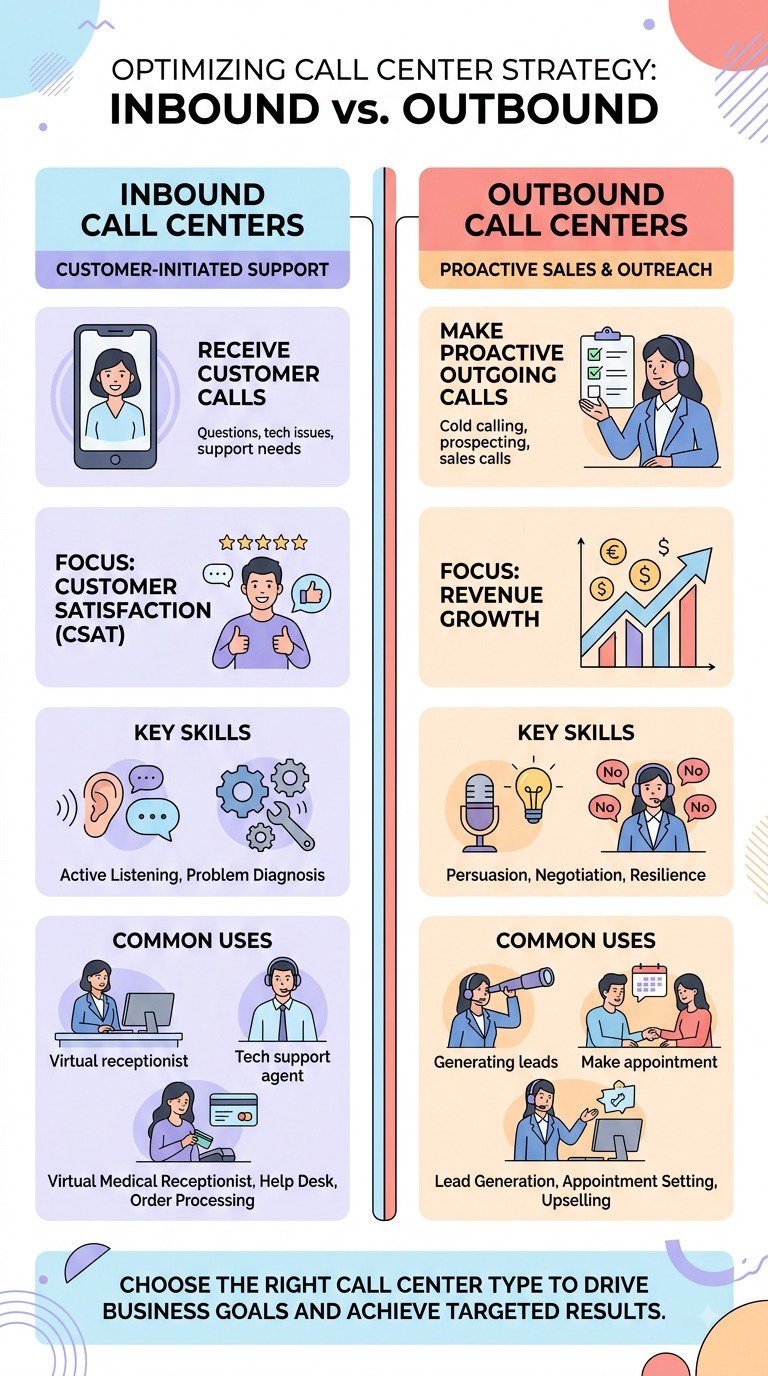
Inbound Call Center
These centers primarily handle inbound customer calls seeking assistance, support, or information. The agents focus on receiving and resolving customer queries on products/services, providing technical support, and processing orders or payments. In healthcare, this same function is often delivered through a virtual receptionist medical practices rely on to greet patients and manage front-desk call volume. Learn more about cold calling assistant for hire.

Outbound Call Center
In contrast, outbound call centers involve agents proactively making calls to customers or prospects for purposes like sales, surveys, SEO lead generation services, and other marketing campaigns.
While inbound centers concentrate on customer service and support, outbound centers drive proactive outreach for sales and marketing goals. Both models play important yet distinct roles in interacting with customers and prospects.
Here’s a quick side-by-side comparison before we go deeper:
| Aspect | Inbound Call Center | Outbound Call Center |
|---|---|---|
| Call direction | Customer/patient calls in | Agent calls out |
| Primary goal | Support, resolution, service | Sales, lead generation, outreach |
| Typical trigger | A question, issue, or need | A campaign, list, or schedule |
| Core skill | Active listening, troubleshooting | Persuasion, resilience |
| Common industries | Healthcare, retail, telecom, financial services | Insurance, real estate, financial services, e-commerce |
| Healthcare example | A medical virtual receptionist answering patient calls | Reminder calls for upcoming appointments |
| Key metrics | CSAT, first contact resolution, wait time | Leads generated, conversion rate, cost per lead |
Now let’s explore the key functions, benefits, and use cases of each type in detail:
Inbound Call Centers: Functions, Benefits & Advantages
Inbound call centers form the critical customer-facing arm for organizations across diverse industries. They handle all incoming calls from customers who could be calling for various needs – from basic inquiries to complaints. The key functions of inbound call center agents encompass:
Fielding product inquiries
Agents respond to customers calling with questions about product features, pricing, availability, shipping times, etc. For example, retail inbound agents can answer queries about an electronics item’s specifications or a clothing brand’s sizing charts.
Providing technical support
Agents troubleshoot and resolve technical issues that customers face with products/services like consumer electronics, software, apps, and internet services. For instance, tech support reps walk customers through fixing smartphone glitches.
Processing transactions
Agents handle orders, payments, refunds, appointment bookings, and other transactions through the phone channel. For example, a restaurant’s inbound center may take reservations, while a clinic’s agents can book medical appointments, a task increasingly handled by a dedicated medical receptionist service rather than in-house staff.
Addressing grievances
Customers can call with complaints about incorrect orders, billing disputes, service issues, etc. Agents need to listen, empathize, and provide satisfactory resolutions. An insurance company’s inbound team would handle claim settlement complaints. Learn more about virtual assistant bookkeeping services.
Conducting surveys
Agents periodically conduct satisfaction surveys or feedback interviews to help improve products and identify customer pain points. For example, a hotel chain may survey guests on their stay experience.
Providing 24/7 support
Many inbound centers offer round-the-clock assistance and support for maximum customer convenience. For instance, banks operate 24×7 to address time-sensitive customer queries.
At a glance, here’s how those functions break down:
| Function | What Agents Do | Example |
|---|---|---|
| Fielding product inquiries | Answer questions on features, pricing, availability | Retail agent explains sizing chart |
| Providing technical support | Troubleshoot product/service issues | Walking a customer through a smartphone fix |
| Processing transactions | Handle orders, payments, bookings | Clinic staff booking patient appointments |
| Addressing grievances | Resolve complaints and disputes | Insurance agent handling a claim complaint |
| Conducting surveys | Gather feedback and satisfaction data | Hotel chain surveying guest experience |
| Providing 24/7 support | Round-the-clock assistance | Bank support desk open around the clock |
The specialized services of inbound call centers offer many advantages:
- Faster response to customer queries through real-time, dedicated assistance resulting in higher satisfaction. For example, food delivery apps provide a quicker resolution if orders are incorrect.
- Increased customer retention and loyalty through effective issue resolution and positive service experiences. For instance, a retailer may retain customers better by quickly replacing damaged goods.
- Lower costs by leveraging technological solutions like interactive voice response (IVR), intelligent call routing, and automation to optimize efficiency — one reason practices increasingly turn to virtual medical receptionist services to reduce overhead.
- Better insights into customer preferences, pain points, and needs by analyzing call data to improve products and services. For example, identifying common tech issues faced by customers.
- Flexible scaling to match call volumes during peak seasons/times, such as supplementing resources during holidays for retailers.
Inbound call services are especially vital for customer-focused sectors like telecom, retail, hospitality, healthcare, financial services, e-commerce, and software/technology. In healthcare specifically, many practices now hire a medical receptionist through outsourced call center partners rather than expanding their in-house front desk. Skilled inbound agents drive higher customer satisfaction levels in these industries. Learn more about content assistant outsourcing.
Outbound Call Centers: Functions, Benefits & Advantages
Outbound call centers take a proactive approach by having agents initiate contact with potential customers and leads. The key functions of outbound call centers include:
Lead generation
Agents make cold calls to prospects found through market research to introduce products/services and qualify outbound lead generation services. For example, insurance agents cold-call people to sell policies.
Direct sales
Agents utilize the phone channel for selling products and services by highlighting features, building rapport, overcoming objections, and closing sales. For instance, outbound reps sell newspaper subscriptions.
Conducting surveys
Outbound teams conduct surveys for customer satisfaction, product/brand feedback, and market research. For example, a food delivery firm asks customers about their ordering experience.
Non-profit campaigns
Charities leverage outbound calling for fundraising campaigns to increase donations. Agents educate donors about causes and request contributions.
Appointment setting
Agents call potential customers to generate interest and set up in-person meetings with the sales team. For example, setting appointments for a software sales rep — though many clinics pair this outbound function with a medical call answering service on the inbound side to confirm and manage bookings.
Upselling
Existing customers are contacted to sell upgrades or additional products that complement existing purchases. For example, outbound calls to bank customers to sell investment products.
At a glance, here’s how those functions break down:
| Function | What Agents Do | Example |
|---|---|---|
| Lead generation | Cold-call and qualify prospects | Insurance agent calling potential policyholders |
| Direct sales | Sell products/services over the phone | Rep selling newspaper subscriptions |
| Conducting surveys | Gather market and satisfaction data | Food delivery firm surveying order experience |
| Non-profit campaigns | Fundraise and educate donors | Charity calling to request contributions |
| Appointment setting | Book meetings for a sales team | Setting up a software demo |
| Upselling | Sell upgrades to existing customers | Bank offering investment products |
The specialized outbound approach offers advantages such as:
- Increased sales and leads by proactively contacting a broader audience of potential customers using calling lists. For example, mortgage brokers sell to first-time home buyers.
- Access to new markets and geographies by expanding reach beyond existing customer base through outbound campaigns.
- Higher conversions and sales closure rates are enabled by personalized and tailored sales pitches based on customer needs analysis.
- Competitive edge by constantly generating new leads and sales opportunities before competitors reach them.
- Productive agents by leveraging automated dialers, call recording, pacing algorithms, and other technologies to enhance efficiency.
Outbound centers are extremely useful for sales-driven industries like financial services, insurance, real estate, e-commerce, and more. Their wide reach and proactive approach help achieve sales goals and business growth objectives. Learn more about amazon virtual assistants.

Inbound vs. Outbound Call Centers: Objectives and Skill Sets
A key differentiator between inbound vs. outbound call centers is their contrasting primary objectives. Inbound centers aim to deliver prompt, accurate resolutions for customer queries and issues. Outbound centers work to generate new sales, lead generation and appointment setting services to convert them into customers, or gather pertinent market insights.
These distinct goals necessitate different skill sets from agents:
| Skill Area | Inbound Call Centers | Outbound Call Centers |
|---|---|---|
| Core focus | Resolving queries accurately and swiftly | Acquiring customers and closing sales |
| Key skill | Active listening, troubleshooting | Persuasion, negotiation |
| Mindset | Patient, detail-oriented | Resilient, goal-driven |
| Knowledge needed | Product, policy, and process fluency | Sales scripts, objection handling |
| Success metric | CSAT, first contact resolution | Conversion rate, revenue per call |
Inbound Call Centers
The core objective of inbound call centers is to resolve customer queries and issues accurately and swiftly. Agents need to be skilled at:
- Active listening and clear communication: Attentively understanding customer problems, asking probing questions, and explaining solutions clearly. For example, carefully diagnosing technical issues customers face.
- Problem diagnosis and troubleshooting: Applying logical reasoning to identify issues and suggest fixes. Such as helping customers resolve software errors.
- Product and process knowledge: Extensive familiarity with the company’s offerings, policies, and workflows to address diverse customer questions — such as fluency with a retailer’s return and refund policies, or the intake protocols that virtual receptionist services medical providers depend on for accuracy.
- Attention to detail: Precisely capturing customer input, orders, and other specifics is crucial for error-free resolution. Such as noting exactly which parts are defective when replacing a gadget.
- Multitasking and adaptability: Handling high call volumes requires efficient context switching between customer cases of varying complexity. One must also be adaptable to evolve with new products and policies.
Metrics like customer satisfaction (CSAT) scores, first contact resolution rates, wait times, and call handling time assess inbound call center effectiveness. Learn more about product listing assistant services.
Outbound Call Centers
Outbound centers aim to acquire new customers and maximize sales. Their agents need skills like:
- Sales expertise: Proficiency in sales processes, objection handling, developing rapport, understanding customer psychology and motivations, and closing techniques.
- Persuasion and negotiation: The ability to highlight product/service benefits, create value, and negotiate to close sales, such as upselling insurance policy add-ons.
- Resilience and grit: Tenacity to make repeated cold calls, overcome rejection, and bounce back from harsh responses.
- Goal orientation: Maintain focus on targets like call quotas, revenue goals, and lead generation services metrics.
- Motivational personality: Energetic, enthusiastic, and passionate about taking the initiative to drive sales.
Key metrics for outbound centers include leads generated, sales conversion rates, revenue growth, cost per lead/sale, and agent utilization rates.
Aligning objectives and agent capabilities is crucial for call centers to deliver maximum business value in line with their goals, whether for customer support or sales. Hire cold calling assistant.
Inbound vs. Outbound Call Centers: Factors When Choosing
Determining whether to hire inbound vs. outbound call centers depends on assessing multiple key factors:
Business Goals and Needs
Clarity on your business goals and needs is paramount. Key questions to ask:
- Do you primarily need to improve customer service and retention or acquire new customers? For instance, a software company may need an inbound center for technical support, while an insurance provider may require outbound sales — and a medical practice handling patient data will specifically need a hipaa-compliant medical answering service rather than a generic call center.
- Will the call center be used for sales, service, or both? A retailer may need inbound for support and outbound for promotions.
- What are your target KPIs – CSAT, revenue, leads? This indicates whether inbound or outbound will achieve those outcomes.
Budget Considerations
- Outbound centers require a significant upfront investment in lead generation, calling lists, hiring specialized agents, and training. Ongoing costs are also higher.
- Inbound centers have more predictable operating costs after initial setup and staffing. Costs depend on call volumes.
- Economies of scale can be achieved with inbound by leveraging technologies to optimize agent productivity.
Integration With Systems and Operations
- How will the call center integrate with your CRM, contact center software, payment systems, workflows, and existing processes?
- For example, inbound centers need tight CRM integration for comprehensive customer history during support calls.
- Outbound centers rely on CRM data for lead scoring and campaign progress tracking.
Scalability for Growth
- Assess the capabilities of call center vendors/partners to scale operations based on your growth and peak demand.
- For example, e-commerce firms need high scalability to manage order-related call surges during holidays.
- Startups benefit from outbound center partners who can scale lead-gen calls as the business expands to new markets.
Technology Needs
- Identify the required tools, such as call center software, interactive voice response (IVR), call recording, analytics, automated dialers for outbound, etc.
- Cloud-based tools offer flexibility, easier scaling, and lower startup costs.
- Advanced analytics can garner insights from call data to improve customer service and sales performance.
Here’s how those five factors compare side by side:
| Factor | Inbound Considerations | Outbound Considerations |
|---|---|---|
| Business goals | Improve service, retention, CSAT | Acquire customers, hit revenue targets |
| Budget | Predictable, scales with call volume | Higher upfront investment in lists and training |
| System integration | Needs deep CRM/history integration | Relies on CRM for lead scoring |
| Scalability | Scale for seasonal/support surges | Scale lead-gen as you enter new markets |
| Technology | IVR, call routing, analytics | Automated dialers, campaign tracking |
Carefully analyzing these factors will help determine whether to invest in inbound support operations or outbound sales and lead generation capabilities that are aligned with long-term business goals. Learn about virtual assistant for real estate.
An inbound center answers patient calls, scheduling, billing questions, and prescription refills, while an outbound center proactively calls patients for reminders, follow-ups, or outreach. Most practices need both, which is why many pair a dedicated healthcare receptionist with a smaller outbound function for reminder calls. Yes. A dedicated receptionist can be trained to manage incoming patient calls during business hours while also making outbound calls for appointment confirmations, insurance follow-ups, or recall campaigns. Reputable providers train and certify agents specifically for healthcare, ensuring calls, scheduling, and patient data are handled under HIPAA guidelines. Look for a HIPAA-compliant virtual assistant service rather than a generic call center to avoid compliance gaps. Costs vary based on call volume, hours of coverage, and whether the service is bundled with scheduling or billing support. A medical call center specialist can typically provide a flat monthly rate that’s more predictable than staffing an in-house front desk. Yes, outbound reminder calls reduce no-shows significantly across multiple locations. Many clinics combine this with a 24/7 scheduling assistant so patients can also reach someone after hours to reschedule. Beyond answering calls, a healthcare virtual assistant can manage insurance verification, patient intake forms, prior authorization follow-ups, and inbox triage, freeing your in-house staff to focus on in-person patient care.Frequently Asked Questions
Conclusion
Inbound call centers enable customer support, virtual live receptionist services, and service with skilled communicators adept at problem resolution. In contrast, outbound call centers are sales powerhouses leveraging persuasion abilities to convert prospects. For healthcare-focused businesses, the decision often comes down to comparing an in-house front desk with a medical office virtual receptionist that can absorb overflow calls without disrupting patient care.
Carefully examining your objectives, growth plans, budgets, operations, and technology requirements will clarify whether to invest in inbound vs. outbound call centers. For customer-centric businesses like e-commerce and healthcare, inbound call centers drive higher satisfaction and retention. Sales-focused financial services and real estate sectors can achieve expansion goals by partnering with outbound call centers.
At Wing, we offer specialized customer support and lead generation services. Our skilled call center agents deliver measurable outcomes tailored to your business needs. Whether you need 24×7 assistance for customers or proactive outreach to prospects, we have the expertise to implement customized call center solutions that integrate seamlessly with your workflows.
We encourage you to take the insights from this guide and objectively assess your call center requirements. Our team is always available to help analyze your needs and recommend the right inbound or outbound solutions to accomplish your goals. Partnering with us will provide you access to scalable resources, the latest call center technologies, experienced specialists, and flexible commercial models to drive growth.

Aya is Wing Assistant’s blog manager who writes about SaaS startups, marketing strategies, SEO, productivity, and remote business growth.