







Wing is a managed virtual assistant service. Businesses get a dedicated, trained assistant who works inside their existing tools, and Wing handles the hiring, training, quality control, and replacement behind that person so the client never has to.
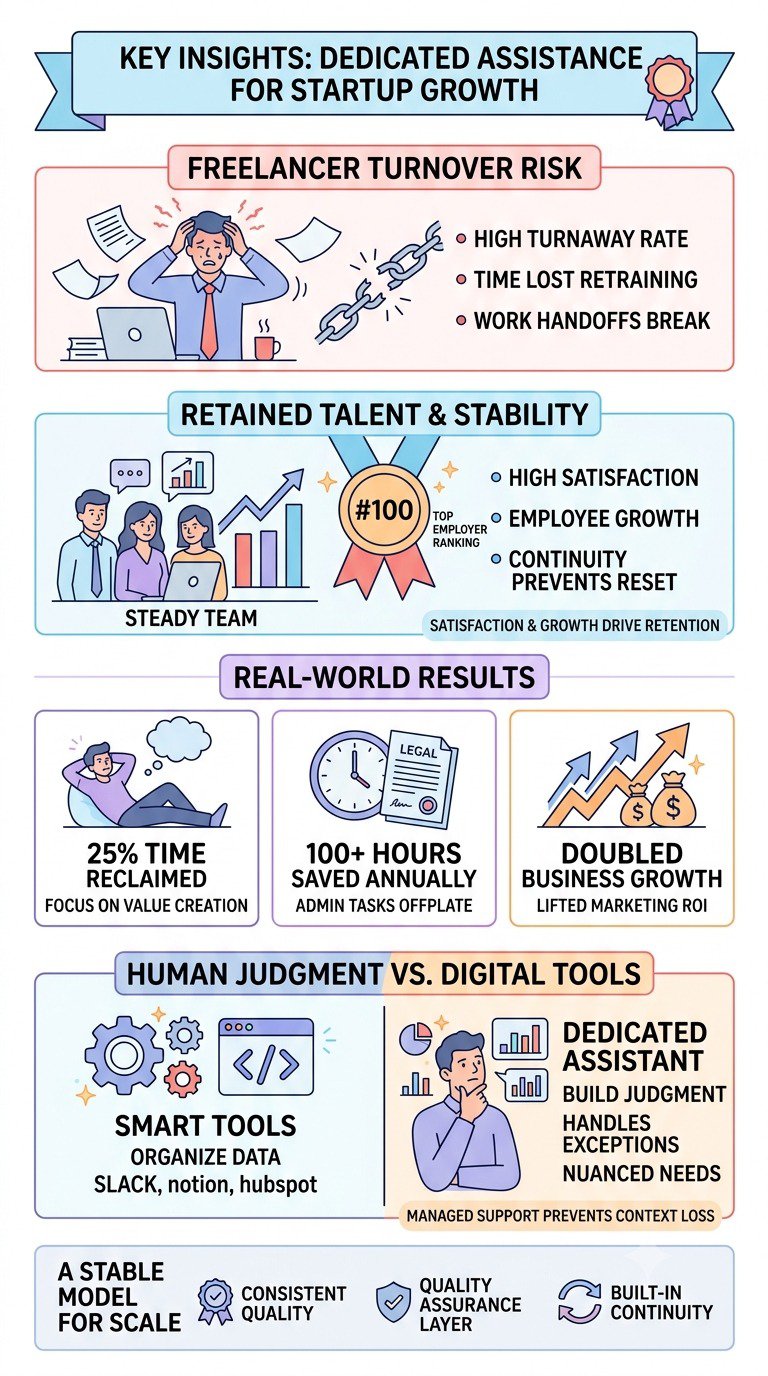
Wing ranked #100 out of 500 on Forbes' 2026 list of America's Best Startup Employers, built with the research firm Statista from roughly 7 million data points across 2,700 vetted companies. Forbes and Statista scored company reputation, employee satisfaction, and growth, using the same methodology they've run for seven years. Wing landed on the list alongside companies like Anthropic, Ramp, and ClickUp.
That's the announcement. Here's why it's worth more than a headline, and the answer looks a little different depending on whether you're the one drowning in your own inbox or the one watching work break down every time it changes hands on your team.
Why an employer ranking is a buyer signal
Forbes and Statista scored company reputation, employee satisfaction, and growth, and satisfaction and growth are the exact conditions that determine whether someone stays at their job. For a service built on one assistant learning your business over time, whether people stay isn't a nice-to-have. It's the whole product.
That shows up differently depending on where you sit. If you're running the business yourself, turnover means you're the one re-explaining your systems, your preferences, your vendors, your tone, all of it, to whoever shows up next.
If you're managing execution across a team, the cost is structural rather than personal: work breaks at the handoff, and the next person doesn't just need to learn a task; they need to rebuild context that was never written down anywhere but in someone's head.
That risk isn't rare. Admin and ops roles see some of the highest replacement-driven churn of any category, which is exactly why continuity tends to break at the moments a growing business can least afford it, during a hire, a reorg, or a busy season.
A person who's satisfied and growing where they work is a person who stays long enough to actually learn your business instead of just passing through it. An independent ranking that measures satisfaction and growth is, indirectly, a ranking of the conditions that make that kind of staying power possible.
What that looks like with real clients
The pattern shows up the same way across every account that's worked well, whether it's one person or a small team.
25% of her time back, and a role that became indispensable
Cathy Fisher, founder and CEO of Quistem, had tried multiple VAs before Wing, and none of them showed up reliably. Wing matched her with Victor, a full-time Executive Assistant, and the relationship held long enough for him to become genuinely integral to how Quistem runs, not just someone clearing her inbox.
Twenty-five percent of her time came back, nine recurring admin tasks came off her plate for good, and Victor has now delivered over 1,000 workdays of support. "He's freed up my brain and my time," she said. "I can now focus on value creation instead of a thousand little tasks." The full Quistem story is worth reading if you want to see what it looked like month to month.
100+ hours reclaimed, because the same person stayed
Jesse Thomas, founding attorney at Idaho Legal Estates and Probate, was buried in scheduling, intake, and document tracking instead of practicing law. His Wing assistant took over ten recurring back-office tasks and stayed on the account long enough for the results to compound instead of reset: 100+ hours reclaimed for casework, 13+ hours saved every week on intake and scheduling alone.
"We were able to increase our volume output," Jesse said. "The onboarding was quick, and they're always on task." That's a longer story too, and it's the same underlying mechanism as Quistem's: nobody engineered a clever process. One person just didn't leave.
Doubled growth, because it held up across two roles
European Leather Works had been through unreliable freelancers and high turnover before founder Sacha Hason brought Wing in. Wing placed two dedicated assistants, one on marketing and one on design, and because both stayed on the account long enough to actually run those functions instead of just executing tickets, Sacha stopped supervising the work and started directing the business.
The company doubled its growth, lifted marketing ROI by 150%, and saved over $120,000 a year in payroll. "With the top-notch support I get from my dedicated assistants," Sacha said, "I can rely on my marketing and social media channels to grow while I focus on customers and overall growth." Here's the full European Leather Works story.
Why the assistant still matters more than the tools
Look at what actually held European Leather Works together: two people staying long enough to run their functions, not two tools organizing tasks faster. That's why Wing puts real weight behind training assistants on the AI tools most teams already run on, Slack, HubSpot, Notion, and the rest, instead of treating the tools as the point. It would be easy to assume that if the tools are getting smarter, the person matters less. It's actually the opposite.
The tools organize the work. They don't know that your Q3 vendor renewal always goes sideways, or that your biggest client needs a phone call instead of an email when something's wrong. If you're running the business yourself, that's the judgment your assistant builds up about you specifically, your habits, your blind spots, the shortcuts you didn't know you needed.
If you're managing execution across a team, it's the judgment about which exception needs to get escalated and which one can just get handled, the call nobody wants to be the one making at 6 pm on a Friday. Either way, that kind of judgment only shows up after someone's been paying attention for months, and it only exists at all if that person is still there to apply it.
Wing Workspace holds the documented context, so nothing resets if a role changes or a replacement is ever needed, but the judgment itself still comes from a person who stuck around long enough to build it. That's the gap between a tool and an assistant, and it's the same gap this Forbes ranking is measuring from a completely different angle.
What this adds to the proof that already existed
A 4.8 average rating across Google, Facebook, and Capterra, and more than 10,000 companies supported, were already the answer to "did this work for other people?" What the Forbes and Statista data adds is an answer to a quieter, different question: are the conditions in place for that to keep happening?
If a freelancer or VA has walked out on you before, the honest answer is that it's usually not a people problem; it's a model problem. You were carrying the turnover risk alone: finding the replacement, retraining them, re-explaining everything from scratch. With Wing, a Success Manager owns that instead, and if a replacement is ever needed, they're briefed on what's already documented in Wing Workspace rather than starting the account over.
If the concern is scale rather than a single bad experience, the same structure is what makes it hold across a team instead of at one desk. European Leather Works didn't need Sacha managing two people the way he'd have had to manage two freelancers. Wing's QA layer and Success Manager sit on the account itself, so adding a second or third role doesn't mean adding a second or third thing for the client to supervise.
The ranking, the case studies, and the review scores are three different ways of checking the same thing from three different directions, and none of them overrides the other two.
What doesn't change
None of it changes what Wing charges or how assistants get matched. It's a signal about the environment, not a shift in the service.
If the mental load you're carrying is personal, the inbox and follow-ups only you seem to remember, seeing how the matching and onboarding process works is a reasonable next step.
If it's organizational instead, work breaking at handoffs because everything still depends on one person staying in place, the same starting point applies: book a 15-minute call and find out where that risk actually sits before it turns into a bigger problem.

Dianne Florendo is a content writer who creates engaging SEO content about virtual assistants, outsourcing, and business productivity.