

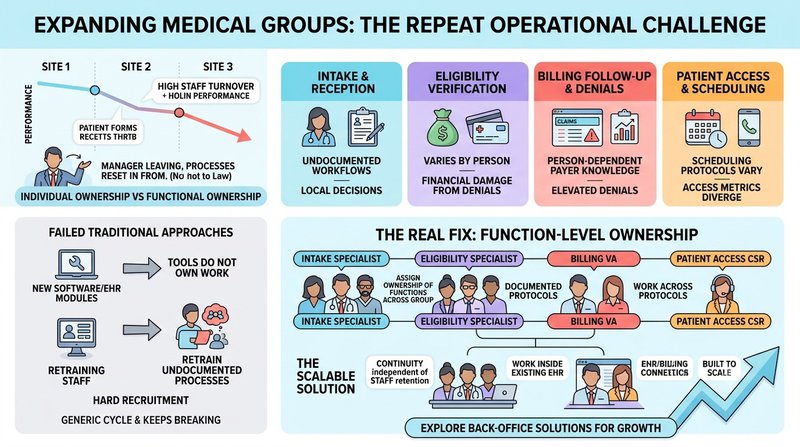
Multi-site medical groups repeat the same operational problems after each expansion because workflows are owned by individuals, not by functions. When a site manager leaves, every process they carried personally resets. Standardization fails not at the strategy level but at the function level, because no one owns intake, billing, or eligibility end-to-end across all locations.
You open a second location. Then a third. Each one takes longer to stabilize than the last. Performance lags, errors multiply, and somewhere in the middle of it, the director of operations is personally triaging eligibility issues at the new site because no one else knows how it was supposed to work.
This is not a growth problem. It is not a technology problem. And it is not a training problem, even though most groups treat it like one.
It is a function-ownership problem. And until that gets named correctly, every new site inherits exactly what the last one did.

The Pattern Nobody Talks About Out Loud
Between 2019 and 2024, roughly 44,000 practices were acquired by larger physician groups or health systems (PAI/Avalere, 2024). Multi-site operations are no longer the exception; they are the default model for mid-sized groups with growth goals.
But most of those groups did not build their back office to scale. They built it to open.
Opening a site and operating a site at standard performance are two different things. When a new location launches, it typically runs on whoever was brought in to stand it up, a site manager, a lead front-desk coordinator, or sometimes a regional operations person on loan from another site. Those people absorb the operational context. They learn the payer mix quirks, the intake timing, and which insurers need prior authorization routed a specific way. They become the process.
For a while, that works. Until it doesn’t.
Front-office turnover in medical practices runs at approximately 40% annually (MGMA DataDive, 2022). That means the person who learned how the new site actually operates has a roughly even chance of leaving before the site reaches full operational maturity. And when they leave, everything they knew goes with them.
The group restarts. Again. Learn more about medical virtual assistant.
Why This Keeps Happening: Four Functions, Four Versions of the Same Failure
The failure pattern is not random. It concentrates on four specific areas, the same ones, at every site, every time.
Intake
Patient intake is almost always undocumented at the function level. Most groups have a version of a front-desk training guide, but what actually happens at intake, how a medical office virtual receptionist handles missing insurance cards, confirms referral source, or decides when to escalate, lives in whoever is working the desk that week. New sites learn from whoever trained them. If that person learned informally from someone at a different site, the variation compounds with every handoff.
Eligibility verification
Eligibility is where undocumented workflows create the most direct financial damage. Which payers require real-time verification? Which plans flag as active but still deny? When does the team escalate versus reattempt? At most multi-site groups, the answers to those questions differ by location, not by policy, but by who happens to be doing verification there. No one owns eligibility across the group. They own it at their desk.

Billing follow-up
Denials management is one of the highest-leverage activities in a medical practice. It is also one of the most person-dependent. The experienced biller, or virtual medical administrative assistant handling denials remotely, carries payer-specific appeal knowledge personally. When they leave, or when a new site launches without someone at that level, denial rates rise and stay elevated until someone figures it out again.
Patient access and scheduling
Scheduling protocols, waitlist management, and same-day slot handling vary by site, not because of intentional policy differences, but because each site was set up by a different person who made reasonable local decisions that were never codified. The result is that access metrics diverge across locations in ways that look like performance problems but are actually documentation problems. Learn more about best healthcare assistant.
Why Software and Retraining Haven’t Fixed It
Every few years, a new EHR module, practice management platform, or workflow tool promises to standardize operations. Groups invest. Training happens. And six months later, the same person-dependent patterns have reconstituted themselves inside the new system.
This happens because tools organize work. They do not own it.
A scheduling module tells staff where to put appointments. It does not decide who is responsible for monitoring access across all three sites, what threshold triggers an intervention, or who gets the weekly report. Those decisions require someone with the authority and accountability to act on them, not just access to the data.
Retraining runs into the same wall. You can train a new front-desk coordinator on the intake workflow. But training requires something to train to. If no one ever documented the workflow at the group level, only one person carried it in their memory, retraining just hands the same undocumented process to the next person, who will eventually leave.The deeper issue is a medical admin bottleneck that no amount of retraining resolves on its own.
Finding backfill fast enough to prevent the gap from widening is also harder than it sounds. In a 2024 survey, 53% of medical groups identified candidate recruitment as their top staffing challenge (MGMA Stat, October 2024). What groups are actually experiencing does not support the assumption that you can quickly hire your way back to stability after a departure.
What Function-Level Ownership Actually Requires
The fix is not a new platform. It is not another all-hands training. It is assigning ownership of each back-office function, not to a site, but to a role that operates across the group.
Someone needs to own intake as a function across all locations. That means documented workflows, consistent protocols, exception handling, and accountability for performance, not at one site, but for all of them.
Same for eligibility, for billing follow-up, and for patient access.
This is not the same as having a “regional manager” who oversees sites. Regional managers oversee people. Function owners own processes. The distinction matters because what fails during site transitions is not the org chart; it is the work underneath it.
For this to work, function owners need to work inside the group’s existing tools. The workflow has to live in the engagement, not in one person’s institutional memory. When that person is replaced, the process does not restart. The next person picks up exactly where the last one left off.
Common issues include inconsistent intake, eligibility verification, billing follow-up, and scheduling. Wing can provide a dedicated Medical Administrative VA to support these functions across locations. Assign ownership of key functions across all locations instead of leaving processes to individual site staff. Wing can support this with a Medical Intake Specialist and other specialized healthcare VAs. Yes. Outsourcing specific back-office functions can provide consistent support across locations. Wing offers Medical Insurance Verification Specialists for eligibility and insurance workflows. A dedicated team member can manage claims and follow-ups using consistent processes across sites. Wing’s Medical Billing Specialists can handle billing support across multiple locations. Wing assigns specialized healthcare VAs to specific functions, helping maintain consistent workflows across locations. Healthcare CSRs can support patient access and communication.Frequently Asked Questions
Why Multi-Site Groups Are Turning to Healthcare Outsourcing Services
More multi-site physician groups are solving this by assigning dedicated support to specific functions, intake, insurance verification, billing follow-up, and patient access through healthcare BPO services that operate across locations rather than within them. Outsourcing healthcare services at the function level, rather than the site level, is what makes the difference.
Among healthcare outsourcing companies, Wing Assistant stands apart by matching AI-trained assistants to specific back-office functions who work inside the group’s existing EHR and billing tools. Because the work lives in the platform and the structured engagement rather than in one person’s memory, function continuity does not depend on staff retention. Wing is ISO 27001 compliant and SOC 2 certified, meeting the security standards that multi-site groups require before extending access to any external support.
The model is built for exactly the failure pattern described above: a medical intake specialist who owns intake across all sites, a medical administrative VA who owns billing follow-up, a healthcare CSR who covers patient access, each operating with documented protocols that do not reset when a site-level staff member transitions out.
The next expansion does not have to inherit the same problems as the last one. But that requires making a different structural choice before the site opens, not retraining the same undocumented workflows into the next person who will eventually leave.
See how Wing covers the back-office functions that break during growth → Book a Demo

Dianne Florendo is a content writer who creates engaging SEO content about virtual assistants, outsourcing, and business productivity.