

Every week, a billing role sits open, claims go unworked, and A/R ages. Every week, a front-desk role is vacant, calls go unanswered, and appointments go unscheduled. With 53% of medical groups reporting that finding candidates is their top staffing challenge, the real gap isn’t days, it’s weeks to months. And most administrators only budget for the cost of the hire, not the cost of every week before it.
The staffing reality nobody puts a number on
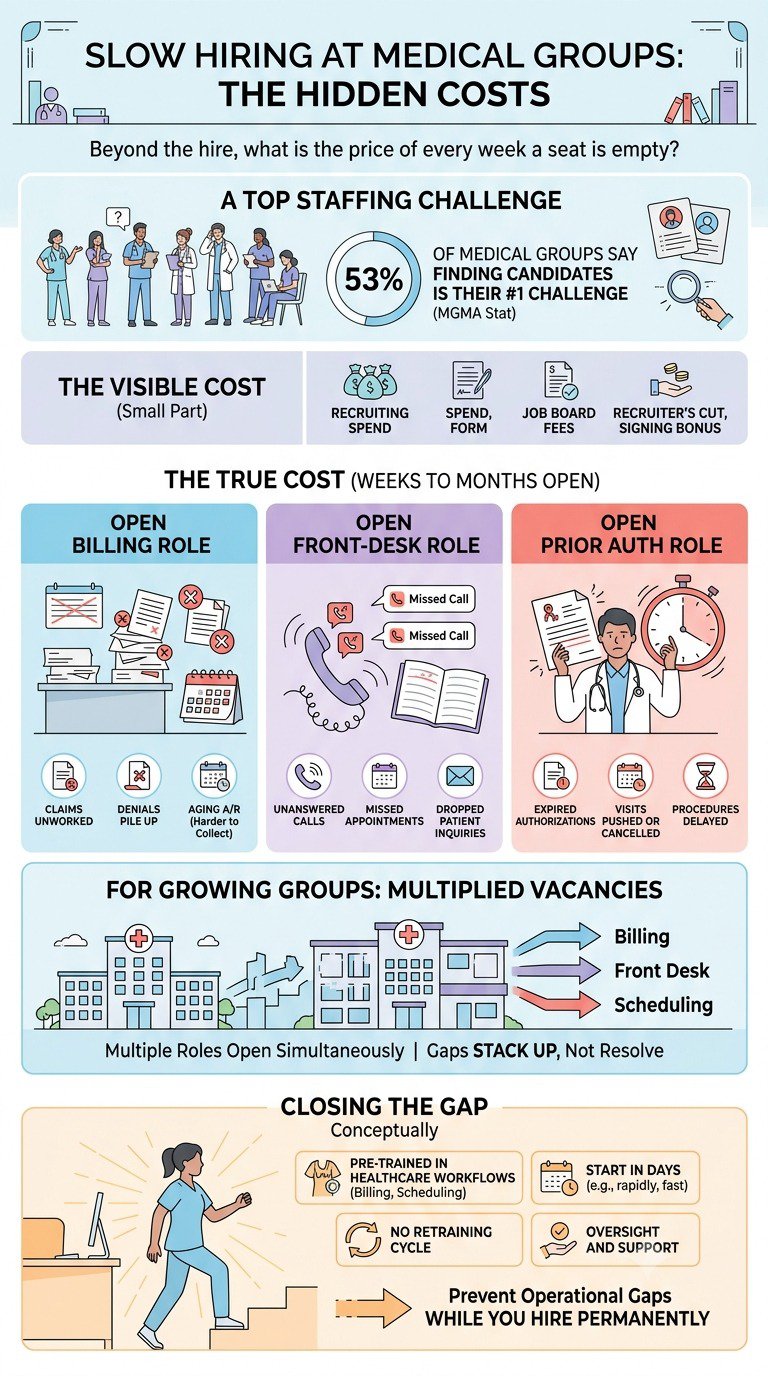
Ask any practice administrator about their biggest operational headache right now, and staffing comes up fast. It’s not a perception problem. MGMA’s most recent Stat poll found that 53% of medical groups name finding qualified candidates as their number one staffing challenge, ahead of pay, turnover, and burnout combined.
What that stat doesn’t capture is what happens in the meantime. A billing role that takes six weeks to fill isn’t a six-week delay. It’s six weeks of claims that don’t get submitted, six weeks of denials that don’t get worked, six weeks of A/R that keep aging past the point where it’s easy to collect.
Most groups track time-to-fill as an HR metric. Almost none of them translate it into what it’s actually costing the practice while the seat is empty.
The cost categories that don’t show up on a hiring at medical group dashboard
When a role opens, the visible cost is the recruiting spend, job board fees, a recruiter’s cut, and maybe a signing bonus. That’s the smallest part of the bill. The larger cost lies in what stops happening while the seat is empty:
- Open billing role: Claims stop getting worked. Denials pile up unaddressed. A/R that’s already aging keeps aging, and every week it sits past 90 days makes it harder to collect.
- Open front-desk role: Calls go to voicemail or don’t get answered at all. New patient inquiries and reschedule requests fall through. Appointment slots that should be filled stay empty.
- Open prior auth role: Authorizations expire before procedures happen. Scheduled visits get pushed or cancelled while someone chases down a payer.
None of these show up as a line item called “cost of vacancy.” They show up three months later as a soft revenue number, a patient complaint, or a provider asking why their schedule is thinner than it should be. Learn more about medical assistant for hire.

What an open billing role actually costs
Take a 10-provider group with a single dedicated billing specialist who leaves. The role takes eight weeks to fill, not unusual, given that front-office turnover runs close to 40% annually and qualified billing talent is hard to find.
During those eight weeks:
- New claims still go out, but nobody is working denials, following up on unpaid claims, or chasing down documentation payers are requesting.
- Initial denial rates industry-wide sit at 11.81%. Without someone working those denials inside the appeal window, a meaningful share of them go unrecovered, even though roughly 90% of claims are ultimately payable if someone actually works them.
- A/R that crosses the 90-day mark is already sitting in a bucket where market-wide collection rates fall off sharply. Industry data puts A/R over 90 days above 35% at many groups, even with fully staffed billing teams.
The revenue at risk isn’t hypothetical. Its claims are sitting in a queue that nobody is touching, in a system where the money is recoverable only if someone works it before it ages out.
Why this compounds for growing groups
A single-site practice with a stable roster can absorb one open role for a few weeks without much damage. A growing multi-site group can’t, because growth multiplies the number of seats that need to be filled at the same time.
Add a site, and you need another front-desk role, another billing seat, and sometimes another scheduling coordinator. Add providers, and prior auth volume climbs with them. Every one of those roles has its own time-to-fill clock running, and when several open at once, which is exactly what happens during a growth phase, the operational gaps stack on top of each other instead of resolving one at a time.
This is the part that catches administrators off guard. The staffing plan was built around steady-state headcount. Growth doesn’t wait for hiring at medical group to catch up, and the gap between the two is where revenue and patient experience both take a hit.

The “we’ll just use temps” response
Bringing in a temp to cover the gap feels like the obvious fix. In practice, it rarely closes in the way it looks like it should.
Temps need training on the practice’s specific billing system, payer mix, and documentation habits before they can do useful work, and by the time they’re up to speed, many contracts are already ending. A biller who doesn’t know the group’s specific denial patterns or a front-desk temp who doesn’t know the providers’ scheduling preferences isn’t operating at the level the seat actually needs. Some temps leave mid-assignment for a permanent offer elsewhere, restarting the ramp-up clock.
The result is a coverage model that looks staffed on paper but still leaves claims unworked and calls unanswered, just with a different person not quite catching up.
What actually closes the gap
Closing the gap without creating a new one requires a coverage model that doesn’t run on the same hiring at medical group timeline as a full-time employee search. That means:
- A role that’s live in days, not weeks or months
- Someone trained on healthcare billing and scheduling workflows before they start, not after
- Oversight and replacement are handled by someone other than the already-stretched administrator
- No retraining cycle every time coverage changes
This is where Wing fits into the staffing conversation differently from a staffing agency or a job board. Wing places a dedicated, HIPAA-trained assistant, a medical billing specialist, a healthcare receptionist, and a prior authorization specialist, live in 48 hours, not weeks. Wing assistants are AI-trained and proficient in modern billing and scheduling tools, so they integrate into existing workflows from day one instead of spending the first month learning the system. Wing is ISO 27001 compliant and SOC 2 certified, so the compliance question that usually stalls outsourcing conversations is already answered.
The point isn’t to replace a hiring at medical group process. It’s to make sure there’s never an eight-week window where nobody is working the claims.
Time-to-fill for billing and front-office roles at medical groups commonly runs six to twelve weeks, driven by a limited pool of candidates with both billing knowledge and healthcare-specific system experience. Wing removes that timeline by placing a dedicated, HIPAA-trained Medical Billing Specialist in as little as 48 hours, so claims keep getting worked while a permanent search runs in parallel if needed. Claims that aren’t actively followed up on tend to age past the point where they’re easy to collect. With initial denial rates near 12% and a large share of A/R sitting past 90 days industry-wide, an unstaffed billing seat accelerates both problems at once. A Wing Denials Management Specialist can step in specifically to work the backlog of unappealed denials so aging A/R doesn’t compound while a seat sits open. Temps can help, but they typically need weeks to learn a practice’s billing system and payer mix before they’re fully productive, and many contracts end around the time that ramp-up finishes. Wing’s Medical Billing Specialist role is trained on modern billing and scheduling tools before placement, so there’s no multi-week ramp-up eating into the coverage window. Billing specialists, front-desk/receptionist roles, and prior authorization specialists see the most direct operational impact, since each has a specific, time-sensitive function that doesn’t pause just because the seat is empty. Wing covers all three with dedicated, HIPAA-trained assistants: a Healthcare Receptionist to keep calls and scheduling covered, a Prior Authorization Specialist to keep authorizations from expiring, and a Medical Call Center Specialist for groups where call volume alone justifies a dedicated seat. Wing places dedicated, HIPAA-trained assistants, including Medical Billing Specialists, Healthcare Receptionists, and Prior Authorization Specialists, in as little as 48 hours, with oversight and replacement handled by Wing so practices aren’t left managing the gap or a retraining cycle on their own.Frequently Asked Questions
Related reading
- What Rising Denial Rates Are Really Costing Your Practice — how the same aging A/R problem plays out when denials go unmanaged, whether or not a seat is vacant
- What Actually Breaks When Your Billing Specialist Leaves — the operational fallout the day after someone gives notice
See how Wing fills the gap without a hiring at medical group cycle. Book a Demo

Dianne Florendo is a content writer who creates engaging SEO content about virtual assistants, outsourcing, and business productivity.