

A legal VA takes non-billable admin off your plate: intake calls, calendar management, document formatting, and correspondence, so your hours go toward casework instead. Built for solo attorneys and small firms without the budget for in-house support staff, not larger practices that already have a paralegal or office manager handling this. What disappears: the intake calls you’re fielding between hearings, the scheduling back-and-forth, and the packet you’re assembling at 9 p.m. before a filing deadline.
It’s 10 p.m., and you’re drafting a routine letter that should’ve gone out six hours ago. The day got eaten by scheduling, a deposition moved, a client called about a court date, another wanted an update you hadn’t written yet. None of it was billable. All of it had to happen anyway.
That’s the quiet cost of running a solo or small firm: conflict checks, court deadlines, client calls, all competing with billable work for the same hours.
The instinct is to hire a legal virtual assistant, but most attorneys hesitate at the same point: what if delegating this just means spending evenings checking someone else’s work instead of doing your own? Help that creates more oversight isn’t help.
What a Virtual Legal Assistant Actually Does
A virtual legal assistant is a remote, non-licensed professional who handles the administrative and client-facing work that keeps a law practice running. They don’t give legal advice, represent clients, or practice law; that stays with the attorney. Their job is to take the operational load off licensed staff so those hours go toward legal work instead of logistics.
That’s a real distinction, not just a licensing technicality. A general VA can manage an inbox or book a meeting for almost any business. A legal VA is trained specifically on the systems a law office runs on: case management platforms like Clio or MyCase, intake protocols built to capture the right details on the first call, court filing formats and deadlines, and the confidentiality standards that come with client matters. That’s the reason firms choose to hire a legal virtual assistant rather than bring on a generalist and absorb the learning curve themselves.

Tasks a Virtual Legal Assistant Handles
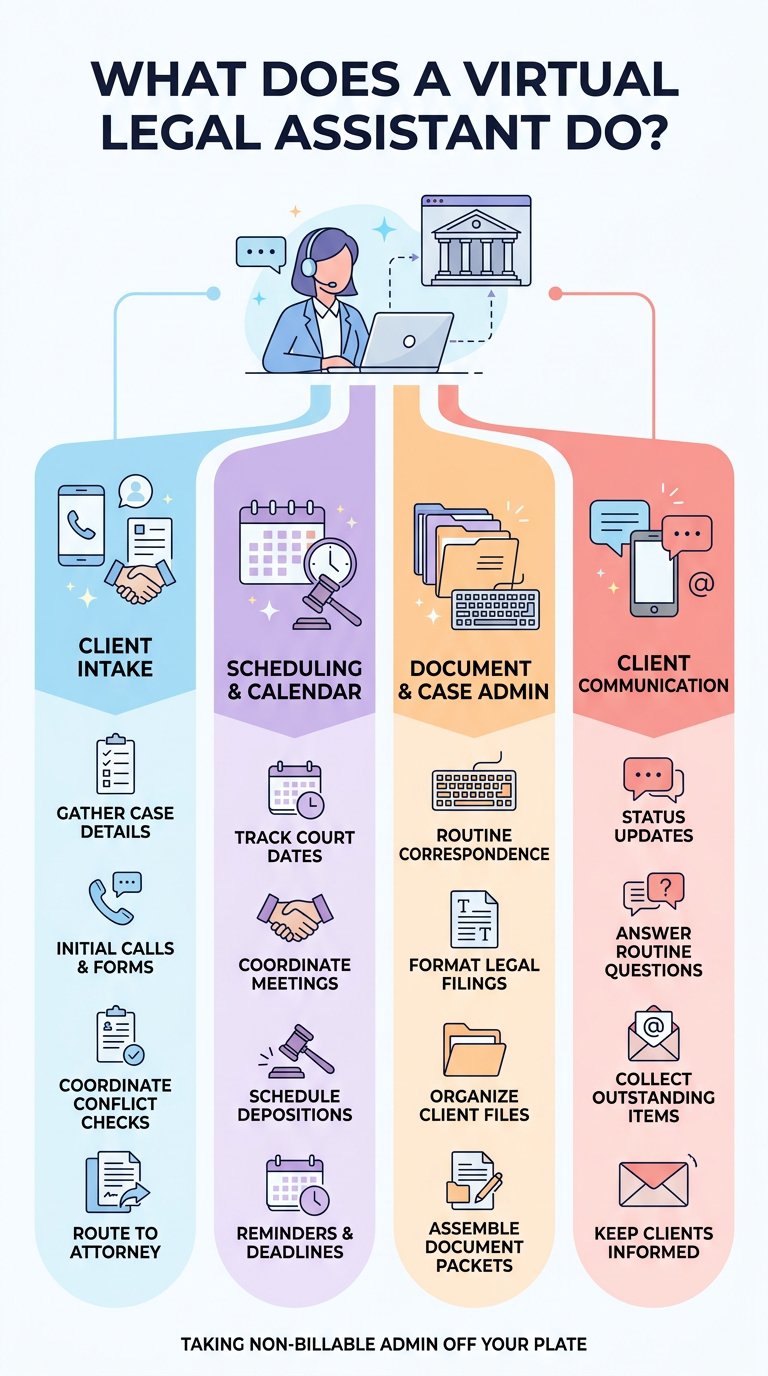
The work falls into four main areas: bringing clients into the practice, keeping the calendar on track, moving documents through the office, and communicating without crossing into advice.
Client Intake
When a prospective client calls or fills out a form, the remote legal assistant gathers case details, contact information, and referral source. They also run the non-legal side of conflict checks and populate the intake forms and case management system, so the attorney has everything organized before the first call.
The VA doesn’t judge legal merit, case value, or conflicts in a legal sense; the attorney does. Qualified leads get routed to them; unrelated inquiries are redirected elsewhere. If this is done well, the file arrives complete and ready to act on, not a name and a vague problem left for the attorney to fill in.
Scheduling & Calendar Management
A virtual assistant for lawyers tracks court dates, coordinates client meetings, and manages deposition scheduling with opposing counsel, flagging deadlines before they become emergencies. The stakes are concrete: a missed court date can mean sanctions or default judgment; a double-booked deposition means rescheduling with a party under no obligation to make it easy. This is recurring, detail-sensitive work, which is why firms assign it to one dedicated person rather than piecing it together ad hoc.
Document Prep & Case Admin
A law firm VA handles routine correspondence, formats and organizes filings, maintains client files, and assembles document packets. A packet missing one exhibit or filed in the wrong format can get rejected at the clerk’s window, so someone has to catch that before it goes out, not after.
Client Communication
Once a case is open, someone has to keep the client informed, provide status updates, answer routine questions, and follow up on outstanding items. Unlike intake, this is the ongoing thread, not the first contact. It’s also usually the first thing that slips when an attorney is buried, and what damages client trust fastest. A legal VA keeps that line open.
Legal VA vs Paralegal VA: Which One Do You Need?
These two roles get put together often, but they solve different bottlenecks. Getting this choice right matters more than the decision to outsource at all; the real risk isn’t handing work to a virtual assistant, it’s handing the wrong kind of work to the wrong role.
Here’s what each role costs through Wing:
| Legal VA | Paralegal VA | |
|---|---|---|
| Handles | Admin, intake, scheduling, correspondence | Substantive case support, trial prep, legal research assistance |
| Part-Time | $1,299/month | $999/month |
| Full-Time | $1,999/month | $1,699/month |
Cost isn’t the only thing that should drive the decision. Talent region, whether you hire through an agency or independently, experience level, and whether payroll and HR are bundled all move the number elsewhere in the market, a low hourly rate that leaves you handling recruiting and replacements can end up pricier than a flat monthly fee that covers it all.
How to decide which one you need: if the bottleneck is admin volume such as intake piling up, calendars slipping, correspondence falling behind, then hire a legal VA. If the bottleneck is case-specific legal support such as research memos, trial prep, substantive drafting, then hire a paralegal VA. If you get it wrong, you’re either paying for expertise you don’t need or missing expertise the work requires.

Is it Safe to Hand Over Case Files and Client Data?
This is the question that stops most firms before they start. Yes, if the provider has the right controls in place, but you’re handling attorney-client privileged information, and privilege can be waived or confidentiality breached if the wrong person has the wrong access. That risk is real, but it can also be managed.
Certifications
Any provider handling case files should be able to show independently audited security credentials, such as SOC 2 certification and ISO 27001 compliance, since both require third-party audits rather than a company simply describing its own practices. Ask any company you’re evaluating to produce the actual certificates, not a page on their website claiming compliance.
Access Control
A legal VA doesn’t need access to every file in your case management system. The structure that works is role-based: the VA sees what’s relevant to the tasks they’re assigned, while privileged strategy notes, settlement figures, and anything requiring attorney judgment stay restricted to licensed staff. Ask a provider how access is scoped, who can see what, and who has the authority to change those permissions. If the answer is “everyone sees everything,” that’s usually a red flag.
NDAs
Every legal VA arrangement should include a signed non-disclosure agreement; no provider should hesitate to offer one. But an NDA is a legal remedy after a breach happens, not a control that prevents one. It doesn’t restrict access, encrypt data, or stop a file from being forwarded to the wrong address. Treat it as the baseline you require, not the safeguard you rely on.
Get a Legal Virtual Assistant Trained for Your Firm
Wing matches, trains, and manages a dedicated legal assistant for your firm, backed by a manager who checks the work and keeps intake, scheduling, and case admin on track. Most clients are live within 72 hours.
Wing handles the support tier so your attorneys handle the law. It’s not a replacement for legal judgment, and it was never meant to be.
Here’s what you can expect:
- Security: Wing is ISO 27001 compliant and SOC 2 certified.
- Tools: Your assistant is AI-trained and proficient in the case management and e-filing systems you already use.
- Oversight: A manager reviews the work, so nothing slips through unchecked.
- Continuity: Coverage continues if your assistant is out, and your case context stays with Wing.
Idaho Legal Estates and Probate, a Boise-based estate planning and probate firm, handed intake, scheduling, and case admin to a dedicated Wing assistant, reclaiming 100+ hours for casework and saving 13+ hours a week on intake and scheduling, while increasing overall case volume.
A dedicated Legal Assistant runs $1,299/mo part-time and $1,999/mo full-time, with no recruiting cost, no benefits, and no long contract. For more substantive work, a separate Paralegal VA is available at $999/mo part-time and $1,699/mo full-time.
Ready to get client intake and case admin off your desk?
Frequently Asked Questions
A legal VA handles administrative and client-facing work: intake, scheduling, correspondence, and case file organization. A paralegal VA takes on more substantive support, like legal research assistance and trial prep, work that requires paralegal-level training. If your bottleneck is admin volume, hire a legal VA; if it’s case-specific legal support, hire a paralegal VA.
Through Wing, a Legal Assistant runs $1,299/mo part-time and $1,999/mo full-time, while a Paralegal VA runs $999/mo part-time and $1,699/mo full-time. Elsewhere in the market, cost depends on the provider, hours, and where the talent is sourced from, a low hourly rate that leaves you handling recruiting and replacements can end up pricier than a flat monthly fee that covers it all.
Yes, when the provider has the right controls in place: independently audited security certifications (SOC 2, ISO 27001), role-based access so the VA only sees what’s relevant to their tasks, and a signed NDA as the baseline. See the section above on handing over case files for the full breakdown.