

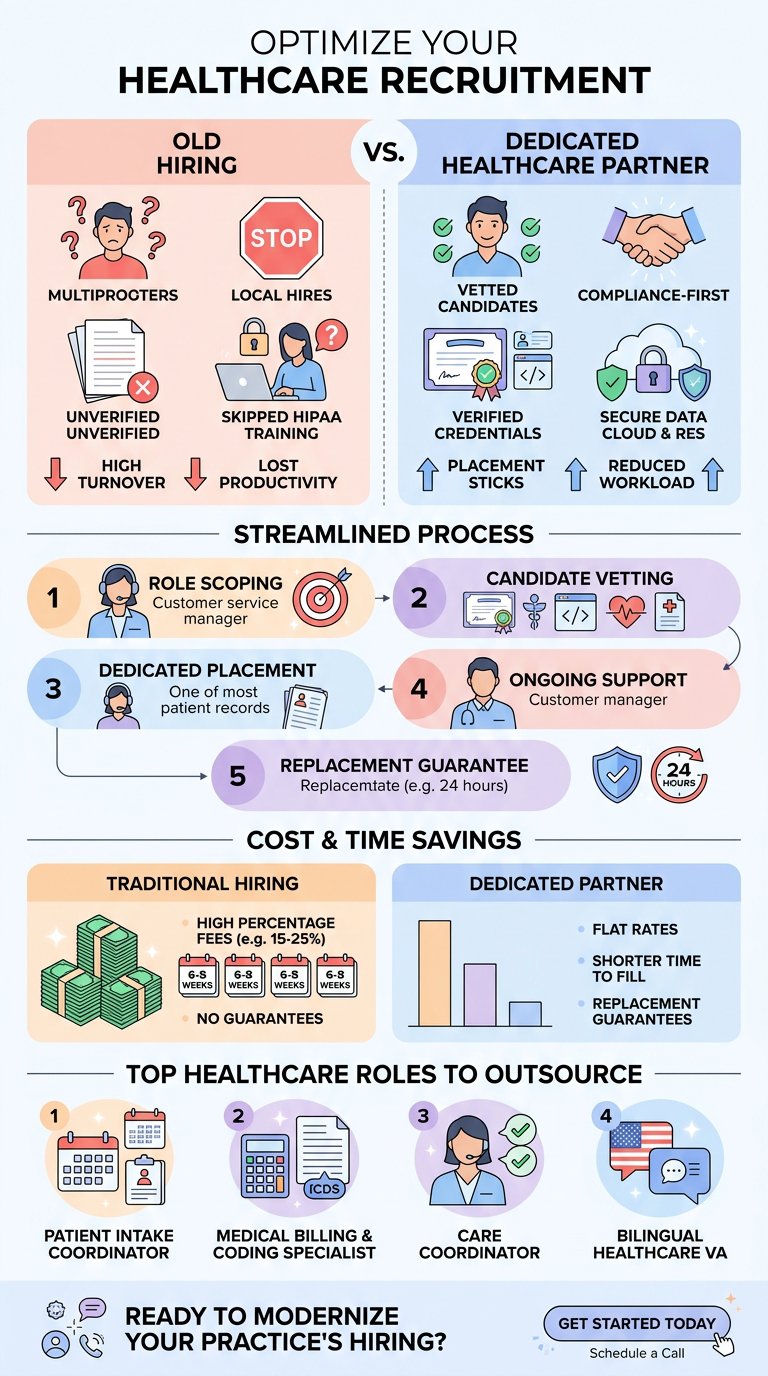
Most practices fill admin and support roles through whoever’s available: a local hire, a friend-of-a-friend, or a general staffing agency that doesn’t specialize in healthcare. Credentials go unverified, HIPAA training gets skipped, and the hire doesn’t make it past 90 days, so the practice is right back where it started. Practices are outsourcing to a dedicated healthcare recruiting partner that vets for compliance and skill before anyone touches a patient record. Placements stick, fewer hires wash out, and staff stops losing hours re-running the same search every few months.
Staffing shortages aren’t news to anyone running a practice. Nearly one in five practices sit with a front-desk or admin seat open for two months or longer, and every day it stays open means slower intake, longer hold times, and more work dumped on whoever’s left.
Here’s what actually makes a healthcare recruiting partner worth trusting, how Wing vets and places candidates, which roles are the easiest first move if you’re outsourcing for the first time, and what it actually costs compared to doing it yourself.

Why Practices End Up Stuck With the Wrong Hire
Most practices don’t set out to make a bad hire. It usually happens because the hiring process wasn’t built for healthcare in the first place.
- The skills gap gets missed. A general job posting pulls in a wide pool of applicants, but few of them have handled insurance verification, medical billing codes, or patient intake under HIPAA. Without someone on the hiring side who knows what to screen for, resumes get judged on general admin experience instead of the specific skills the role needs.
- Compliance falls through the cracks. A local staffing agency or a generalist recruiter may not ask a single question about HIPAA handling, data security, or how a candidate has previously worked with protected health information. That’s not a knock on those recruiters; it’s just not their specialty. But it means the compliance risk quietly shifts onto the practice, and it usually doesn’t surface until something goes wrong.
- Turnover resets the clock. Administrative and support roles in healthcare see high turnover industry-wide, often driven by burnout, unclear expectations, or a mismatch between the role and the person filling it. Every time a hire doesn’t work out, the practice is back to square one: writing a new job post, screening a new batch of resumes, and losing weeks of productivity in the gap.
What Makes a Healthcare Recruiter Trustworthy?
Not every staffing option is built for healthcare. A trustworthy healthcare recruiting partner needs to clear three bars before a single candidate is presented:
- Compliance-first vetting. Every candidate should be screened against HIPAA handling requirements before placement, not after an incident.
- Verified credentials. Certifications, coding credentials, and prior healthcare experience should be confirmed, not self-reported.
- Security infrastructure that backs it up. The partner itself should carry independent compliance certifications, not just apply them to candidates.
Wing is built around all three. Every placement runs through HIPAA-aligned vetting, and Wing’s own operations are backed by SOC 2 and ISO 27001 certification, so the compliance standard doesn’t stop at the candidate’s resume. It extends to the systems they work in every day.
Questions Worth Asking Before You Sign With Anyone
If you’re evaluating a recruiting or staffing partner, healthcare or otherwise, a few questions tend to separate the reliable ones from the rest:
- What happens if the placement doesn’t work out? A recruiter with real confidence in their vetting process will have a clear, no-fuss answer. A vague one is a warning sign.
- How do you screen for HIPAA readiness specifically? If the answer is generic (“we run background checks”), that’s not a healthcare-specific process.
- Is pricing flat-rate or percentage-of-salary? Percentage-based recruiting fees can add up fast, especially for practices hiring more than one role.
- Who do I talk to after the placement is made? If the answer is “nobody, the relationship ends at the hire,” that’s worth factoring into your decision.
These aren’t complicated questions, but a surprising number of staffing arrangements don’t hold up well against them.
How Wing’s Placement Process Works
Outsourcing hiring only solves the problem if the process behind it is actually reliable. Here’s what that looks like with Wing:
| Step | What Happens |
|---|---|
| Role scoping | A Customer Success Manager maps the exact tasks and compliance requirements for the role |
| Candidate vetting | Candidates are screened for healthcare-specific credentials, HIPAA readiness, and relevant experience |
| Dedicated placement | You get one dedicated VA assigned to your practice, not a rotating pool |
| Pricing | Flat-rate pricing, so there’s no per-hire recruiting fee or percentage-of-salary surprise |
| Ongoing support | A Customer Success Manager stays engaged post-placement to handle any adjustments |
| Replacement guarantee | If a placement isn’t the right fit, Wing replaces them within 24 hours |
That last point matters more than it sounds. Traditional recruiting relationships often end the moment someone signs an offer letter. Wing’s doesn’t. The Customer Success Manager stays in the picture after placement, so if the role needs adjusting, or the fit isn’t quite right, there’s already someone who knows the account and can act on it immediately.

What It Actually Costs to Do This Yourself
It’s worth being honest about what in-house hiring or a generalist recruiter usually costs, even when the invoice doesn’t spell it out directly.
- Time. Writing a job post, screening resumes, running interviews, and onboarding a new hire regularly takes six to eight weeks from start to finish. During that stretch, the role stays unfilled or gets patched over by existing staff.
- Recruiting fees. Traditional recruiters commonly charge a percentage of the new hire’s first-year salary, often somewhere in the 15 to 25 percent range. For a role paying $45,000, that’s a fee well into four figures before the person even starts.
- Re-hiring costs. If the placement doesn’t work out, most of that time and cost repeats. There’s rarely a built-in replacement guarantee with a generalist recruiter or an internal hire.
- Opportunity cost. Every week a role sits open or is filled by someone still learning the job, existing staff absorb the overflow, which is its own quiet cost to morale and output.
A flat-rate, dedicated-VA model sidesteps most of this. There’s no percentage-of-salary fee, no guessing at how long the search will take, and a replacement guarantee that actually gets used if it’s needed.
Which Roles Should You Outsource First?
Not every healthcare role belongs on this list, but several are consistently the easiest and highest-impact roles to outsource:
- Patient intake coordinators: handling scheduling, pre-visit paperwork, and insurance verification
- Medical billing and coding specialists: reducing claim errors and speeding up reimbursement cycles
- Care coordinators: managing follow-ups, referrals, and care plan logistics between visits
- Bilingual healthcare VAs: closing communication gaps for practices serving non-English-speaking patients
These are high-volume, process-driven roles, exactly where a vetted, dedicated VA tends to outperform a generalist hire or an unfilled req. They also tend to be the roles where a mistake is most visible to patients, a missed insurance verification or a scheduling error shows up immediately in the day-to-day, which makes getting the hire right the first time worth the extra vetting.
A Practice That Made the Switch
Provida Family Medicine was managing patient intake and scheduling internally, with staff stretched across too many responsibilities to keep either running smoothly.
- Before: Scheduling conflicts and intake delays were becoming a regular part of the day, and the staff covering those gaps had less time for the parts of their job that actually needed their attention.
- The change: The practice brought on a dedicated Wing VA for intake and scheduling support, set up around their existing workflows rather than a generic template.
- After: Scheduling errors dropped, and front-desk staff were freed up to focus on patients actually in the building, without adding a full-time in-house hire or taking on recruiting overhead.
The process didn’t require the practice to run its own search, screen its own candidates, or take on the risk of an unvetted hire handling patient scheduling and records.
Common Concerns Practices Have Before Outsourcing
A few concerns come up often enough that they’re worth addressing directly.
“Will an outsourced VA actually understand our workflows?” This is usually less about the VA and more about the onboarding process. With a dedicated placement and a Customer Success Manager mapping the role upfront, the VA is set up around your specific workflows from day one, not left to guess at them.
“What if our patient data isn’t secure?” This is exactly why compliance certifications matter at the partner level, not just the candidate level. SOC 2 and ISO 27001 certification means the security standard applies to the systems the VA works in, not just a one-time background check.
“Isn’t this more expensive than just hiring locally?” Usually the opposite. Flat-rate pricing without a percentage-of-salary recruiting fee, combined with a much shorter time-to-fill, tends to come out ahead of a traditional local hire once you factor in the full cost of the search.
“What if we only need help with one role right now?” That’s the majority of practices that start here. Most don’t outsource their entire admin team at once. They start with the single role causing the most friction, usually intake or scheduling, and expand from there once they’ve seen how the process works.
Ready to outsource your next healthcare hire to a partner that’s actually built for it?
Wing is a managed virtual assistant company with a dedicated healthcare vertical, so you get recruiter-level vetting for healthcare-specific roles, plus the flat-rate pricing and dedicated-VA model of a managed staffing partner. Learn more about Wing’s healthcare VAs. Every healthcare placement goes through HIPAA-aligned vetting, and Wing’s operations are backed by SOC 2 and ISO 27001 certification. Wing replaces the placement within 24 hours at no additional cost. There’s no separate recruiting fee to re-run the search. Yes, bilingual healthcare VAs are one of Wing’s most requested placements for practices serving diverse patient populations. Placement timelines vary by role, but the process is built to move faster than a traditional recruiting search, since candidates are already vetted against healthcare-specific criteria before your search even starts. Schedule a call to discuss timelines.Frequently Asked Questions

Dianne Florendo is a content writer who creates engaging SEO content about virtual assistants, outsourcing, and business productivity.