

Most brokers still run their brokerage’s back office themselves, reviewing transaction files, onboarding agents, and updating listings between their own deals. That work grows with every agent you add, so recruiting slows, compliance gaps show up, and your own production takes the hit. A dedicated virtual assistant for real estate brokers takes over the repeatable admin layer, working inside your MLS, CRM, and transaction management tools. You get your hours back for recruiting, coaching, and closing, without adding a full-time in-house hire.
Running a brokerage means doing two jobs at once. According to NAR’s 2026 Member Profile, sales agents report a median of 30 hours of work per week, while brokers and managers who also sell report a median of 40 to 45 hours. Much of that gap is brokerage operations: compliance, agent support, and the systems that keep everyone else selling.
This guide covers what a virtual assistant for real estate brokers actually does, which tasks to hand off first, what it costs compared with other options, how to hire the right one, and how brokers use Wing’s dedicated virtual assistants to run a tighter operation.
What does a virtual assistant for real estate brokers do?
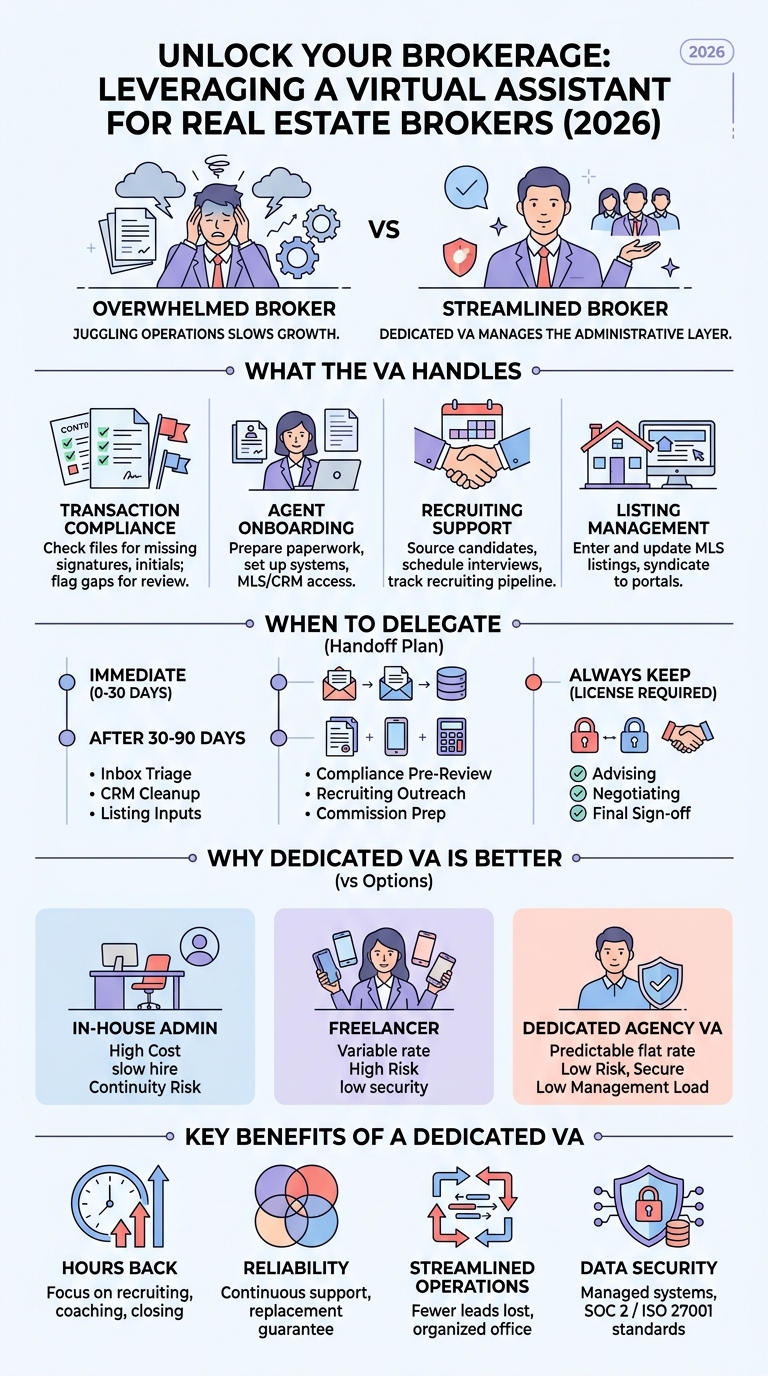
A virtual assistant for real estate brokers is a remote, dedicated assistant who handles the administrative and operational work of running a brokerage, so the broker can focus on licensed activities, agent leadership, and revenue. Unlike an agent-level assistant, a broker’s VA supports the whole office: files from every agent, the recruiting pipeline, and brokerage-wide systems.
| Task area | What the VA handles | Why it matters for brokers |
| Transaction file compliance | Checks files for missing signatures, initials, and disclosures; flags gaps for your review | Catches problems before they become audit or liability issues |
| Transaction coordination | Tracks contract deadlines, contingencies, inspections, and closing dates across agents | Keeps deals moving without you chasing every file |
| Agent onboarding and offboarding | Prepares paperwork, sets up MLS/CRM/email access, manages license and association records | New agents get productive faster; departing agents don’t leave loose ends |
| Recruiting support | Sources candidates, sends outreach, schedules interviews, tracks your pipeline | Recruiting keeps running even in your busiest weeks |
| Listing management | Enters and updates MLS listings, syndicates to portals, monitors status changes | Listing data stays accurate across the office |
| CRM and lead routing | Cleans contact data, routes inbound leads to agents, sets up nurture campaigns | Fewer leads fall through the cracks |
| Commission and back-office prep | Prepares commission disbursement worksheets and organizes closing documents for accounting | Payouts go out on time with fewer errors |
| Marketing and communication | Builds listing flyers, schedules social posts, drafts office newsletters | Your brand stays active without your direct effort |
| Inbox and calendar | Triages email, books meetings, manages your schedule | You stop losing hours to coordination |

Which brokerage tasks should you delegate first?
Start with work that is high volume and low judgment. These tasks eat the most time, follow a repeatable process, and are easy to check.
Delegate in the first 30 days:
- Inbox triage and calendar management
- MLS listing input and updates
- CRM cleanup and lead routing
- Agent onboarding checklists and system access setup
Delegate once the VA knows your processes (30 to 90 days):
- Transaction file pre-review against your compliance checklist
- Deadline and contingency tracking across active files
- Recruiting outreach and interview scheduling
- Commission worksheet preparation
Keep with you (or another licensed person):
- Anything that requires a license: advising clients, negotiating, writing offers
- Final compliance sign-off on transaction files
- Agent coaching, performance conversations, and hiring decisions
- Trust account and escrow decisions
The pattern is simple: the VA prepares, organizes, and flags; you decide and sign.
How much does a virtual assistant for real estate brokers cost?
The real cost isn’t just the hourly rate. It includes hiring time, turnover risk, and how much management the role needs from you.
| Option | Monthly cost | Time to start | Continuity risk | Security and compliance | Management load on you |
| In-house admin | BLS puts the May 2025 median wage for secretaries and admin assistants at $48,310 a year, before payroll taxes, benefits, and office costs | Weeks to months to hire | Moderate; vacancies leave you uncovered | Depends on your own systems | High |
| Freelancer marketplace | Varies widely by hourly rate | Days to weeks of screening | High; freelancers juggle clients and can disappear | Usually on personal devices | High |
| Task-based VA agency | Per task or shared hours | Fast | Moderate; different people handle your work | Varies | Medium |
| Dedicated Wing VA | Flat monthly rate | Matched within 48 hours | Low; replacement guarantee and Customer Success Manager | ISO 27001 compliant and SOC 2 certified, with a secure workspace | Low |
For most small and mid-size brokerages, the deciding factor is continuity. A brokerage’s back office runs on accumulated knowledge of your forms, your agents, and your compliance rules. Losing that knowledge every time a helper leaves is the hidden cost of cheaper options.

How do you hire the right virtual assistant for your brokerage?
- List the tasks. Write down every recurring admin task you and your agents do in a typical week. Mark which ones need a license.
- Choose the model. Decide whether you need one dedicated assistant who learns your office or shared, on-demand help. For brokerage operations, dedicated almost always wins.
- Check real estate tool experience. Look for hands-on experience with your stack: your MLS, a transaction management platform like SkySlope or dotloop, and a CRM like Follow Up Boss or kvCORE.
- Verify data security. Your VA will see client financials, contracts, and agent records. Ask about device policies, access controls, and certifications.
- Document as you go. Most brokerages don’t have written processes. Use the VA’s first few weeks to record how each workflow runs, so nothing depends on memory.
- Start with a 30-day handoff plan. Begin with the first-wave tasks above, review output weekly, then expand into compliance pre-review and recruiting.
Why do brokers choose Wing virtual assistants?
Wing is built for owners who want help without becoming a full-time VA manager.
- Dedicated assistant: One person learns your office, your agents, and your forms.
- Flat-rate pricing: One predictable monthly cost with no hiring fees.
- Customer Success Manager: Someone on Wing’s side keeps quality on track so you’re not troubleshooting alone.
- 24-hour replacement guarantee: If the fit isn’t right, you aren’t starting over from scratch.
- Wing Workspace: Tasks, communication, and file sharing in one platform.
- Security: SOC 2 and ISO 27001 compliance, so client and transaction data stays protected.
- Specialized roles: Real estate assistants, transaction coordinators, receptionists, and property management assistants, matched to the work you actually need.
Case study: How Ansley Real Estate’s Chris Norris got hours back every day
Chris Norris, a North Georgia commercial real estate specialist with Ansley Real Estate, had built an extensive network of leads over more than two decades but lacked a structured system for nurturing them. He wanted to implement a CRM and a multichannel marketing tool to re-engage those relationships, which made organizing his data urgent.
Wing matched him with Butch, an experienced VA with a background in real estate assistance, social media, property management, and customer service.
Results:
As Chris put it, “It’s about creating time more than saving it.”
Read the full story: Wing Helps Real Estate Professional Build a Lead Nurturing System
Ready to get your brokerage hours back?
Book a call with Wing to scope the tasks, tools, and coverage your brokerage needs:
Frequently Asked Questions
Yes. A Wing real estate transaction coordinator tracks deadlines, manages contract tasks, organizes files, and coordinates with lenders, inspectors, and title across your agents’ deals. Final compliance sign-off stays with the broker.
Yes. An agent’s VA supports one person’s pipeline. A broker’s VA supports the whole office: agent onboarding, compliance pre-review, recruiting, and brokerage-wide systems. Wing’s real estate virtual assistants can be scoped for either.
Yes. A Wing VA can source candidates, send outreach, schedule interviews, and keep your recruiting pipeline updated in your CRM. You make the hiring decisions.
Yes. Wing’s virtual receptionists handle inbound property inquiries, showing scheduling, and follow-ups so calls don’t go unanswered.
Yes. Wing’s virtual property management assistants handle leasing intake, tenant communication, maintenance coordination, and owner reporting.
Wing is SOC 2 certified and ISO 27001 compliant, with access controls and a secure workspace so sensitive files don’t live on personal devices.
Wing matches you with a dedicated assistant within 48 hours, and the first weeks focus on mapping and documenting your workflows.

Dianne Florendo is a content writer who creates engaging SEO content about virtual assistants, outsourcing, and business productivity.