

You’re already sending the reminders. The confirmation came back. The patient still didn’t show. More reminders won’t fix it; by the time the text goes out, the patient’s intent to show has already eroded. The practices reducing no-shows are looking at what happens between booking and visit day: lead time, reschedule friction, and whether the follow-up matches the actual risk of the appointment. Fix that window, and the rate moves. A healthcare virtual assistant can handle the coordination layer, patient follow-ups, reschedule requests, and appointment tracking, so the system actually runs without adding to your team’s workload.
Patient no-shows cost U.S. medical practices an estimated $150 billion annually, with individual providers losing an average of $200 per missed appointment.
Across most outpatient settings, no-show rates typically land between 14% and 18%. A systematic review of no-show studies found a mean rate of 15.2% (median 12.9%), and a 2025 patient survey by Tebra put the figure at 16% of U.S. adults reporting a missed medical appointment in the past year.
Rates run higher in behavioral health (18–22%) and lower in primary care (10–12%), and practices relying solely on reminders see little improvement over time regardless of where they fall in that range.
The problem isn’t patient behavior. It’s how appointments are designed from the moment they’re booked.
In the end, reducing no-shows comes down to one shift: stop treating it as a communication problem and start treating it as a scheduling design problem.
This guide walks through why the standard playbook falls short, how the pattern forms, what a working reduction system looks like step by step, and what it actually takes to move the number.
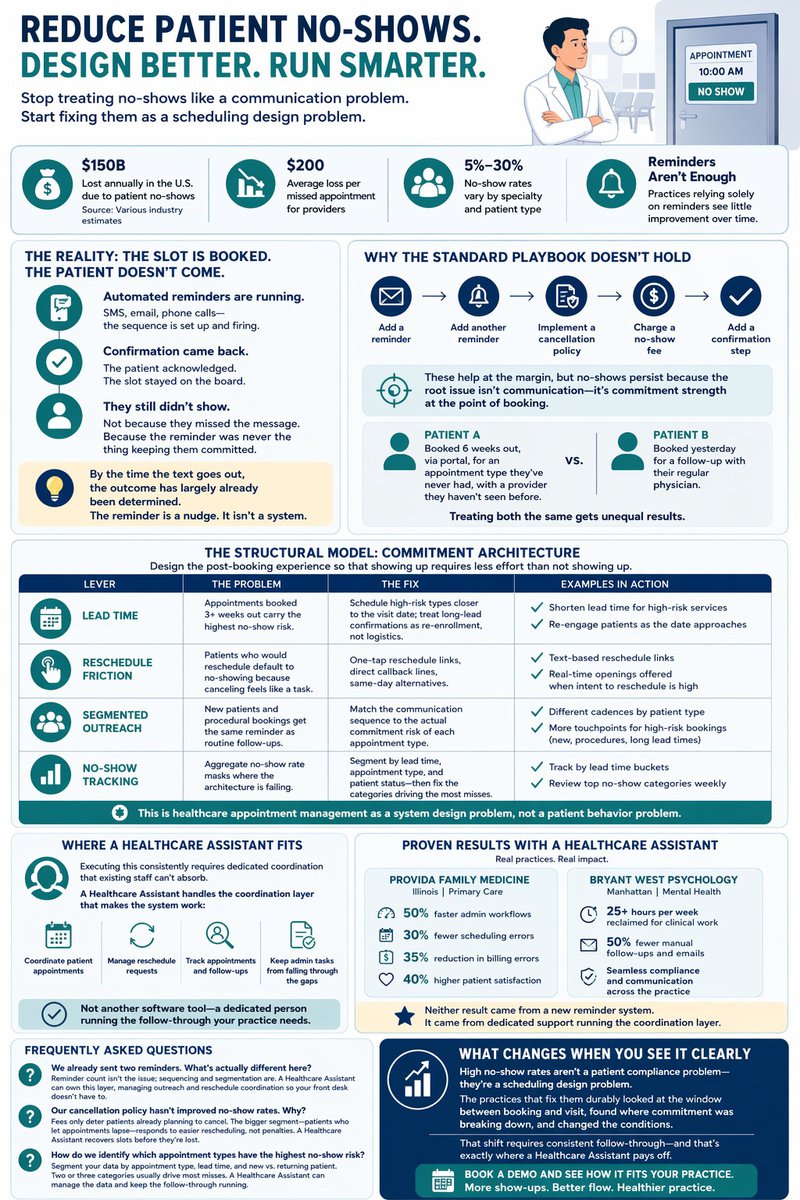
The Slot Is Booked. The Patient Doesn’t Come.
Your reminder went out. The patient confirmed. The slot stayed on the schedule. After 10 minutes had passed, the appointment time, the room was still empty.
This happens across practice types, patient demographics, and reminder systems, even the well-run ones. Here’s what that usually looks like:
- Automated reminders are running. SMS, email, phone calls, the sequence is set up and firing.
- Confirmation came back. The patient acknowledged. The slot stayed on the board.
- They still didn’t show. Not because they missed the message. Because the reminder was never the thing keeping them committed.
What’s actually happening: the conditions that make a patient follow through are set well before the reminder fires. By the time the text goes out, the outcome has largely already been determined. The reminder is a nudge. It isn’t a system.

Most no-show reduction strategies treat this as a communication problem. It isn’t. It’s a commitment architecture problem, and until practices treat it that way, no-show rates stay structurally embedded regardless of how many touchpoints are added. Learn more about affordable sales assistant.
Why the Standard Playbook Doesn’t Hold
The default response to high no-show rates follows a predictable sequence:
- Add a reminder
- Add another reminder
- Implement a cancellation policy
- Charge a no-show fee
- Add a confirmation step
Each of these seems reasonable. Some help at the margin. But practices that have run all of them still report persistent no-show rates in specific appointment types, time slots, or patient segments. That’s not a reminder problem. That’s a signal that the structural conditions haven’t changed.
The missing variable is commitment strength at the point of booking. Consider the difference:
- Patient A booked six weeks out, via a portal, for an appointment type they’ve never had, with a provider they haven’t seen before.
- Patient B booked yesterday for a follow-up with their regular physician.
Sending both the same two-day reminder treats unequal commitment as if it were equal, and predictably gets unequal results.
Reminder optimization without addressing that gap is symptom management. The real variable is what happens between “appointment booked” and “appointment day.”
How the Pattern Forms and Stays Hidden
No-show problems stay invisible because practices measure the wrong thing. A 12% aggregate no-show rate looks manageable, but segmented by lead time, appointment type, and patient history, it usually reveals a narrow slice of appointments driving the majority of misses. That slice gets averaged away.
The front desk adapts, and the problem normalizes:
- Gaps get filled reactively — recovery becomes the process instead of prevention.
- Overbooking quietly compensates — utilization looks fine, so no one investigates.
- The coordination cost stays hidden — absorbed by staff, never logged as a scheduling failure.
The reinforcement loop runs itself: the schedule looks full, the rate looks stable, and urgency disappears. The structural issue compounds beneath numbers that appear acceptable.
When It Becomes Undeniable
For most practices, there’s no single moment, just a slow accumulation until something forces the calculation. Usually it’s one of two things:
- A high-value service line starts bleeding. Procedures, diagnostics, specialist consults- these aren’t $75 primary care slots. At $400–$1,200 per missed appointment, with prep costs and blocked provider time, the revenue math becomes impossible to ignore.
- The front desk hits a ceiling. Reactive slot-filling was manageable at 150 appointments a week. At 300, it’s consuming two staff members and creating downstream scheduling errors. The workaround becomes the bottleneck.
At that point, the question finally shifts, from “how many reminders should we send” to “how are we designing the window between booking and visit?” That’s the right question. It’s just arriving later than it should.

The 5-Step No-Show Reduction System
Once a practice accepts that reminders alone won’t move the number, the fix comes down to five steps, run in sequence for every appointment:
- Reminder — send the first reminder based on lead time, not a fixed schedule. A visit booked six weeks out needs a different cadence than one booked yesterday.
- Confirmation — capture an active confirmation (tap, reply, call), not just a delivered message. Passive reminders don’t tell you if commitment actually held.
- Waitlist — the moment a slot shows risk of cancellation, a waitlist system should be ready to backfill it same-day, not after the slot goes empty.
- Follow-up — for high-risk appointment types (new patients, long lead times, procedural visits), add a live follow-up touch beyond the automated sequence.
- Tracking — segment no-show data by appointment type, lead time, and patient status. Aggregate rates hide the two or three categories actually driving your misses.
Practices that run all five steps as one connected system, not five separate tools, are the ones that see the rate actually move.
The Structural Model: Commitment Architecture
The core shift: no-show reduction is about designing the post-booking experience so that showing up requires less effort than not showing up. It comes down to four levers:
| Lever | The Problem | The Fix |
|---|---|---|
| Lead time | Appointments booked 3+ weeks out carry the highest no-show risk | Schedule high-risk types closer to the visit date; treat long-lead confirmations as re-enrollment, not logistics |
| Reschedule friction | Patients who would reschedule default to no-showing because canceling feels like a task | One-tap reschedule links, direct callback lines, same-day alternatives |
| Segmented outreach | New patients and procedural bookings get the same reminder as routine follow-ups | Match the communication sequence to the actual commitment risk of each appointment type |
| No-show tracking | Aggregate no-show rate masks where the architecture is failing | Segment by lead time, appointment type, and patient status, then fix the categories driving the most misses |
This is healthcare appointment management as a system design problem, not a patient behavior problem.
Where Wing’s Healthcare Assistant Fits
Executing this consistently is where most practices stall, not because the model is unclear, but because the follow-through requires dedicated coordination that existing staff can’t absorb.
Wing’s Healthcare Assistant handles exactly that layer: coordinating patient appointments, managing reschedule requests, and keeping admin tasks from falling through the gaps. It’s not another software tool; it’s a dedicated person running the follow-through that makes the system work.
Where Wing sits in the reminder-to-follow-up loop:
- Cadence design — 24/7 Scheduling VAs match reminder timing and frequency to each appointment’s actual commitment risk, not a one-size sequence
- Confirmation handling — 24/7 Scheduling VAs collect and log active confirmations, flagging non-responders for live follow-up
- Reschedule coordination — Patient Care Coordinators own the reschedule request end-to-end so canceling doesn’t default into a no-show
- Waitlist management — Patient Care Coordinators fill at-risk slots same-day instead of absorbing the loss
- Follow-up after a miss — Medical Call Center Specialists reach out post-no-show to rebook, rather than letting the slot disappear from tracking
- Data tracking — Healthcare Receptionists and Patient Care Coordinators maintain the segmented no-show data (by lead time, type, patient status) that most practices don’t have staff bandwidth to keep current
What This Looks Like in Practice
Two medical practices that made this shift with Wing’s Healthcare Assistant:
Provida Family Medicine — a growing primary care clinic in Illinois, was dealing with scheduling delays, billing bottlenecks, and data inconsistencies as patient volume climbed. After bringing on a Wing Healthcare Assistant:
- 50% faster admin workflows
- 30% fewer scheduling errors
- 35% reduction in billing errors
- 40% higher patient satisfaction
Bryant West Psychology — a Manhattan-based mental health practice, was spending 25+ hours a week on scheduling, billing, and documentation. With a HIPAA-trained Wing Healthcare VA:
- 25+ hours per week reclaimed for clinical work
- 50% fewer manual follow-ups and emails
- Seamless compliance and communication across the practice
Neither result came from a new reminder system. It came from having dedicated support running the coordination layer that keeps appointments from falling through.
Frequently Asked Questions
Most outpatient practices see no-show rates between 14% and 18%, though this varies by specialty — primary care tends to run lower (10–12%), while behavioral health runs higher (18–22%). A rate under 10% is generally considered strong; anything above 20% signals a scheduling or follow-through gap worth investigating. Wing’s 24/7 Scheduling VAs and Patient Care Coordinators help practices track their rate against these benchmarks and catch drift before it becomes a pattern.
They help at the margin, but reminders alone rarely move a practice’s underlying rate. The bigger driver is what happens between booking and the visit — lead time, how easy rescheduling is, and whether the outreach cadence matches the actual risk of that appointment type. Practices that add reminders without addressing those factors tend to see the same misses recur. Wing’s Medical Call Center Specialists run live follow-up calls for high-risk appointments where an automated reminder alone isn’t enough.
Reminder count isn’t the issue; sequencing and segmentation are. A new patient booked four weeks out needs a different cadence than a returning patient booked yesterday. Wing’s 24/7 Scheduling VAs can own this layer, managing outreach and reschedule coordination so your front desk doesn’t have to.
Fees only deter patients already planning to cancel. The bigger segment, patients who let appointments lapse without deciding either way, responds to easier rescheduling, not penalties. Wing’s Patient Care Coordinators handle reschedule coordination directly, recovering slots before they’re lost.
Segment your no-show data by appointment type, lead time, and new vs. returning patient. Two or three categories are usually driving the majority of misses. If your team lacks bandwidth to track this consistently, a Wing Healthcare Virtual Assistant can manage the data and keep the follow-through running.
What Changes When You See It Clearly
High no-show rates aren’t a patient compliance problem, they’re a scheduling design problem. The practices that fix them durably aren’t the ones that added more reminders. They’re the ones who looked at the window between booking and visit, found where commitment was breaking down, and changed the conditions.
That shift requires consistent follow-through, and that’s exactly where a Wing Healthcare Assistant pays off. From patient coordination to reschedule management, Wing gives your practice the operational capacity to run this system without overloading your team.
Book a demo with Wing and see how it fits your practice.

Dianne Florendo is a content writer who creates engaging SEO content about virtual assistants, outsourcing, and business productivity.