

Why 80% of recruiter time goes to work that doesn’t require a recruiter, and what it’s costing your firm. Why ATS upgrades, coordinator hires, and offshore VAs fix efficiency but never fix ownership. What separating the recruiting layer from the operational layer actually looks like. How Wing’s dedicated virtual assistants own the operational layer so your recruiters can focus on placements.
Most recruiters aren’t recruiting. They are coordinating, chasing, fixing, and updating. Actual recruiting happens in whatever time is left.
Research backs this up: recruiters spend roughly 80% of their working day on tasks that don’t require a recruiter, losing the equivalent of one full day per week to admin alone, according to Cornerstone OnDemand.
That is a full day every week not spent on the work that drives revenue: sourcing the right candidates, strengthening client relationships, and closing placements before a competitor does.
The industry’s response has been to make recruiters better at managing both by introducing more tools, tighter workflows, and time management training.
But efficiency is not the same as separation. The firms pulling ahead are not trying to make recruiters faster at doing two jobs. They are splitting the two jobs apart entirely and letting each one be done properly.
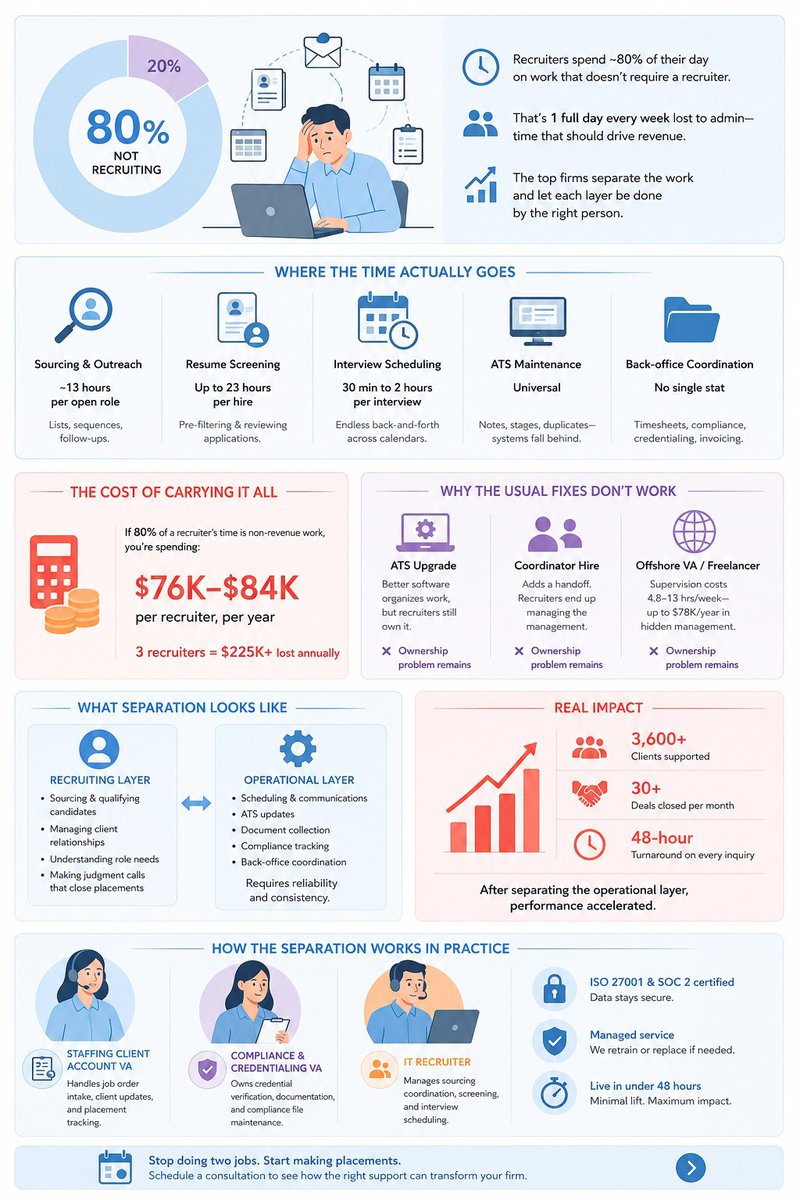

Where the Time Actually Goes
The 80% figure is striking. What sits behind it is more so.
Here is where recruiter time actually goes, broken down by task category:
- Sourcing & Outreach: ~13 hours per open role (RecruitingDaily)
Building prospect lists, sending templated sequences, following up on messages that require no judgment to send, but not at a recruiter’s desk. - Resume Screening: Up to 23 hours per hire (Shortlistd)
The majority is pre-filtering, reviewing applications against criteria that could be documented, systematized, and handed off without a single conversation. - Interview Scheduling: 30 minutes to 2 hours per interview (Crosschq)
Not because calendars are complicated, but because the coordination step has no dedicated owner. It bounces between recruiter, candidate, and hiring manager until someone forces a resolution. That someone is almost always the recruiter. - ATS Maintenance: No single stat, but universal
Notes fall behind, candidate stages go stale, and duplicate records multiply until the system becomes unreliable and recruiters stop trusting it. So they turn to shadow spreadsheets, which end up creating more work. - Back-office Coordination: Timesheets, compliance, credentialing, invoicing
In firms under $50 million in revenue, this lands on recruiting teams by default because there is no dedicated function to absorb it yet.
The Cost of Carrying It All
A recruiter earning $75,000 costs closer to $95,000 to $105,000 fully loaded. If 80% of that time goes to work that does not require recruiting judgment, you are spending between $76,000 and $84,000 a year on tasks that belong somewhere else. Three recruiters, and that number exceeds $225,000 annually.
Most firms are not aware that they are paying it. They just know their recruiters always seem busy and their pipelines never seem full enough.
Why the Usual Fixes Don’t Work
Most recruiting leaders have already tried to solve this, but based the solution on the wrong diagnosis.
The ATS Upgrade
Firms that invested heavily in Bullhorn, Greenhouse, and Lever upgrades expected the operational load to lighten. In most cases, it didn’t. Better software organized the work, but it didn’t decide who owned it.
Recruiters still updated the records, chased the missing information, and resolved the exceptions the system flagged, but couldn’t fix. The tool improved the infrastructure. The ownership problem remained exactly where it was.
The Coordinator Hire
Adding a recruiting coordinator seems like the logical next step. And it helps, up to a point. The breakdown comes at the handoff.
Coordinators need direction, context, and feedback to function. When that responsibility falls to the recruiter, as it almost always does, the recruiter hasn’t shed a job. They’ve taken on a management layer on top. The operational burden shifts in shape but not in weight.

The Offshore VA or Freelancer
The unit economics look compelling until the supervision cost surfaces. Research from AbroadWorks puts the management overhead of a direct offshore hire at between 4.8 and 13 hours per week.
At a conservative $150 per hour in recruiter time, that is up to $78,000 per year in recovered cost that never materializes, because it gets spent managing the solution instead. The recruiter is still doing two jobs. One of them is just called management now.
What All Three Fixes Have in Common
Each one addressed efficiency. None of them addressed ownership. And that is why the problem persists regardless of what gets added to the stack.
The firms that have actually moved the needle did not find a better way to manage the operational layer. They found someone to own it entirely, so their recruiters never had to think about it again.
What Separation Actually Looks Like
Separating the two layers is not a reorganization. It requires one decision: that the operational layer needs a dedicated owner who is not a recruiter.
In practice, the two layers look like this:
- The Recruiting Layer: Sourcing and qualifying candidates, managing client relationships, understanding what a role actually requires, and making the judgment calls that move a placement forward.
- The Operational Layer: Scheduling, ATS updates, candidate communications, document collection, compliance tracking, and back-office coordination. Work that requires reliability and consistency. Not recruiting judgment.
What Changes When Ownership is Clarified
The shift is faster than most firms expect.
Candidate follow-up happens within hours because someone’s primary job is to make sure it does. Interview scheduling stops competing with sourcing for the same hour. ATS records stay current because updating them is not the last item on a recruiter’s list at the end of a full day. Back-office steps stop backing up during growth spurts because they have a dedicated owner who is not also trying to fill reqs.
The outcomes are measurable. My Personal Mentors, a fast-scaling career consultancy, was managing thousands of client interactions with a small team. Missed follow-ups were eroding client trust just as sales were accelerating. Once a dedicated assistant took ownership of the operational layer, the firm closed 30+ deals per month, supported 3,600+ clients, and maintained a 48-hour turnaround on every inquiry.
The recruiting work did not change. The ownership of the layer underneath it did.
How the Separation Works in Practice
The operational layer doesn’t need a reorganization to find an owner. It needs one person whose entire job is to make sure it runs.
In practice, that looks like a dedicated assistant embedded directly in the firm’s existing tools and workflows. Not a coordinator who needs managing, or a freelancer who needs briefing every week. Someone matched to the firm’s specific ATS, VMS, and candidate workflows, trained before they start, and overseen by a managed service that handles performance, quality, and continuity on their end.
The recruiting team sets direction. They never manage the operational layer again.
That is exactly the model Wing provides:
- A Staffing Client Account VA handles job order intake, client status updates, and placement tracking. Nothing sits in an inbox waiting for a recruiter to action it.
- A Compliance and Credentialing VA owns credential verification, documentation tracking, and compliance file maintenance. Placements don’t stall on paperwork.
- An IT Recruiter handles candidate sourcing coordination, screening, and interview scheduling so the pipeline keeps moving without the senior recruiter managing the mechanics of it.
Wing is ISO 27001 compliant and SOC 2 certified, so candidate data and client information stay protected throughout. If something is not working, Wing retrains or replaces the assistant. The recruiting team doesn’t manage that process. Wing does. Most firms are live in under 48 hours.
Recruiters often spend significant time on interview scheduling, ATS updates, candidate follow-ups, documentation, and other coordination work. Wing can take ownership of these operational tasks through roles such as an HR Recruiter or Human Resources Virtual Assistant. Yes. A dedicated assistant can manage candidate coordination, interview scheduling, ATS updates, and follow-ups, allowing recruiters to focus on sourcing and placements. Wing provides managed recruiting support designed around these workflows. Wing can support job order intake, candidate screening and coordination, interview scheduling, documentation, and placement-related back-office work. A Staffing Client Account VA can also help keep client updates and placement tracking organized.Frequently Asked Questions
Successful Firms Aren’t Working Harder. They’re Working Smarter.
The operational layer isn’t going away. Candidates still need to be scheduled, records still need to be current, and documents still need to be collected. None of that changes.
What changes is who owns it. And when that question finally has a clear answer, recruiters stop doing two jobs and start doing one. The placements follow.
Schedule a consultation to see how Wing can support your firm.