

When coding accuracy slips, the default move is more staff, more training, more SOPs. None of that addresses the real gap: your specialty volume has outgrown what a generalist in-house team can handle. Outsourcing a medical coding specialist closes that gap, with certified coders, built-in compliance, and no fixed headcount. The result is cleaner claims, shorter AR cycles, and a coding function that actually scales with your practice.
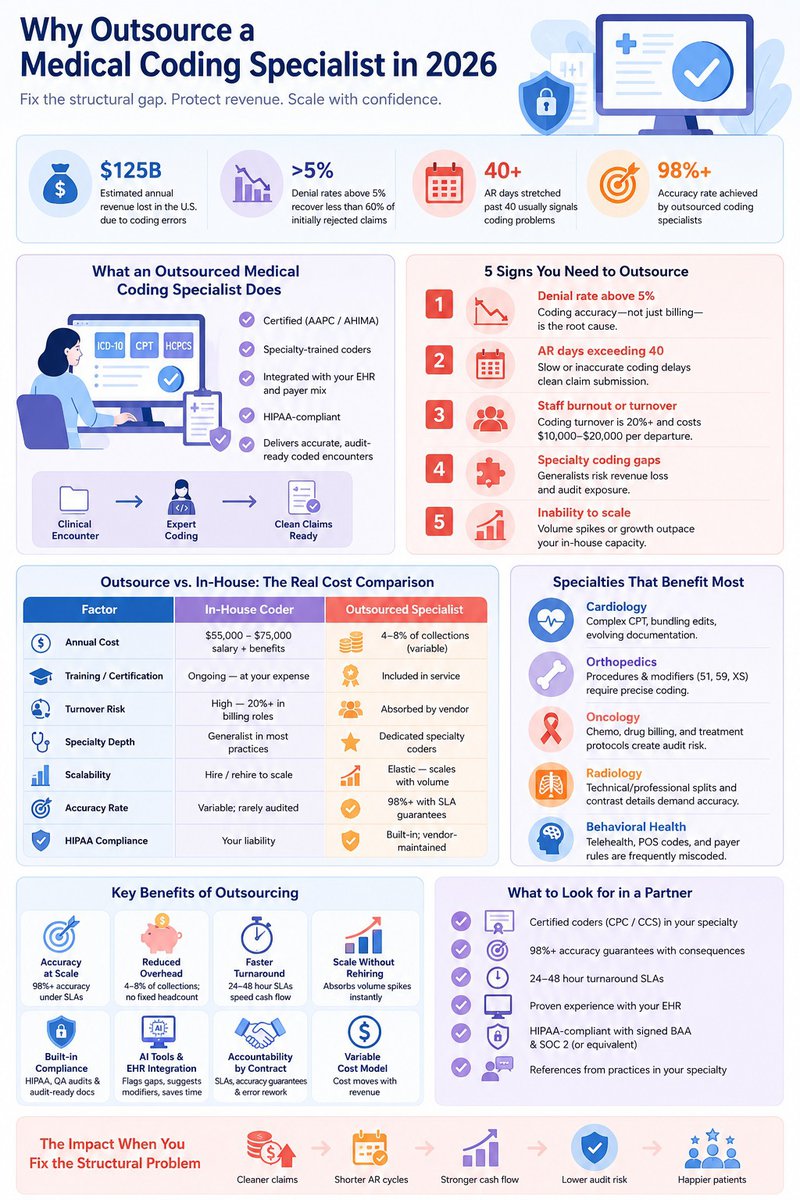
Medical coding errors cost the US healthcare system an estimated $125 billion in lost revenue annually. Practices with denial rates above 5% recover less than 60% of initially rejected claims, and most never identify coding accuracy as the root cause.
This guide breaks down why outsourcing a medical coding specialist is a structural fix, not just a cost-cutting move, covering the real cost comparison between in-house and outsourced coding, the specialties that benefit most, and what to look for in a partner.
If you’re evaluating whether outsourcing is the right call for your practice, Wing Assistant provides certified medical coding specialists who integrate directly with your existing EHR and billing workflow.
When Your Coding Process Becomes a Revenue Problem
Your denial rate is climbing. AR days are stretching past 40. And the coders on staff aren’t underperforming; they’re underwater.
The volume is there. The team isn’t keeping up. Here’s what that usually looks like in practice:
- Claims go out with documentation gaps
- Modifiers get missed on specialty encounters
- Payers push claims back, and the cycle repeats
The default response is to retrain, hire, or tighten SOPs. Those moves feel like progress. What they actually do is add cost and complexity to a system that’s already misaligned with the work it’s being asked to do.
The pattern most practices miss: in-house coding scales with headcount, but specialty volume doesn’t. That gap is where revenue leaks, quietly, consistently, and usually before anyone connects it to coding.

What an Outsourced Medical Coding Specialist Actually Does
An outsourced medical coding specialist is not a billing service. The distinction matters.
Medical billing handles downstream functions: claims submission, payment posting, and patient statements.
Medical coding is the upstream function—it translates clinical encounters into ICD-10, CPT, and HCPCS codes that determine what gets billed and whether it clears payer edits.
Outsourced coding specialists are:
- Certified through AAPC (CPC, COC) or AHIMA (CCS, CCS-P)
- Trained in specific specialties, not general practice
- Integrated directly into your EHR and payer mix
- Operating under HIPAA-compliant agreements
The output is coded encounters ready for claims, accurate, documented, and auditable.
When you outsource a medical coding specialist, you’re not handing off a task. You’re replacing a fixed-cost function with a variable, accountability-tied one. Learn more about appointment setting assistant services.
5 Signs Your Practice Needs to Outsource Medical Coding
Denial rate above 5%: Industry benchmark is under 5%. If you’re consistently above it, coding accuracy, not just billing, is a root cause.
AR days exceeding 40: When accounts receivable stretches past 40 days, the upstream problem is usually slow or inaccurate code assignment delaying clean claim submission.
Staff burnout or turnover: Medical coding turnover runs at 20%+ in many practices. Each departure costs $10,000–$20,000 in recruiting, onboarding, and lost productivity.
Specialty coding gaps: If your practice sees cardiology, orthopedics, oncology, or behavioral health volume, generalist coders will leave revenue on the table, or create audit exposure.
Inability to scale: Seasonal volume spikes, new provider hires, or service line expansions require coding capacity that in-house teams can’t absorb without rehiring.
Key Benefits of Outsourcing a Medical Coding Specialist
Accuracy at scale
- Certified coders operate at 98%+ accuracy rates under contractual SLAs
- In-house accuracy is rarely measured at the same standard—most practices don’t know their real rate until a payer audit surfaces it
Reduced overhead
- Burdened cost of an in-house coder typically exceeds $70,000/year
- Outsourced coding runs at 4–8% of collections—cost moves with revenue, not headcount
Faster turnaround
- 24–48 hour turnaround SLAs compress the coding-to-claims cycle
- Shorter cycle means faster cash flow and a smaller AR backlog
Scalability without rehiring
- New provider, new service line, seasonal spike—outsourced teams absorb it immediately
- No job posting, no onboarding lag
Built-in compliance
- HIPAA BAAs, internal QA audits, and audit-ready documentation included
- Compliance is embedded in the service, not managed separately by your team
AI tools and EHR integration
- Leading vendors use AI-assisted coding platforms inside your existing EHR
- Flags missing documentation, suggests modifiers, reduces manual review time

Outsource vs. In-House: The Real Cost Comparison
The following comparison reflects typical costs for a single FTE coder in a small-to-mid-sized US practice versus an outsourced engagement handling equivalent volume.
| Factor | In-House Coder | Outsourced Specialist |
|---|---|---|
| Annual Cost | $55,000–$75,000 salary + benefits | 4–8% of collections (variable) |
| Training / Cert | Ongoing—at your expense | Included in service |
| Turnover Risk | High—20%+ annual in billing roles | Absorbed by vendor |
| Specialty Depth | Generalist in most practices | Dedicated specialty coders |
| Scalability | Hire / rehire to scale | Elastic—scales with volume |
| Accuracy Rate | Variable; rarely audited | 98%+ with SLA guarantees |
| HIPAA Compliance | Your liability | Built-in; vendor-maintained |
The math tends to favor outsourcing once you factor in turnover costs, certification maintenance, and the opportunity cost of management time spent on a coding function that isn’t a core competency.
Specialties That Benefit Most from Outsourced Coding
Cardiology: High CPT complexity, frequent bundling edits, and evolving documentation requirements make generalist coding a liability.
Orthopedics: Fracture care, surgical procedures, and modifier usage (especially 51, 59, and XS) require coders with procedure-level fluency.
Oncology: Chemotherapy administration codes, drug billing, and treatment protocol documentation create audit risk without specialty-trained coders.
Radiology: High volume, technical and professional component splits, and contrast/non-contrast distinctions require consistent coding precision.
Behavioral Health: Telehealth parity laws, place-of-service codes, and payer-specific billing rules for mental health services are frequently miscoded by generalists.
What to Look for in an Outsourced Medical Coding Partner
Not every outsourcing vendor operates at the same level. The following criteria separate durable partners from transactional vendors.
Certifications: Look for CPC (AAPC) or CCS (AHIMA) credentials at the coder level, and verify that coders are certified in your specific specialty, not just general practice.
Accuracy guarantees: Contractual SLAs should specify accuracy rate commitments (98%+) and consequences for missing them.
Turnaround SLAs: 24–48 hour turnaround is standard. Anything longer creates cash flow drag equivalent to in-house bottlenecks.
EHR compatibility: Confirm the vendor has experience operating within your specific EHR platform. Integration friction is a common source of early-engagement problems.
HIPAA compliance: Require a signed BAA before any PHI is shared. Ask for evidence of SOC 2 certification or equivalent security posture.
Specialty expertise: Ask for references from practices in your specialty, not just general internal medicine or family practice.
How Practices Are Solving This with Wing Assistant
The administrative and coding burden isn’t unique to one specialty or practice size. Provida Family Medicine, a growing primary care clinic in Illinois, faced the same compounding problem: scheduling delays, billing bottlenecks, and data inconsistencies that were slowing down both operations and patient care.
After partnering with Wing Assistant for specialized healthcare administrative support, the results were measurable:
- 50% faster clinic admin workflows
- 35% reduction in billing errors
- 25% faster claims processing
- 40% higher patient satisfaction
“The recruitment process was absolutely wonderful. Everyone at Wing was knowledgeable and friendly.”
— Carlos Baltazar, Manager of Office Operations & HR
Wing’s healthcare assistants are trained in EHR workflows, billing coordination, and HIPAA compliance, and integrate directly into your existing systems. For practices evaluating whether to outsource a medical coding specialist, Wing provides a structured, accountable alternative to adding fixed headcount.
Most established outsourced medical coding specialist firms have documented experience with major EHR platforms. Before signing, request a structured pilot, 30 to 60 days on a defined encounter subset. Review the accuracy output and integration friction directly. A credible partner will welcome the evaluation period rather than resist it. Wing’s Coding Specialist and Medical Billing Specialist are trained to integrate directly into your existing EHR and billing workflow from day one. Reputable vendors include error-correction SLAs: rework at no charge and root-cause documentation on any claim that is denied due to coding. The contractual accountability structure is, in practice, stricter than what most in-house setups enforce. Wing’s Denials Management Specialist works alongside your coding function to catch and resolve claim rejections before they impact your AR cycle. Yes—and often more so than for large systems. Small practices carry the full burdened cost of a coder even when volume doesn’t justify a full-time role. Per-encounter or percentage-of-collections pricing models mean you pay for what you produce. Wing offers flexible support through its Healthcare Virtual Assistant, Prior Authorization Specialist, and Medical Administrative VA, giving smaller practices access to specialized roles without the overhead of full-time hires.FAQs
What Changes When You Fix the Structural Problem
Rising denial rates and AR drag are not primarily performance problems. They’re structural ones, the result of a fixed-cost, generalist function being asked to handle variable, specialty-level complexity. That mismatch compounds quietly until the numbers make it impossible to ignore.
Outsourcing a medical coding specialist doesn’t eliminate complexity. It puts the complexity in the hands of a function built to handle it: certified coders, audit-ready documentation, and a cost model that moves with your revenue rather than against it.
The role of practice leadership isn’t to manage coders. It’s to own the revenue integrity of the practice. Outsourcing the coding function is how you get back to that.
Ready to see what that looks like for your practice? Book a free demo with Wing Assistant and find out how quickly you can close the gap.

Dianne Florendo is a content writer who creates engaging SEO content about virtual assistants, outsourcing, and business productivity.