Most sales teams let reps handle their own follow-up alongside closing. The problem: HBR found leads contacted within an hour are 7x more likely to qualify, but 48% of salespeople never follow up at all, since reps’ capacity gets eaten by their existing book of business. The fix is a dedicated appointment setter (narrower scope than a full SDR) handling outreach, ICP qualification, and calendar booking at $1,500-$3,000/month, versus $45K-$65K/year in-house with a 60-90 day ramp. Result: consistent meeting volume without adding headcount, with show rate and qualified-meeting rate as the real signals of whether it’s working. That’s the role Wing’s Appointment Setter is built to fill.
If your sales pipeline has gaps, slow follow-up is usually the culprit. Leads go cold, demos don’t get booked, and your reps spend half their day on outreach instead of closing. A virtual appointment setter fixes that, not by adding headcount, but by making sure no qualified lead falls through the cracks.
This guide covers everything you need to know about virtual appointment setter services: what appointment setters do, how outsourced appointment setting compares to in-house, what it costs, how to measure it, and what to look for in an appointment setting company. If you’re actively evaluating your options, Wing Assistant offers fully managed appointment-setting support with trained, dedicated setters ready to plug into your sales workflow.
What Is a Virtual Appointment Setter?
A virtual appointment setter is a sales support professional who handles outbound outreach, SEO lead generation services, and meeting scheduling on behalf of your sales team. Their job is to move qualified prospects from first contact to a booked call, so your reps show up to conversations that are already warmed up.
A virtual appointment setter does the same work remotely, typically as part of a managed support service or outsourced SDR function.
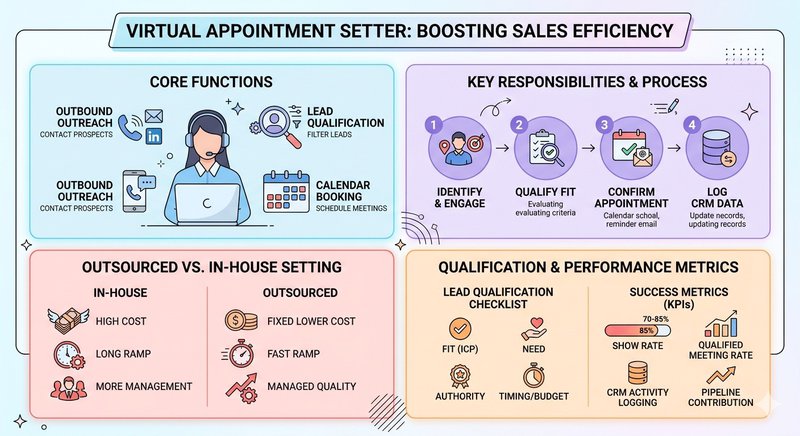
Core responsibilities include:
- Conducting outbound prospecting via phone, email, and LinkedIn
- Qualifying inbound and outbound lead generation services against your ICP criteria
- Booking discovery calls, demos, and consultations directly onto your sales calendar
- Sending confirmation emails and appointment reminders to reduce no-shows
- Logging activity and updating contact records in your CRM
- Re-engaging and rescheduling leads who cancel or go dark
What they’re not doing: closing deals, running demos, or writing proposals. That stays with your account executives and closers. The appointment setter’s job ends when the meeting is on the calendar. Learn more about dedicated medical billing assistant.

What Do Virtual Appointment Setter Services Include?
Appointment setting services typically cover the full top-of-funnel outreach cycle, from first contact through to a confirmed, qualified meeting. Depending on the provider and scope, services may include:
| Service Component | What It Covers |
|---|---|
| Outbound prospecting | Cold calls, email sequences, LinkedIn outreach |
| Lead qualification | ICP scoring, BANT/MEDDIC screening, discovery questions |
| Calendar management | Booking, confirmations, rescheduling, and no-show recovery |
| CRM management | Contact updates, activity logging, pipeline stage management |
| Follow-up sequences | Multi-touch outreach cadences pre- and post-meeting |
| Reporting | Dials, connect rates, booked meetings, and show rates |
At Wing, our appointment setting support includes all of the above — with dedicated setters who learn your product, your ICP, and your preferred outreach approach before going live.
Appointment Setter vs. SDR: What’s the Difference?
This is one of the most common questions sales managers ask when evaluating outsourced options.
| Appointment Setter | SDR (Sales Development Rep) | |
|---|---|---|
| Primary focus | Booking qualified meetings | Pipeline development and prospecting strategy |
| Scope | Narrower — executes outreach and scheduling | Broader — builds sequences, manages cadences, contributes to messaging |
| Typical seniority | Mid-level support role | Entry-to-mid sales role |
| Cost | Lower — especially outsourced | Higher — full-time salary + benefits + ramp time |
| Best for | Businesses that need a consistent meeting volume | Businesses building a full outbound sales motion |
| Ramp time | Days to weeks | 60–90 days |
For many small and mid-sized businesses, a virtual appointment setter delivers the same pipeline-filling output as an SDR at a fraction of the cost, without the risk of a long ramp period or a bad hire. Learn more about remote executive assistant services.
In-House vs. Outsourced Appointment Setting
Building an internal appointment setting function works well at scale. Getting there, however, usually requires more resources than most businesses have available early on.
In-house appointment setter:
- Full-time hire at $40,000–$60,000+ per year (before benefits, tools, and management overhead)
- 60–90 day ramp before they’re fully productive
- Requires supervision, coaching, and performance management
- Single point of failure if they leave
Outsourced appointment setting:
- Fixed monthly rate — typically 60–70% less than a full-time equivalent
- Trained and ready to start within days
- Managed quality assurance built in
- Scales up or down based on pipeline demand
Outsourced appointment setting makes the most sense for businesses that need consistent meeting volume but aren’t ready to build a full SDR team. It also works well as a bridge while you’re hiring, or as a permanent function for lean sales organizations. Learn more about best sales assistant.

Why Slow Follow-Up Is Killing Your Pipeline
The data on follow-up timing is clear: the window between a lead’s first signal and their decision to engage elsewhere is short.
A Harvard Business Review study found that companies responding to leads within an hour are 7 times more likely to qualify that lead than those who wait even 60 minutes longer. Yet 48% of salespeople never follow up with a prospect at all.
The problem isn’t usually intent, it’s capacity. When your reps are managing a full book of business, follow-up is the first thing to slip. A dedicated appointment setter eliminates the gap by maintaining structured outreach cadences regardless of what else is happening in the pipeline. Learn more about virtual store management assistant.
Common signs your team needs appointment-setting support:
- Leads go cold before a call is ever scheduled
- Your reps are spending significant time on scheduling and outreach instead of selling
- No-show rates are high because confirmations aren’t being sent consistently
- CRM data is incomplete because nobody has time to update it
- Sales cycles are longer than they should be because meetings take too long to get on the calendar. Hire sales assistant
Lead Qualification: What Good Appointment Setting Looks Like
A strong appointment setter isn’t just booking meetings — they’re filtering for fit. Unqualified meetings waste your closers’ time as much as no meetings at all.
A good qualification workflow typically includes:
1. ICP alignment — Does the prospect match your target company profile? (Industry, company size, revenue, geography, tech stack)
2. Need discovery — Is there a pain point your product solves? Is it active or latent?
3. Timing and budget — Is there a buying timeline? Is the budget allocated or available?
4. Decision-making authority — Are you talking to someone who can say yes, or who needs to escalate?
Setters use qualification frameworks like BANT (Budget, Authority, Need, Timeline) or MEDDIC, depending on the complexity of your sale. The goal is to ensure every meeting that lands on your calendar is worth your closer’s time.
CRM and Pipeline Management
A virtual appointment setter doubles as a CRM operations resource. Keeping your pipeline data clean isn’t glamorous, but it’s critical for forecasting, follow-up, and attribution.
Typical CRM tasks handled by appointment setters:
- Creating and updating contact and company records
- Logging call notes, email activity, and meeting outcomes
- Moving prospects through pipeline stages after each touchpoint
- Flagging stale leads for re-engagement or disqualification
- Pulling lists for outbound campaigns based on CRM filters
Wing setters are trained in HubSpot, Salesforce, Zoho, and other major CRMs, and can adapt to your existing setup without requiring a process overhaul.
Tools Appointment Setters Use
A capable appointment setter should be comfortable with the tools your sales team already uses. Standard tool categories include:
Scheduling & calendar: Calendly, Google Calendar, Outlook Calendar, HubSpot Meetings
CRM platforms: HubSpot, Salesforce, Zoho CRM, Pipedrive, GoHighLevel
Outreach & sequencing: Outreach.io, Salesloft, Apollo, Instantly, Lemlist
Communication: Zoom, Google Meet, Slack, Loom (for async follow-ups)
Prospecting & data: Apollo, LinkedIn Sales Navigator, ZoomInfo, Hunter.io
Wing integrates seamlessly with this stack and can be added to your existing workflows without disrupting what’s already working.
Appointment Setting KPIs: How to Measure Performance
Vague metrics lead to vague accountability. These are the KPIs that matter for appointment setting:
| KPI | What It Measures | Healthy Benchmark |
|---|---|---|
| Dials per day | Outbound activity volume | 50–80 (cold calling) |
| Connect rate | % of dials that reach a live person | 8–15% |
| Meeting booked rate | % of connects that convert to a booked meeting | 10–20% |
| Show rate | % of booked meetings that actually happen | 70–85% |
| Qualified meeting rate | % of meetings that advance past first call | 50–70% |
| Pipeline contribution | Revenue attributed to setter-sourced meetings | Varies by ACV |
If you’re just starting out, prioritize show rate and qualified meeting rate, these tell you whether the setter is booking real opportunities, not just filling a calendar with low-quality meetings, hire a dedicated cold calling assistant.
B2B Appointment Setting: Industry Use Cases
Appointment setting is most valuable in B2B sales environments where deals require a human conversation to move forward. Here’s how different industries use it:
SaaS and technology: Booking product demos and trial conversion calls. Works well for both inbound demo requests and outbound prospecting into target accounts.
Professional services (consulting, legal, finance): Scheduling discovery calls and new client intake consultations. Setters handle first contact so advisors can focus entirely on high-value client conversations.
Healthcare and wellness: Coordinating patient consultations, insurance verifications, and provider introductions. Particularly useful for practices scaling their new patient pipeline.
Real estate: Top real estate virtual assistant handles booking property tours, investor meetings, and buyer/seller consultations. High-volume outreach for lead lists, with tight scheduling coordination across multiple agents.
Insurance and financial services: Scheduling policyholder reviews, new client consultations, and referral meetings. Compliance-aware outreach cadences are standard.
Staffing and recruitment: Coordinating candidate screenings, client intake calls, and placement follow-ups.
In all of these contexts, the value is the same: a dedicated resource keeping your calendar full so your producers don’t have to chase their own leads.
How Businesses Scale Appointment Setting Without Building a Full SDR Team
Scaling the pipeline doesn’t always mean hiring more salespeople. For many businesses, the highest-leverage move is increasing the volume and quality of meetings getting booked, not adding closers who don’t have enough to work.
The typical scaling path looks like this:
- Start with one appointment setter focused on a single target segment or outreach channel
- Establish baseline metrics — dials, connect rates, meetings booked, show rates
- Refine messaging and qualification criteria based on which meetings convert
- Add capacity by scaling hours or adding a second setter once the playbook is proven
With SDR assistant and outsourced appointment setting, this scaling happens without the hiring lag, onboarding cost, or management overhead of adding full-time headcount. You pay for results, adjust scope as needed, and maintain quality through a managed provider relationship.
How Much Do Appointment Setting Services Cost?
Costs vary based on model, scope, and provider type.
| Model | Typical Cost | Best For |
|---|---|---|
| In-house full-time | $45,000–$65,000/year + benefits + tools | Businesses with established outbound programs |
| Freelance appointment setter | $15–$30/hour | Low-volume, project-based needs |
| Outsourced service (flat-rate managed) | $1,500–$3,000+/month | Growing teams wanting consistent, managed support |
| Per-appointment model | $50–$150 per booked meeting | Performance-based arrangements |
Wing uses a flat-rate pricing model — one predictable monthly rate, no per-appointment fees, no hidden costs. You know exactly what you’re paying and what you’re getting.
Is Outsourced Appointment Setting Worth It?
For most growing B2B businesses, yes, with one condition: the right qualification criteria and handoff process need to be defined upfront.
Outsourced appointment setting delivers clear ROI when:
- Your reps are spending significant time on top-of-funnel activities instead of closing
- You have a defined ICP and proven offer, but not enough meeting volume
- You need to test a new market or segment without committing to a full hire
- Your current follow-up process is inconsistent or reactive
It’s less effective when:
- Your ICP, messaging, or offer is still being figured out
- There’s no sales infrastructure (CRM, tracking, closing capacity) to receive the meetings
- The sales cycle requires deep technical knowledge; the setter can’t develop quickly
If you’re in a position where a better pipeline would directly translate to more revenue, outsourced appointment setting is almost always worth evaluating seriously.
Work with Wing’s Appointment Setters
Wing provides fully managed appointment setting support for B2B businesses that need a consistent flow of qualified meetings without building an in-house SDR team.
Our setters are trained in outbound sales, lead qualification, and CRM management. They work within your existing tools and workflows, follow your qualification criteria, and represent your business professionally at every touchpoint.
Book a free consultation with Wing to talk through your current pipeline challenges and see whether our appointment setting services are the right fit for your sales motion.
Frequently Asked Questions
An appointment setter handles outbound outreach, lead generation and appointment setting services, and meeting scheduling on behalf of your sales team. Their core deliverable is a booked, confirmed meeting with a qualified prospect, so account executives can focus on closing. Wing’s Appointment Setter assistants are trained in outbound sales, ICP qualification, and CRM management, and can be up and running within days.
Appointment setting services are managed or outsourced offerings where a provider supplies trained appointment setters who work on behalf of your company. Services typically include outbound prospecting, lead generation services, calendar management, CRM updates, and follow-up sequences. Wing also offers adjacent roles, like a Sales Development Representative, Lead Generation VA, or Outbound Calling Agent, depending on how much of your top-of-funnel you need covered.
Costs range from $1,500 to $3,000+ per month for a managed outsourced service, depending on scope and hours. In-house appointment setters cost $45,000–$65,000/year when you factor in salary, benefits, and tools. Outsourced models typically run 60–70% less than a comparable full-time hire. Wing uses flat-rate pricing with no hidden fees; you know exactly what you’re paying each month.
For most B2B businesses with a defined ICP and closing capacity, yes. The key metric is whether booked meetings translate to closed revenue. If your reps are consistently closing the meetings they get and you just need more of them, outsourced appointment setting is one of the highest-leverage investments in your sales stack. Wing’s Appointment Setter and SDR roles are built specifically for businesses that want pipeline results without the overhead of a full-time hire.
An SDR (Sales Development Representative) typically owns the full top-of-funnel function, building sequences, refining messaging, and managing outreach strategy. An appointment setter is more execution-focused: outreach, qualification, and booking. Appointment setters are faster to ramp, lower-cost, and well-suited for businesses that don’t yet need a full SDR function. Wing offers both: a dedicated Appointment Setter for meeting volume, or a full Sales Development Representative if you need someone owning the broader prospecting motion.
Common tools include HubSpot, Salesforce, or Pipedrive for CRM; Calendly or Google Calendar for scheduling; Apollo, LinkedIn Sales Navigator, or ZoomInfo for prospecting; and Outreach or Salesloft for sequencing. Wing also offers a CRM & Automation Specialist and a CRM Data Entry Assistant if you need dedicated support keeping your pipeline data clean alongside your appointment setter.
Track show rate, qualified meeting rate, and pipeline contribution. A strong setter should be delivering a 70–85% show rate and booking meetings that advance through your pipeline at a healthy rate. Volume metrics like dials and connect rate matter, but conversion quality is a better indicator of fit and effectiveness. Wing provides ongoing performance visibility so you’re never left guessing whether your setter is delivering.

Dianne Florendo is a content writer who creates engaging SEO content about virtual assistants, outsourcing, and business productivity.