

The standard move is hiring a front desk employee, training them, and hoping they stay. The problem is the model: fixed hours, single point of failure, gone at 5 PM. A healthcare virtual receptionist extends coverage without extending payroll, remote, HIPAA-trained, working inside your existing systems. Calls get answered, schedules stay full, and you’re not rebuilding the front desk every time someone quits.
Wing at a Glance: HIPAA-Compliant, SOC 2-Certified, Fully Managed. Wing’s healthcare virtual receptionists come with a signed Business Associate Agreement, documented PHI handling training, and encrypted communication as standard, not an add-on. Wing operates under SOC 2 and ISO 27001 certification, and every assistant is a dedicated, managed hire (not a shared agent pool), trained specifically on your EHR and scheduling logic before they take a single call.
Research from Accenture found that 68% of patients have switched healthcare providers due to poor communication, and most of those breakdowns start at the front desk.
A virtual receptionist, an answering service, and an AI receptionist solve different problems. A virtual receptionist is a dedicated remote employee trained on your practice’s systems, scheduling logic, and providers, handling calls, intake, and scheduling as a continuous part of your team.
An answering service is a shared, message-taking resource that answers on your behalf but typically has no practice-specific context or scheduling access. An AI receptionist is an automated voice or chat system that handles simple, repeatable interactions (basic scheduling, FAQs) without a live person, at the lowest cost and lowest judgment ceiling.
Most medical offices land on a virtual receptionist when calls require context, insurance questions, triage, provider-specific scheduling — and reach for an answering service or AI layer only for pure overflow.
This guide walks through virtual receptionist services, what a virtual receptionist for a medical office actually does, how the costs compare to in-house hiring and to answering services and AI receptionists, what HIPAA compliance requires from any provider you consider, and how to get set up without disrupting current operations.
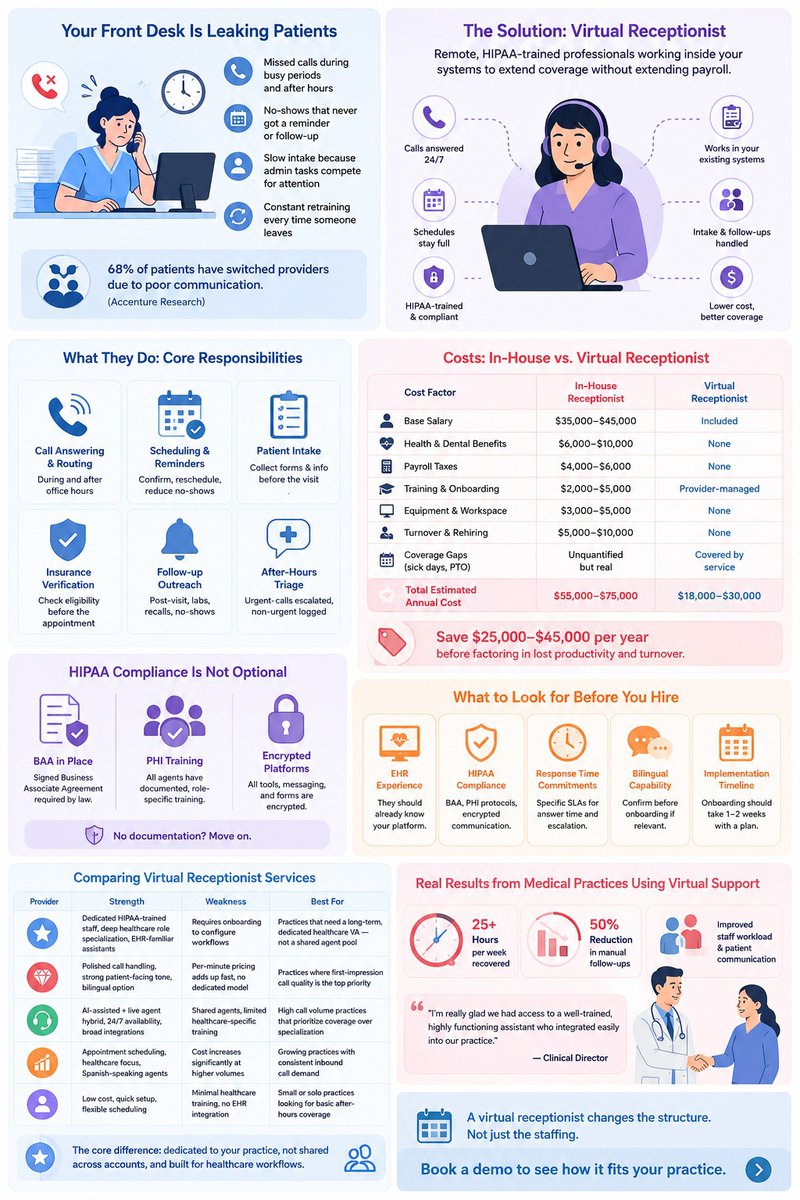
Your Front Desk Is Leaking Patients
Most front desks aren’t understaffed; they’re structurally overloaded.
One person. Phones, check-ins, insurance questions, scheduling, follow-ups, all at once. When volume spikes, or someone calls in sick, the first thing that fails is call answering.
The gaps this creates are predictable:
- Missed calls during busy periods and after hours
- No-shows that never got a reminder or follow-up
- Slow intake because admin tasks compete for the same attention
- Constant retraining every time someone leaves
Patients don’t wait. If they can’t get through, they move on. Hire a virtual receptionist.

What a Virtual Receptionist for a Medical Office Actually Does
A virtual medical receptionist is a remote professional trained to handle front desk operations, calls, scheduling, intake, insurance, and follow-ups, inside your existing systems.
They’re not a generic answering service. They know your providers, your scheduling logic, and when to escalate.
What they cover:
- Answering and routing calls during and after office hours
- Scheduling, confirming, and rescheduling appointments
- Collecting intake forms and patient information before the visit
- Verifying insurance before the appointment, not at check-in
- Sending reminders and following up on no-shows
- Triaging urgent after-hours calls to the right contact
Same functions as an in-house receptionist. Different model.
Core Responsibilities
- Appointment scheduling and reminders. Incoming scheduling requests are handled in real time. Automated reminders reduce no-show rates, which typically run 15–30% in primary care without active follow-up.
- Patient intake. Pre-visit forms, insurance information, and referral documentation can be collected before the patient arrives, cutting in-office wait times.
- Insurance verification. Eligibility checks happen before the appointment, reducing claim denials and front-desk scrambles at check-in.
- 24/7 call answering. After-hours calls get a live or AI-assisted response instead of voicemail. Urgent calls are triaged and escalated. Non-urgent requests are logged for next-day follow-up.
- Follow-up outreach. Post-visit instructions, lab result notifications, and recall reminders can be handled without pulling clinical staff into administrative tasks. Learn more about medical virtual assistant.
What This Costs Compared to In-House Staff
Most practices underestimate what a front desk employee actually costs. The salary is visible. Everything attached to it usually isn’t.
| Cost Factor | In-House Receptionist | Virtual Receptionist |
|---|---|---|
| Base Salary | $35,000–$45,000 | Included |
| Health & Dental Benefits | $6,000–$10,000 | None |
| Payroll Taxes | $4,000–$6,000 | None |
| Training & Onboarding | $2,000–$5,000 | Provider-managed |
| Equipment & Workspace | $3,000–$5,000 | None |
| Turnover & Rehiring | $5,000–$10,000 | None |
| Coverage Gaps (sick days, PTO) | Unquantified but real | Covered by service |
| Total Estimated Annual Cost | $55,000–$75,000 | $18,000–$30,000 |
The delta is $25,000–$45,000 per year, before you account for the productivity lost every time someone leaves, and you start over.
Virtual Receptionist vs. Answering Service vs. In-House Front Desk vs. AI Receptionist
Cost isn’t the only variable — scope and compliance shift just as much across these four models.
| Factor | In-House Front Desk | Answering Service | AI Receptionist | Virtual Receptionist (Wing) |
|---|---|---|---|---|
| Typical annual cost | $55,000–$75,000 | ~$3,600–$9,600 ($300–$800/mo) | ~$1,800–$6,000 ($150–$500/mo) | $18,000–$30,000 |
| Scope | Full front desk: scheduling, intake, insurance, follow-up | Message-taking and basic call routing; limited scheduling access | Automated scheduling and FAQs for simple, repeatable requests | Full front desk: scheduling, intake, insurance verification, escalation |
| Practice-specific context | Full (on-site, trained on your workflows) | Minimal — typically a shared agent pool with a script | None beyond configured rules | Full — dedicated assistant trained on your EHR and providers |
| HIPAA compliance | Owned internally, dependent on practice’s own protocols | Varies by vendor; BAA coverage often costs extra | Varies widely; many platforms lack a signed BAA or healthcare-specific training | Signed BAA, PHI training, and encrypted platforms included as standard |
| Best for | Practices with steady in-person volume and budget for full-time staff | Low-volume after-hours or overflow coverage | High call volume, simple/repeatable interactions | Practices that need full-scope coverage without the cost or turnover of a full-time hire |
The pattern: answering services and AI receptionists are cheaper per month, but they hand back less — no scheduling judgment, inconsistent HIPAA coverage, and no continuity across calls. A virtual receptionist costs more than either but replaces the in-house role outright rather than patching around it.
HIPAA Compliance Is Not Optional
Any service handling patient calls, intake, or scheduling is handling protected health information. HIPAA compliance isn’t optional, and it’s not something to verify after onboarding.
Before you commit to any provider, get written confirmation on these three things:
- BAA in place — A signed Business Associate Agreement is required by law before any PHI changes hands.
- PHI training for all agents — Company policy isn’t enough. Every agent handling patient data needs documented, role-specific HIPAA training.
- Encrypted platforms across the board — Scheduling tools, messaging platforms, intake forms, all of it needs to run on encrypted infrastructure.
No documentation? Move on.
Wing’s HIPAA-Compliant Virtual Assistant meets all three requirements as standard, not as an upgrade.

What to Look for Before You Hire
Five things to confirm before you hire a virtual medical receptionist:
- EHR experience — They should already know your platform. Training a virtual receptionist on your EHR from scratch defeats part of the purpose.
- HIPAA compliance — Signed BAA, PHI handling protocols, encrypted communication. All three. No exceptions.
- Response time commitments — Ask for specific SLAs. Answer time, escalation path, after-hours handling. Vague availability guarantees aren’t enough.
- Bilingual capability — Relevant if your patient base is diverse. Confirm before onboarding, not during.
- Implementation timeline — Onboarding should take one to two weeks with a defined process. Open-ended setup timelines are a red flag.
If a provider hesitates on any of these, keep looking.
Comparing Virtual Receptionist Services for Medical Offices
Five providers worth evaluating, and where each one fits.
| Provider | Strength | Weakness | Best For |
|---|---|---|---|
| Wing Assistant | Dedicated HIPAA-trained staff, deep healthcare role specialization, EHR-familiar assistants | Requires an onboarding period to configure workflows | Practices that need a long-term, dedicated healthcare VA — not a shared agent pool |
| Ruby Receptionists | Polished call handling, strong patient-facing tone, bilingual option | Per-minute pricing adds up fast, no dedicated model | Practices where first-impression call quality is the top priority |
| Smith.ai | AI-assisted + live agent hybrid, 24/7 availability, broad integrations | Shared agents, limited healthcare-specific training | High call volume practices that prioritize coverage over specialization |
| Nexa | Appointment scheduling, healthcare focus, Spanish-speaking agents | Cost increases significantly at higher volumes | Growing practices with consistent inbound call demand |
| PATLive | Low cost, quick setup, flexible scheduling | Minimal healthcare training, no EHR integration | Small or solo practices looking for basic after-hours coverage |
The core difference with Wing: assistants are dedicated to your practice, not shared across accounts, and healthcare roles are built around specific clinical and administrative workflows, not general call handling.
Real Results from Medical Practices Using Wing
Bryant West Psychology needed HIPAA-trained support for scheduling, insurance billing, and compliance tracking. Their Wing assistant, Ed, had seven years of medical sector experience and integrated directly into existing clinic operations.
Results:
- 25+ hours per week recovered
- 50% reduction in manual follow-ups
- Measurable improvement in staff workload and communication
“I’m really glad Wing was available to assist me with a well-trained, highly functioning assistant who integrated easily into our practice.” — Stephen Schneider, Clinical Director
The underlying problem: administrative load outpacing the capacity of in-house staff. Virtual support didn’t change the clinical model. It cleared the operational drag around it.
It depends entirely on the provider, not the job title. A HIPAA-compliant virtual receptionist requires a signed Business Associate Agreement, documented PHI-handling training for every agent, and encrypted scheduling and communication platforms. Wing’s healthcare virtual receptionists meet all three as standard. Always ask for documentation before onboarding, “HIPAA-aware” or “HIPAA-trained” marketing language without a signed BAA isn’t compliance. Yes, when they’re trained on your specific platform before they start. Wing’s virtual receptionists work directly inside major EHR systems to book, confirm, and reschedule appointments, update patient records, and flag scheduling conflicts, the same access an in-house receptionist would have, under the same access controls and audit logging your compliance program already requires. An answering service typically takes messages using a shared agent pool and a script, with limited or no access to your actual scheduling system. A virtual receptionist is a dedicated employee trained on your practice’s providers, scheduling logic, and EHR, who can act on calls in real time, booking appointments, verifying insurance, and following up, rather than just relaying a message for someone else to handle later. They should, before they start, not after. Wing’s Healthcare Receptionist and Medical Administrative VA are trained on major EHR platforms. Ask specifically which systems they’ve worked in and whether your platform is on that list. Yes. Beyond call answering and scheduling, Wing offers specialized roles, including a Medical Insurance Verification Specialist and Medical Billing Specialist, both trained for the specific compliance and accuracy requirements of medical billing workflows. Always verify. Wing’s HIPAA-Compliant Virtual Assistant comes with a signed BAA, PHI handling training, and secure communication protocols built in. Don’t assume compliance; ask for documentation before onboarding begins.Frequently Asked Questions
The Real Problem Was Never the Headcount
The front desk doesn’t fail because of bad staff. It fails because the model asks too much of too few people and breaks the moment anything goes sideways.
A virtual receptionist changes the structure, not just the staffing. Calls get answered after hours. Intake runs before the patient arrives. No-shows get followed up. And none of it depends on whether one person showed up that morning.
That’s not a personnel upgrade. It’s a structural fix.
Book a demo with Wing Assistant to see how it fits your practice.

Dianne Florendo is a content writer who creates engaging SEO content about virtual assistants, outsourcing, and business productivity.