

When the schedule gets busy, admin tasks get absorbed by whoever has a free moment, which is rarely the same person twice. The result: inconsistent follow-up, no-shows that weren’t caught in time, and billing that piles up at the end of the week. A chiropractic virtual assistant takes ownership of those functions specifically, not as extra help, but as the person accountable for them. Retention tightens. Billing clears faster. The front desk stops firefighting.
Chiropractic practices lose more revenue to admin gaps than to patient shortages, missed follow-ups, stalled insurance verification, and front-desk overload that compounds quietly until it shows up in retention and cash flow.
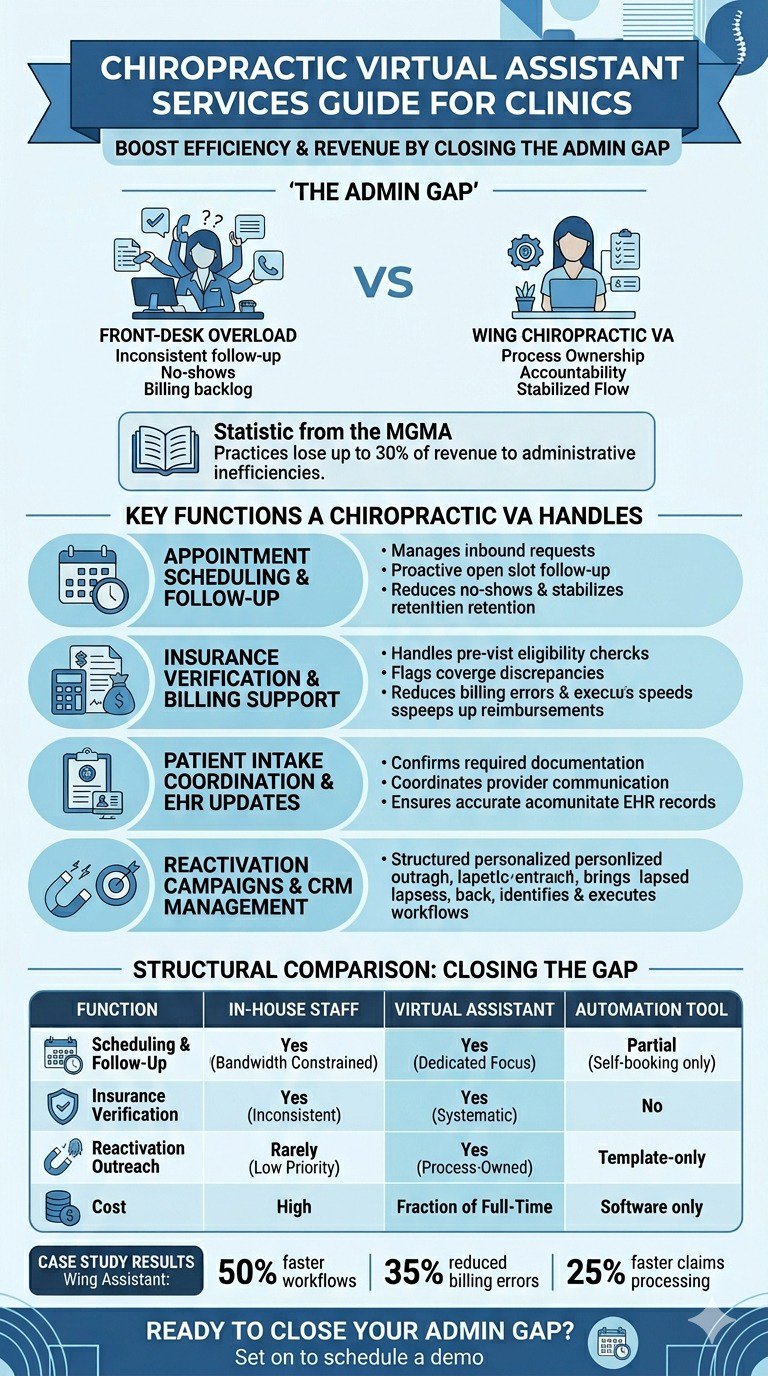
According to the Medical Group Management Association, practices lose up to 30% of revenue to administrative inefficiencies. For lean chiropractic teams, it compounds faster.
This guide covers where the gap forms, why hiring doesn’t fix it, and how Wing Assistant has helped healthcare practices cut billing errors through structured VA support, not more headcount.
The Admin Load That Stalls Patient Flow
Most chiropractic clinics don’t lose revenue from a shortage of patients. They lose it from what happens between appointments, or more precisely, what doesn’t happen.

Here’s what that looks like in practice:
- A new patient completes their intake, but doesn’t hear back for two days
- A recurring patient misses their Thursday slot and receives no follow-up until they call in themselves
- Insurance verification sits in a queue while the front desk handles check-ins
- Billing notes accumulate because there’s no dedicated window to process them
None of these is catastrophic on its own. Stacked across a week, they translate to open slots, delayed reimbursements, and patients who quietly stop booking.
The problem isn’t workload. It’s that these tasks don’t have a clear owner, so they get handled when there’s time, which means they often don’t get handled at all.
That’s the gap a chiropractic virtual assistant is built to close. Learn more about best virtual assistant.
Why Hiring More Front-Desk Staff Doesn’t Fix It
The instinctive response to admin overload is headcount. Add a second receptionist. Cross-train the billing coordinator. Ask the office manager to absorb the gaps.
It seems rational. More people should cover more tasks. But it breaks down quickly:
- A full-time front-desk hire runs $35,000–$55,000 annually before benefits and training time
- The bottleneck shifts rather than disappears, because the issue isn’t the number of hands, it’s who owns what
- Without clear ownership, tasks get absorbed by whoever has capacity at the moment
- That inconsistency is what erodes patient retention over time
Automation tools help at the edges. Reminders reduce no-shows. Self-booking handles simple scheduling. But automation doesn’t manage exceptions, complex insurance questions, treatment plan coordination, or the kind of personalized outreach that brings a lapsed patient back after three months of silence.
That’s the gap in-house staff and software both leave open:
- In-house staff: high cost, bandwidth-constrained, inconsistent on low-priority tasks
- Automation: scalable, but no judgment and no follow-through on exceptions
- Chiropractic virtual assistant: structured process ownership at a fraction of full-time cost
The problem isn’t that your team isn’t working hard enough. It’s that the work doesn’t have the right structure around it. Learn more about amazon seller assistant pricing.
How the Admin Gap Forms Over Time
The breaking point is rarely a single event. It’s a convergence — usually three to six months after a growth threshold the practice assumed it had already absorbed.
Here’s what it looks like:
- Front-desk staff shift from proactive to reactive
- Scheduling holds get missed until a patient calls
- Billing backlogs appear and keep growing
- A reactivation campaign sits on the to-do list for weeks because no one has bandwidth to run it
It feels like a busy stretch. It’s actually a structural failure.
The inflection point usually surfaces as a staffing conversation, someone quits, performance slips, or the owner realizes they’ve been personally holding the system together. But that’s the symptom. The condition is that task volume outpaced process design, and the gap got filled by whoever was available rather than whoever owned it.
From there, clinics go one of two directions, overinvest in headcount and software, or push through and hope it corrects. Neither works. The tasks still don’t have a defined owner. The next growth threshold hits the same wall. Learn more about best scribe company.
When the System Hits a Hard Limit
The breaking point is rarely a single event. It’s a convergence, usually months after a growth threshold the practice assumed it had already absorbed:
- Front-desk staff shift from proactive to reactive
- Scheduling holds get missed until a patient calls
- Billing backlogs appear and keep growing
- Reactivation campaigns sit untouched because no one has bandwidth
It feels like a busy stretch. It’s actually a structural failure.

The cause is consistent: task volume outpaced process design, and the gap got filled by whoever was available rather than whoever owned it. From there, clinics either overinvest, new hire, new software stack, or push through and hope it corrects. Neither works. The tasks still don’t have a defined owner. The next growth threshold hits the same wall.
What a Chiropractic Virtual Assistant Actually Handles
A virtual assistant for a chiropractic clinic isn’t a general admin resource. The role functions as structured process ownership across specific, repeatable functions.
Appointment Scheduling and Follow-Up
A dedicated chiropractic VA manages inbound scheduling requests, handles reschedules, and proactively follows up on open slots. For recurring adjustment schedules, the VA tracks gaps and reaches out before a patient disengages, not after they’ve already stopped booking. This single function, executed consistently, reduces no-shows and stabilizes retention without requiring practitioner time.
Insurance Verification and Billing Support
Insurance verification before visits is a consistent time drain for front-desk staff. A trained VA handles pre-visit eligibility checks, flags coverage discrepancies, and ensures intake is complete before the patient arrives. On the billing side, VAs support charge entry review, prior authorization follow-up, and claims status tracking, reducing the lag between service delivery and reimbursement.
Patient Intake Coordination and EHR Updates
New patient intake involves more than forms. It includes confirming required documentation, coordinating between referring providers when applicable, and ensuring EHR records are complete before the first visit. A chiropractic VA manages this coordination loop, reducing intake errors and keeping practitioner charts accurate.
Reactivation Campaigns and CRM Management
Lapsed patients don’t always disengage intentionally. Life interrupts. A structured reactivation workflow, personalized outreach at 30, 60, and 90-day intervals, brings a predictable percentage back into active care. A VA owns this workflow end-to-end: identifying the list, executing outreach, logging responses, and scheduling confirmed bookings.
In-House Staff vs. Virtual Assistant vs. Automation: A Structural Comparison
| Function | In-House Staff | Virtual Assistant | Automation Tool |
|---|---|---|---|
| Scheduling + Follow-Up | Yes, but bandwidth-constrained | Yes, dedicated focus | Partial (self-booking only) |
| Insurance Verification | Yes, inconsistent | Yes, systematic | No |
| Billing Support | Yes, often batched | Yes, structured | Limited |
| Reactivation Outreach | Rarely, low priority | Yes, process-owned | Template-only |
| Cost (annual) | $35K–$55K + benefits | $12K–$24K | $1K–$6K (software only) |
| Scalability | Low | High | High |
| Exception Handling | Yes | Yes | No |
The pattern is consistent: automation handles predictable volume; in-house staff handles volume plus exceptions but at high cost-per-task; a virtual assistant handles volume, exceptions, and structured process ownership at a unit cost that scales with the practice rather than ahead of it.
How Chiropractic Clinics Use Wing to Close the Gap
The structural problem in most chiropractic practices isn’t unique. It shows up across healthcare: admin volume grows faster than the process designed to handle it, and the front desk absorbs the difference until it can’t.
Wing’s work with Provida Family Medicine, a primary care practice facing the same convergence of scheduling delays, billing bottlenecks, and EHR inconsistencies, shows what structured VA support actually produces:
- 50% faster clinic admin workflows
- 35% reduction in billing errors
- 30% fewer scheduling errors
- 25% faster claims processing
- 40% higher patient satisfaction scores
That’s how Wing operates in chiropractic settings: not as overflow support, but as structured continuity across the functions that keep leaking, verification, follow-up, intake, reactivation, and billing coordination. The VA owns the workflow. The front desk runs the clinic.
Yes. Wing’s Healthcare Virtual Assistants are trained across commonly used EHR platforms and scheduling systems, including Jane App, ChiroTouch, and EZchiroEHR. Onboarding is structured around your specific workflow and tool stack, with a defined ramp period before full process ownership. Most VAs are operationally integrated within two to three weeks. Wing offers dedicated Medical Insurance Verification Specialists and Medical Billing Specialists who handle pre-visit eligibility checks, prior authorization follow-up, and claims status tracking as standalone functions — not tasks absorbed into a general admin role. That separation is what makes the process consistent. At Provida Family Medicine, the same structure reduced billing errors by 35% and accelerated claims processing by 25%. For clinics seeing 60 or more patients per week, ROI typically shows within the first 60 days — primarily through reduced no-shows, faster reimbursements, and recovered revenue from reactivated patients. Wing’s 24/7 Scheduling VA and Patient Care Coordinator roles are structured specifically for practices that need dedicated coverage without full-time overhead. A single recovered lapsed patient per week, at average visit value, often exceeds the monthly VA cost.Frequently Asked Questions
The Shift That Clarifies the Path Forward
Chiropractic clinics that struggle with admin overload aren’t mismanaged. They’re running a system designed for an earlier stage of growth.
The fix is defined ownership, specific functions, consistently executed, with someone accountable for outcomes. A chiropractic virtual assistant inserts that structure where the informal process has been absorbing growth.
More predictable patient experience. Cleaner revenue cycle. A front desk that runs ahead of problems instead of behind them.
Book a demo with Wing Assistant and get a custom recommendation for your practice.

Dianne Florendo is a content writer who creates engaging SEO content about virtual assistants, outsourcing, and business productivity.