

The default is to layer coordination onto existing staff, schedulers, MAs, nurses, and call it covered. The problem is that clinical work always wins. Coordination yields, and the gaps accumulate quietly until they don’t. Outsourcing to a Patient Care Coordinator VA moves coordination into a function with its own ownership, its own systems, and no competing priorities. Readmissions drop. Referral cycles tighten. The clinical team gets its bandwidth back.
Care coordination is one of the most resource-intensive functions in a growing practice, and one of the least structurally supported. A 2023 NEJM Catalyst report found that 70% of healthcare leaders identified care coordination gaps as a primary driver of preventable readmissions and patient drop-off.
The operational cost isn’t just clinical; it lands on staff time, billing cycles, and patient retention.
This article breaks down why in-house coordination consistently fails at scale, what the structural fix actually looks like, and how practices are using outsourced partners like Wing Assistant to build a coordination function that holds, without adding to the clinical team’s load.

When In-House Coordination Starts Breaking Down
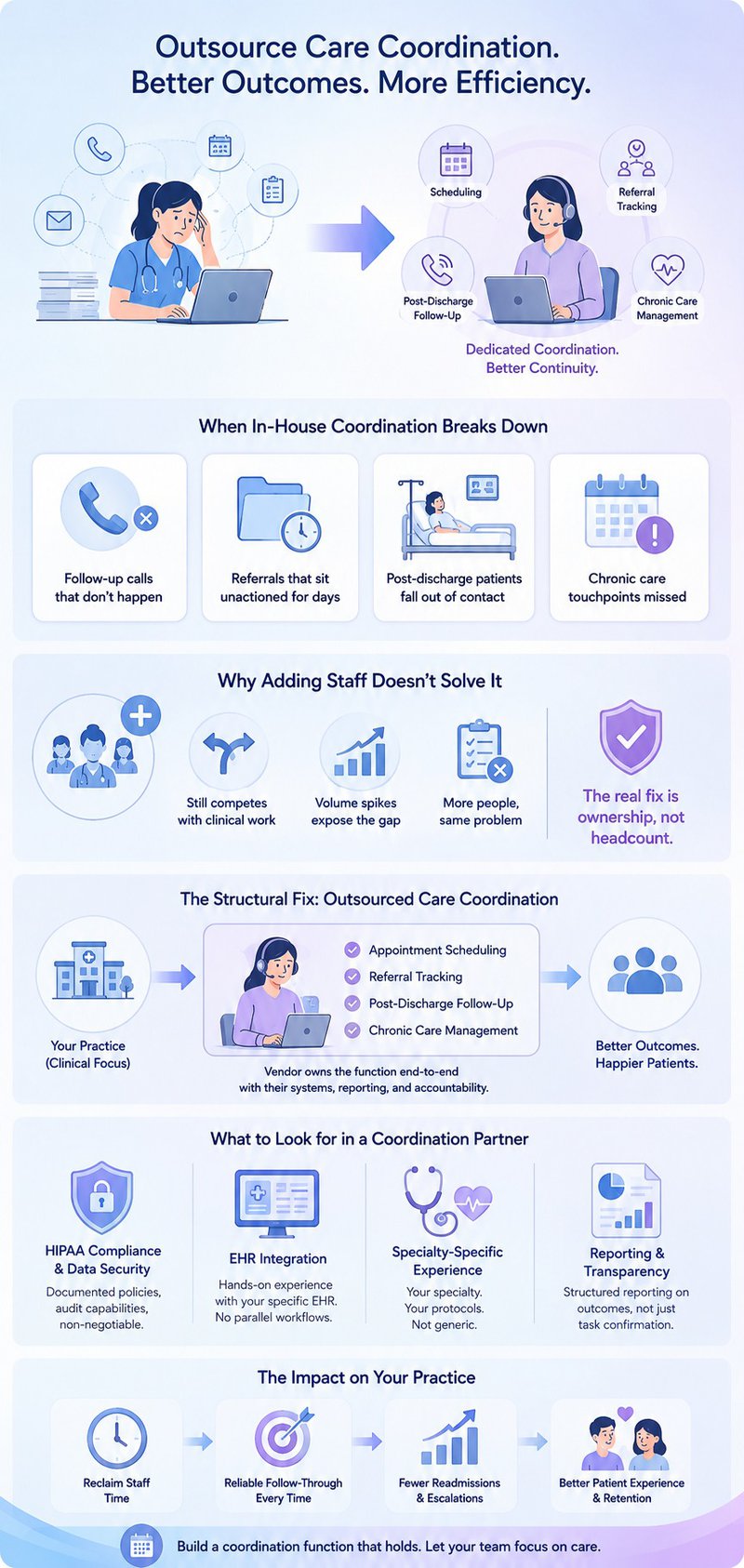
At low volume, in-house coordination works. A small team covers scheduling, referrals, and follow-ups, and it holds together. Then volume grows, and the cracks show up in predictable places:
- Follow-up calls that don’t happen
- Referrals that sit unactioned for days
- Post-discharge patients who fall out of contact entirely
- Chronic care touchpoints were missed because no one had time
These aren’t one-off failures. They’re what happens when a function was never built to scale. According to the American Academy of Family Physicians, poor care coordination costs the U.S. healthcare system more than $25 billion annually, not from lack of effort, but from a structural mismatch between where coordination sits and what it actually takes to run it well.
Why Adding Staff Doesn’t Solve It
When coordination starts slipping, the typical responses are:
- Hire another coordinator
- Redistribute tasks across existing staff
- Write better SOPs or add a checklist
None of it holds. The problem isn’t the people; it’s that the structure doesn’t change. Coordination still competes with clinical work. When volume spikes, clinical priorities win and coordination slips again.
The real gap isn’t headcount. It’s operational ownership, coordination needs its own accountability structure, not a secondary slot in someone else’s job description.
How the Problem Forms Without Anyone Noticing
It starts small. At low volume, staff absorb coordination tasks alongside their main responsibilities, and it holds. That becomes the default model.
As volume grows, the pattern compounds quietly:
- Referral tracking gets handed to whoever has a moment
- Post-discharge calls happen when time allows, which means sometimes they don’t
- No one formally owns coordination, so everyone owns it partially
- Because the system mostly functions, leadership doesn’t flag it as broken
Incidents get attributed to individual lapses, not structural gaps. The fix is a reminder or a checklist. Neither changes the ownership problem. Growth locks it in; the faster the practice scales, the more fragile the informal system becomes. Learn more about appointment setting assistant outsourcing.
The Moment It Becomes Undeniable
There’s usually a threshold event that makes the gap impossible to ignore:
- A high-risk patient isn’t followed up after discharge, and is readmitted
- A specialist referral goes untracked for three weeks
- A chronic care patient misses a critical touchpoint and escalates to the ED
These aren’t just clinical failures; they’re financial ones. CMS data shows nearly 20% of Medicare patients are readmitted within 30 days, with inadequate care transitions as a leading factor.
By this point, the question isn’t “how do we do this better?” It’s “who should actually own this.”

The Structural Case for Outsourced Coordination
Delegating tasks to a vendor while keeping oversight fragmented internally is just task transfer; it produces the same results as handing off to internal staff.
What actually changes with a well-structured outsourcing engagement is authority transfer. The vendor owns the function end-to-end:
- Appointment scheduling
- Referral tracking
- Post-discharge follow-up
- Chronic care management
Their systems. Their reporting. Their accountability for outcomes.
The practice keeps oversight, without carrying the operational load. And the downstream benefits follow directly from that structure:
- Access to trained coordinators without hiring and onboarding overhead
- Scalability that adjusts to volume without adding headcount
- Care continuity that doesn’t depend on clinical staff bandwidth
What to Look for in an Outsourced Care Coordination Partner
Not all vendors are structurally equivalent. Look beyond cost and evaluate on four criteria:
- HIPAA compliance and data security documented policies, audit capabilities, and the same privacy standards your practice operates under. Non-negotiable.
- EHR integration is not just generic compatibility claims. The partner should have hands-on experience with the specific EHR your practice uses, or coordination creates a parallel workflow instead of supporting the existing one.
- Specialty-specific experience cardiology follow-ups and behavioral health referrals are not the same function. Generic coordination experience isn’t enough for high-complexity specialties.
- Reporting and transparency expect structured reporting on follow-up completion rates, referral cycle times, and patient contact rates. Task confirmation isn’t accountability.
Where Outsourced Coordination Fits the Practice Model
This isn’t primarily a cost play, though savings typically follow. It’s about building a function that can actually hold the patient relationship between clinical touchpoints.
Practices that get this right create a clean operational split:
- Clinical staff focus on clinical work
- A dedicated coordination function owns continuity and follow-through
- Neither competes with the other for time or priority
Bryant West Psychology saw similar gains. With a HIPAA-trained Wing assistant handling patient scheduling, insurance billing, and compliance tracking, the clinical team reclaimed 25+ hours per week and cut manual follow-ups by 50%.
“I’m really glad Wing was available to assist me with a well-trained, highly functioning assistant who integrated easily into our practice.”
— Stephen Schneider, Clinical Director
In this case, the shift wasn’t just operational; it was structural. Coordination moved into a dedicated function with its own accountability, and the clinical team got its focus back. Learn more about patient scheduling assistant for hire.
Yes, when the partner is set up correctly. Wing’s Healthcare Virtual Assistants and Patient Care Coordinator VA are on board with specialty-specific protocols and work directly within your EHR, using the same patient data your internal team does. There’s a defined transition period to align workflows before going live, no guesswork, no parallel systems. Outsourced partners operate under a Business Associate Agreement (BAA), the same legal framework that governs any third-party vendor handling protected health information. Wing’s HIPAA-trained Healthcare VAs are specifically vetted for compliance, with documented security practices and QA supervision built into the engagement. Both parties remain accountable under HIPAA; compliance doesn’t transfer with the task. Most practices find outsourced coordination costs less than maintaining equivalent in-house capacity, primarily because it eliminates recruitment, benefits, and training overhead. Wing’s Healthcare Virtual Assistant model scales with patient volume, so you’re not carrying fixed headcount through slow periods. The more useful comparison isn’t salary vs. service fee, it’s cost per coordinated patient, and what it costs when coordination breaks down.Frequently Asked Questions
What This Changes About How You Run the Practice
Coordination failures aren’t a people problem; they’re a structure problem. When coordination is distributed across a clinical team, it will always yield to clinical priorities. That’s not a flaw; it’s how clinical teams are supposed to work.
The fix is separation. A dedicated coordination function with its own ownership, systems, and accountability doesn’t compete with clinical work; it runs alongside it. That’s when follow-through becomes reliable, not situational.
If your practice is past the point where internal fixes are holding, it’s worth seeing what a structured outsourced model actually looks like in practice.
Book a demo with Wing Assistant and see how a dedicated Healthcare VA fits into your coordination workflow.

Dianne Florendo is a content writer who creates engaging SEO content about virtual assistants, outsourcing, and business productivity.