

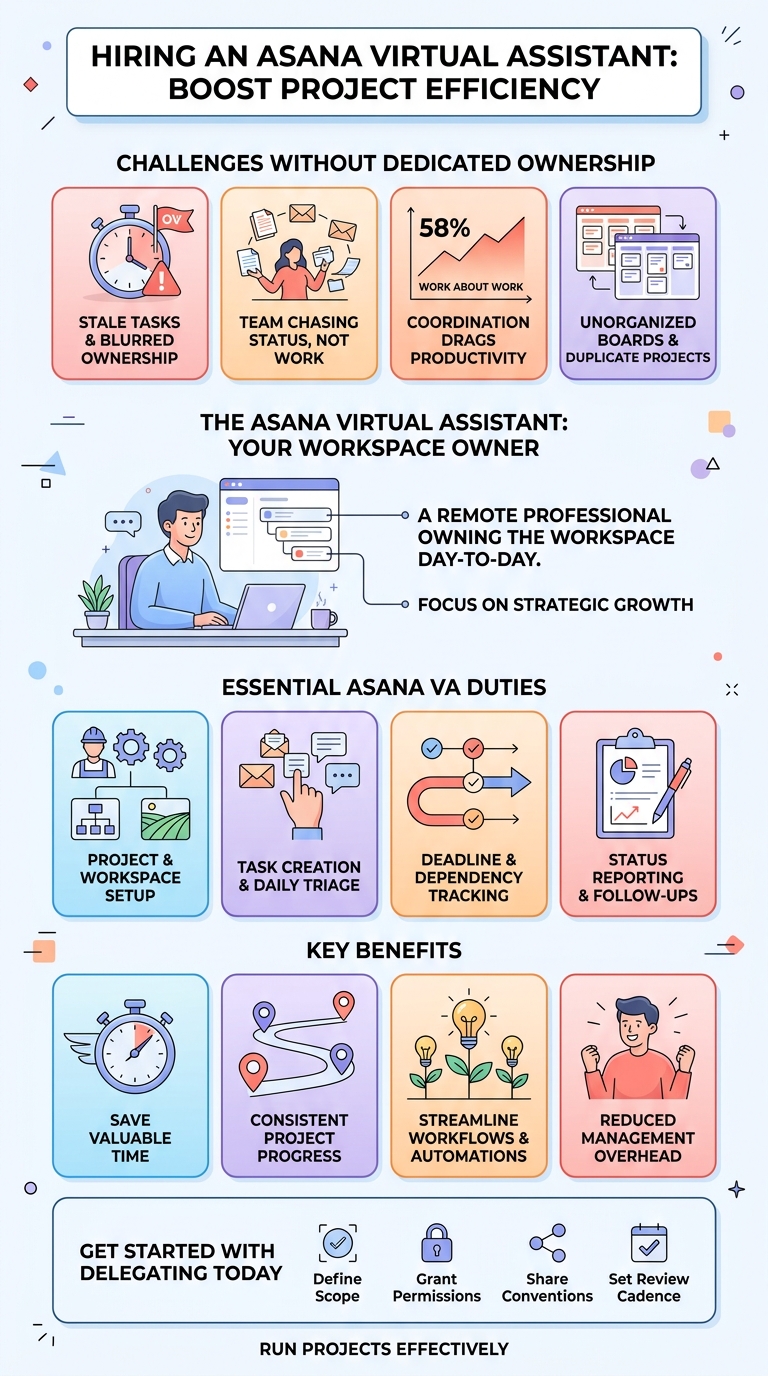
Most teams adopt Asana, then leave its upkeep to whoever has a spare minute between meetings. That spare minute rarely comes. Tasks go stale, owners blur, and managers spend their week chasing status instead of moving work forward. An Asana virtual assistant owns the workspace day to day, including setup, task hygiene, follow-ups, and weekly reporting.Your boards start reflecting reality again, deadlines hold, and you get your time back without adding a full-time in-house coordinator.
Asana’s own research shows how much time coordination eats. In its 2023 Anatomy of Work Global Index, work about work, meaning coordination rather than skilled or strategic tasks, still took up 58% of the average worker’s day, and knowledge workers estimated they could save 4.9 hours a week with better processes.
A project management tool can’t fix that by itself. Someone has to run it. This guide covers what an Asana virtual assistant does, when hiring one makes sense, and how Wing Assistant matches you with a VA who can keep your projects on track from week one.

Asana virtual assistant: what does one actually do?
An Asana virtual assistant is a remote professional who manages your Asana workspace so you and your team can focus on the actual work. The role sits somewhere between an executive assistant and a project coordinator.
Typical responsibilities include:
- Workspace and project setup: building projects, sections, custom fields, and portfolios that match how your team really works.
- Task creation and assignment: turning emails, Slack threads, and meeting notes into clear tasks with owners and due dates.
- Deadline and dependency tracking: flagging at-risk tasks before they slip and keeping timelines current.
- Daily triage: clearing the inbox, closing finished work, and reassigning orphaned tasks.
- Status reporting: writing weekly rollups or status updates so leadership sees progress without asking for it.
- Templates and rules: creating reusable project templates and setting up Asana rules to automate repetitive steps.
- Integrations: connecting Asana to Slack, Google Workspace, Microsoft 365, your CRM, and other tools your team already uses.
- Follow-ups: nudging task owners on overdue items so you don’t have to.
The common thread is ownership. A VA treats the health of your Asana workspace as their job, not a side chore.
Why do Asana workspaces fall apart without a dedicated owner?
Most Asana rollouts don’t fail because of the tool. They fail because nobody is responsible for keeping it accurate. Here are the patterns that show up again and again.
Pattern insight: the slow decay of a shared workspace
| What happens | Why it happens | What it costs you |
| Tasks sit overdue with no update | Owners finish work but never mark it done | Boards stop reflecting reality, so people stop trusting them |
| Duplicate projects multiply | Different team members create their own versions | Information splits across projects and gets lost |
| Tasks have no clear owner | Work gets assigned in meetings but never in Asana | Accountability disappears, and so do deadlines |
| Weekly reviews get skipped | Managers run out of time | Small delays compound into missed launches |
| Status lives in Slack or email | Updating Asana feels like extra work | You’re back to chasing updates manually |
Once a workspace hits this point, people go back to spreadsheets, sticky notes, and “quick check-in” meetings. You’re paying for Asana and still doing all the coordination by hand.

Asana VA vs. in-house project coordinator: which makes sense?
If you need someone to own Asana, you have two main options: hire a full-time project coordinator or bring on a virtual assistant. Here’s how they compare.
| Factor | Asana virtual assistant | In-house project coordinator |
| Cost | Lower total cost, with no office, equipment, or full benefits overhead | Full salary, benefits, payroll taxes, and equipment |
| Ramp-up time | Fast, especially with a VA who already knows Asana | Longer recruiting, hiring, and onboarding cycle |
| Flexibility | Easy to scale hours up or down as projects change | Fixed headcount, harder to adjust |
| Coverage hours | Can work across time zones to extend your coverage | Usually limited to your local business hours |
| Management overhead | Light, focused on clear scope and a review cadence | Ongoing people management and career development |
| Tool expertise | Can be matched specifically for Asana experience | Varies by candidate |
For most small and mid-sized teams, a VA covers what they actually need: consistent, reliable workspace ownership. An in-house coordinator makes more sense when the role requires deep strategic planning or in-person stakeholder management.
What tasks should you delegate in Asana first?
You don’t need to hand over everything at once. Start with the work that drains the most time and needs the least judgment from you.
- Daily triage. Have your VA review new tasks, update statuses, and close out finished work every morning. This alone restores trust in your boards.
- Meeting-to-task follow-ups. Your VA turns meeting notes and action items into assigned tasks with due dates, so nothing gets forgotten after the call.
- Recurring task templates. Monthly reports, client onboarding, and content calendars can all become templates your VA maintains.
- Weekly status rollups. A short written summary of what moved, what’s stuck, and what’s due next.
- Overdue task follow-ups. Your VA pings owners directly, which takes you out of the reminder loop.
- Workspace cleanup. Archiving dead projects, merging duplicates, and standardizing naming conventions.
Once these are running smoothly, you can expand into timeline management, portfolio reporting, and automation building.
How do healthcare practices use an Asana assistant?
Medical practices, clinics, and healthcare groups run on recurring, deadline-driven admin work, which is exactly what Asana handles well. An Asana VA can manage:
- Credentialing and re-credentialing trackers: keeping renewal dates, payer applications, and document requests visible for every provider.
- Staff onboarding checklists: making sure new hires complete training, system access setup, and paperwork on time.
- Compliance task reminders: recurring tasks for policy reviews, training renewals, and audit preparation.
- Patient communication campaigns: timelines for newsletters, recall campaigns, and seasonal reminders like flu shot outreach.
- Vendor and equipment tracking: contract renewals, maintenance schedules, and supply orders.
One important note: Asana is a project management tool, not a system for protected health information. Keep patient data in your EHR and other HIPAA-compliant systems, and use Asana for the operational work around it. A good healthcare VA understands that boundary and works within it.
How do you hire and onboard an Asana virtual assistant?
A smooth start comes down to clear scope and early structure. Follow these steps:
- Define the scope. List which projects, teams, and recurring tasks your VA will own. Be specific about what they should handle on their own and what needs your approval.
- Grant the right permissions. Add your VA as a member or admin depending on scope. Give access to the projects they manage, not your entire organization by default.
- Share your conventions. Document naming rules, status definitions, priority levels, and how your team uses custom fields. If none exist yet, have your VA draft them.
- Set a review cadence. A 15-minute weekly check-in in the first month helps your VA learn your priorities quickly.
- Measure what matters. Track on-time task completion, the number of overdue tasks, and how often you still have to chase updates yourself. Those numbers should improve within the first few weeks.
What should you look for in an Asana-skilled VA?
Not every virtual assistant is ready to run a project management system. Look for:
- Hands-on Asana experience: comfort with projects, portfolios, timelines, custom fields, and forms.
- Familiarity with rules and automations: the ability to cut repetitive steps instead of doing them manually forever.
- Strong written communication: clear task descriptions and status updates that don’t need a follow-up call to understand.
- Proactive habits: they flag risks before they become problems.
- Time-zone overlap: enough shared hours for quick questions and handoffs.
- Data security practices: respect for access controls and sensitive information, which is especially important in healthcare.
Wing vets assistants for these skills and matches you with someone whose experience fits your workflows, so you’re not training a beginner on the basics.
Why is Wing the right choice for an Asana virtual assistant?
Wing is a managed virtual assistant service. You get a vetted assistant matched to your tools and workflows, plus the structure and accountability freelancer marketplaces usually lack. Your assistant owns recurring processes end to end, and that kind of ownership is what keeps an Asana workspace accurate.
Case study: Quistem
Quistem, an automotive consultancy led by Cathy Fisher, had outgrown its founder-run admin after several freelancers didn’t work out. Wing matched Cathy with Victor, a full-time Executive Assistant who now manages her inbox, scheduling, internal workflows, and documentation, bringing order and accountability to Quistem’s systems.
| Result | Impact |
| 25% of CEO’s time saved | More focus on strategic growth |
| 9 recurring admin tasks offloaded | Coordination no longer runs through the founder |
| 1,000+ workdays of support delivered | Consistent, long-term ownership |
“He’s freed up my brain and my time. I can now focus on value creation instead of a thousand little tasks.” Cathy Fisher, Founder & CEO, Quistem
Get your projects back on track
Asana works when someone owns it. If your boards have drifted out of date and you’re spending more time chasing updates than doing your own work, it’s time to hand off the upkeep.
Schedule a call with Wing and get an Asana-ready assistant running your projects this month.
Frequently Asked Questions
Yes. A Wing Project Manager can own your Asana workspace across multiple teams. That covers daily triage, task assignment, deadline tracking, follow-ups, and weekly status reports. Your team still owns its tasks, and your Wing assistant keeps the system accurate around them.
A Wing virtual assistant typically costs less than a full-time in-house coordinator because you skip the benefits, office, and equipment overhead. Wing plans can flex with your workload, so book a call to compare options for your team.
Wing matches you with assistants based on the tools and workflows you need. If Asana is a requirement, you’ll be paired with someone who already knows the platform. If you’re a founder or leader who mainly needs your own projects and priorities managed in Asana, a Wing Executive Assistant is a strong fit.
Yes. A Wing Technical Ops Specialist can build your workspace structure, project templates, and custom fields, then document your conventions. To connect Asana with Slack, your CRM, and other tools, or to build rules that automate repetitive steps, a Wing CRM & Automation Specialist can handle the setup.
A Wing Administrative Virtual Assistant is a good place to start. They can turn meeting notes into tasks, update statuses, close out finished work, and keep your boards clean without needing a full project management role.
It can be, especially for operational work. A Wing Medical Administrative VA can manage staff onboarding checklists and compliance reminders in Asana. A Wing Credentialing Coordinator can track provider renewals and payer applications. For practices that need extra care around sensitive data, Wing also offers a HIPAA-Compliant Virtual Assistant who keeps patient information in your EHR and other compliant systems, not in Asana.

Dianne Florendo is a content writer who creates engaging SEO content about virtual assistants, outsourcing, and business productivity.