

Most practices respond to admin overload by spreading the work across whoever’s available, front desk, coordinators, and sometimes the surgeon themselves. That stops working fast in orthopedics. Insurance verifications, prior auths, and post-op follow-ups aren’t generic tasks, and general support doesn’t carry the knowledge to clear them without constant back-and-forth. The fix isn’t more headcount. It’s the right kind: an orthopedic VA who already knows the terminology, the workflow, and what a denial actually requires to resolve. The result is fewer errors, faster turnaround, and surgeon time that stays on surgery.
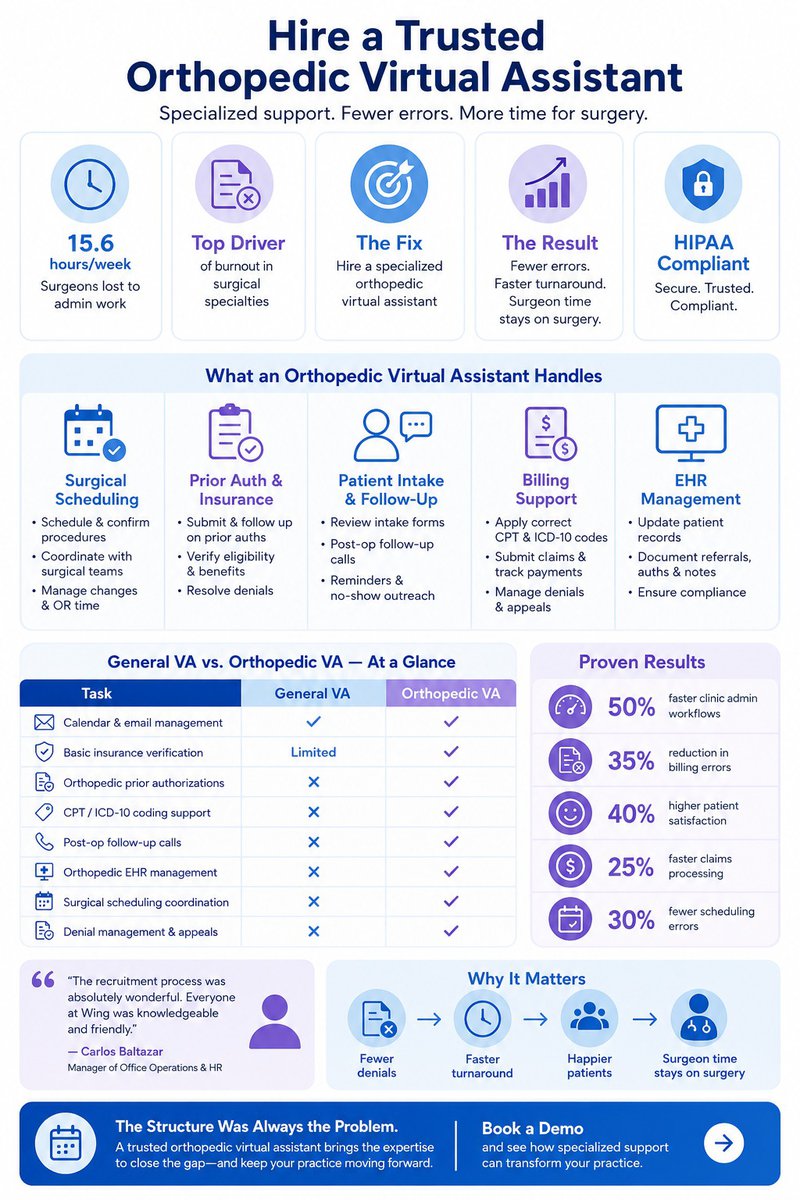
Orthopedic surgeons lose an average of 15.6 hours per week to administrative work. According to a 2022 Merritt Hawkins survey, it’s the top driver of burnout in surgical specialties.
The problem isn’t just volume, it’s specificity. Prior auths, post-op follow-ups, and orthopedic billing require domain knowledge that general staff doesn’t have. When that work gets mishandled, the practice pays in denials, delays, and lost clinical time.
This article covers what an orthopedic virtual assistant handles, why specialization matters, what to look for when hiring one, and how Wing helps practices close that gap.
When Admin Load Silently Outpaces Clinical Growth
Orthopedic practices scale by adding cases, but the paperwork attached to each one scales faster. As surgical volume grows, so does the administrative layer behind it:
- Prior authorizations and insurance verifications
- Surgical scheduling and referral coordination
- Post-operative follow-up calls
- EHR documentation and billing support
Most practices respond by spreading that load across existing staff or letting surgeons absorb the overflow. Neither holds. Staff without orthopedic-specific training slow down on complex tasks. Surgeons handling non-clinical work lose time that doesn’t come back.

The backlog doesn’t shrink, it shifts. And the longer it shifts, the more it looks like a normal operating pattern instead of a structural problem.
Why General Admin Support Doesn’t Solve This
The default response is familiar: hire an administrative assistant, delegate the overflow, and expect relief. It seems reasonable; the tasks exist, someone is handling them, and the surgeon’s calendar opens up.
It holds until the work hits friction:
- An insurance denial that requires orthopedic-specific procedure codes
- A prior authorization that needs clinical vocabulary to push through
- A patient intake form tied to post-op protocols, the assistant doesn’t recognize
- An EHR update that requires familiarity with the system the practice actually uses
General admin hires handle volume. They struggle with precision. In orthopedics, precision is the requirement.
What’s missing isn’t effort; it’s domain context:
- Fluency with orthopedic CPT and ICD-10 codes
- Familiarity with EHR platforms like Modernizing Medicine or Kareo
- Working knowledge of surgical scheduling timelines
- The language to communicate with insurance coordinators and surgical teams without retraining
Without that context, delegation creates a new bottleneck. Tasks get handed off, but don’t get resolved; they come back for clarification. Specialization isn’t an upgrade. In orthopedic administration, it’s the baseline requirement. Learn more about appointment setting assistant company.
How the Administrative Gap Forms Over Time
Early in practice growth, the admin volume is manageable. A small team handles scheduling, insurance calls, and documentation alongside clinical staff. The surgeon fills gaps where needed. Nothing feels structural; it feels like a temporary stretch.
Then the caseload grows and the incremental load compounds:
- Each new case adds a verification call, a pre-auth submission, a follow-up sequence, and an EHR update
- Staff start cutting corners to keep up, deferring follow-up calls, leaving documentation incomplete, and skipping secondary insurance checks
- The surgeon absorbs the overflow, and it becomes the default operating pattern
- Workarounds get treated as workflows
The inefficiency turns invisible because it’s been present long enough to feel routine. The practice keeps moving, but the errors accumulate quietly:
- Missed authorizations
- Delayed reimbursements
- Documentation gaps that surface during audits
- Patient follow-ups that never happened
By the time it becomes a visible problem, it’s been a structural one for months.
What an Orthopedic Virtual Assistant Actually Handles
A qualified orthopedic virtual assistant covers the tasks that require domain knowledge — not just availability. Here’s what that looks like in practice:
Surgical Scheduling & Coordination
- Schedule and confirm surgical procedures with hospitals and ASCs
- Coordinate with surgical teams on pre-op requirements
- Manage cancellations, reschedules, and OR block time
- Send pre-operative instructions to patients
Prior Authorization & Insurance Verification
- Submit and follow up on prior authorizations for orthopedic procedures
- Verify insurance eligibility and benefits before appointments
- Resolve denials using orthopedic-specific procedure codes
- Communicate authorization status to clinical staff
Patient Intake & Follow-Up
- Collect and review intake forms before appointments
- Conduct post-operative follow-up calls using condition-specific protocols
- Flag clinical concerns for the care team
- Manage appointment reminders and no-show outreach

Medical Billing Support
- Apply correct orthopedic CPT and ICD-10 codes
- Submit claims and track outstanding reimbursements
- Identify and escalate coding errors before submission
- Support denial management and appeals
EHR Management
- Update and maintain patient records in orthopedic EHR platforms
- Document referrals, authorizations, and clinical notes
- Ensure documentation meets compliance requirements
General VA vs. Orthopedic VA — At a Glance
| Task | General VA | Orthopedic VA |
|---|---|---|
| Calendar and email management | Yes | Yes |
| Basic insurance verification | Limited | Yes |
| Orthopedic prior authorizations | No | Yes |
| CPT / ICD-10 coding support | No | Yes |
| Post-op follow-up calls | No | Yes |
| Orthopedic EHR management | No | Yes |
| Surgical scheduling coordination | No | Yes |
| Denial management and appeals | No | Yes |
The difference isn’t effort; it’s what they can actually execute without supervision. A general VA moves tasks. An orthopedic VA closes them.
Where Structured VA Support Fits the Practice Model
Orthopedic practices don’t need more hands; they need clearly assigned ownership over tasks that currently drift. When a prior authorization stalls, it should have one owner. When a follow-up call doesn’t happen, that gap should be traceable. A specialized orthopedic VA introduces that accountability layer without adding full-time staff overhead.
The numbers bear it out. Wing’s work with Provida Family Medicine, a primary care practice facing the same administrative pressure points, produced measurable results after bringing on a trained healthcare VA:
- 50% faster clinic admin workflows
- 35% reduction in billing errors
- 40% higher patient satisfaction
- 25% faster claims processing
- 30% fewer scheduling errors
Testimonial:
“The recruitment process was absolutely wonderful. Everyone at Wing was knowledgeable and friendly.”
— Carlos Baltazar, Manager of Office Operations & HR
Wing provides trained orthopedic virtual assistants who operate within HIPAA-compliant frameworks and carry the domain knowledge to handle specialized tasks from day one, prior authorizations, surgical scheduling, post-op follow-ups, EHR management, and billing support.
A qualified orthopedic virtual assistant with existing EHR familiarity and prior authorization experience typically requires two to four weeks for practice-specific onboarding. The more orthopedic-specific their background, the shorter the ramp. Wing’s Orthopedic VA and Prior Authorization Specialist roles are built for this, trained on orthopedic workflows from day one, so the practice isn’t starting from scratch. Yes, provided the VA operates under a signed Business Associate Agreement and follows HIPAA-compliant protocols for handling PHI. Wing’s HIPAA-Compliant Virtual Assistants are trained specifically for this, with documented compliance frameworks and data-handling procedures in place before access is ever granted. Wing also offers a dedicated Medical Insurance Verification Specialist for practices that need focused coverage on that function. A full-time in-house administrative employee carries salary, benefits, training, and overhead costs that a virtual assistant model doesn’t. Wing’s Healthcare Virtual Assistant and Medical Billing Specialist roles deliver specialized support at a fraction of that cost, with the added benefit of domain knowledge that a general in-house hire typically lacks, reducing error rates and cutting retraining cycles from the start.Frequently Asked Questions
The Structure Was Always the Problem
The issue was never effort; it was specialization. Orthopedic admin work requires orthopedic knowledge, and general support can’t deliver that. A trusted orthopedic virtual assistant closes that gap: fewer denials, faster turnaround, and surgeon time that stays on surgery.
Wing provides HIPAA-compliant orthopedic VAs with the domain knowledge to handle this work from day one.
Book a Demo and see how Wing can reduce your practice’s administrative load.

Dianne Florendo is a content writer who creates engaging SEO content about virtual assistants, outsourcing, and business productivity.