







AI tools are software applications that use artificial intelligence to automate specific tasks like writing, data entry, or scheduling. Virtual assistants are trained human professionals who manage tasks, make judgment calls, and own outcomes on your behalf. The hidden $600 trap refers to the cumulative monthly cost of AI tool subscriptions ($200–$600+) that promise to replace human work but still require significant management time, leaving founders with fragmented workflows and no clear accountability.
TL;DR: Many businesses spent 2024 replacing human workers with AI tools, but the expected ROI failed to materialize, leading to widespread subscription cancellations. Anthropic's research indicates AI can theoretically handle 94% of knowledge work tasks, yet actual professional usage remains at only 33%, revealing a significant execution gap. Most business roles are neither fully replaceable by AI nor completely safe from automation; drawing the right line between the two determines whether your workflows succeed or fail. A dedicated Wing virtual assistant starts at $699/month part-time or $999/month full-time, is fully managed, and takes accountability for outcomes rather than just completing tasks.
Somewhere in 2024, a lot of founders made the same call. Cancel the hire. Grab the AI tool instead.
ChatGPT for writing. Zapier for automation. Clay for outreach. A CRM with AI features baked in, then another tool to connect everything. Month one felt like progress. Month three, the bills were adding up. Month six, someone finally ran the actual number.
The stack added up to $400–$600/month in subscriptions alone—before counting the 5–10 hours weekly spent managing integrations and fixing broken automations. The work it was supposed to eliminate was still there, just fragmented across a dozen half-working automations that someone, usually you, had to babysit. The tasks didn't disappear. They just got harder to find.
Quietly, people started getting hired back.
The Number That Explains Why
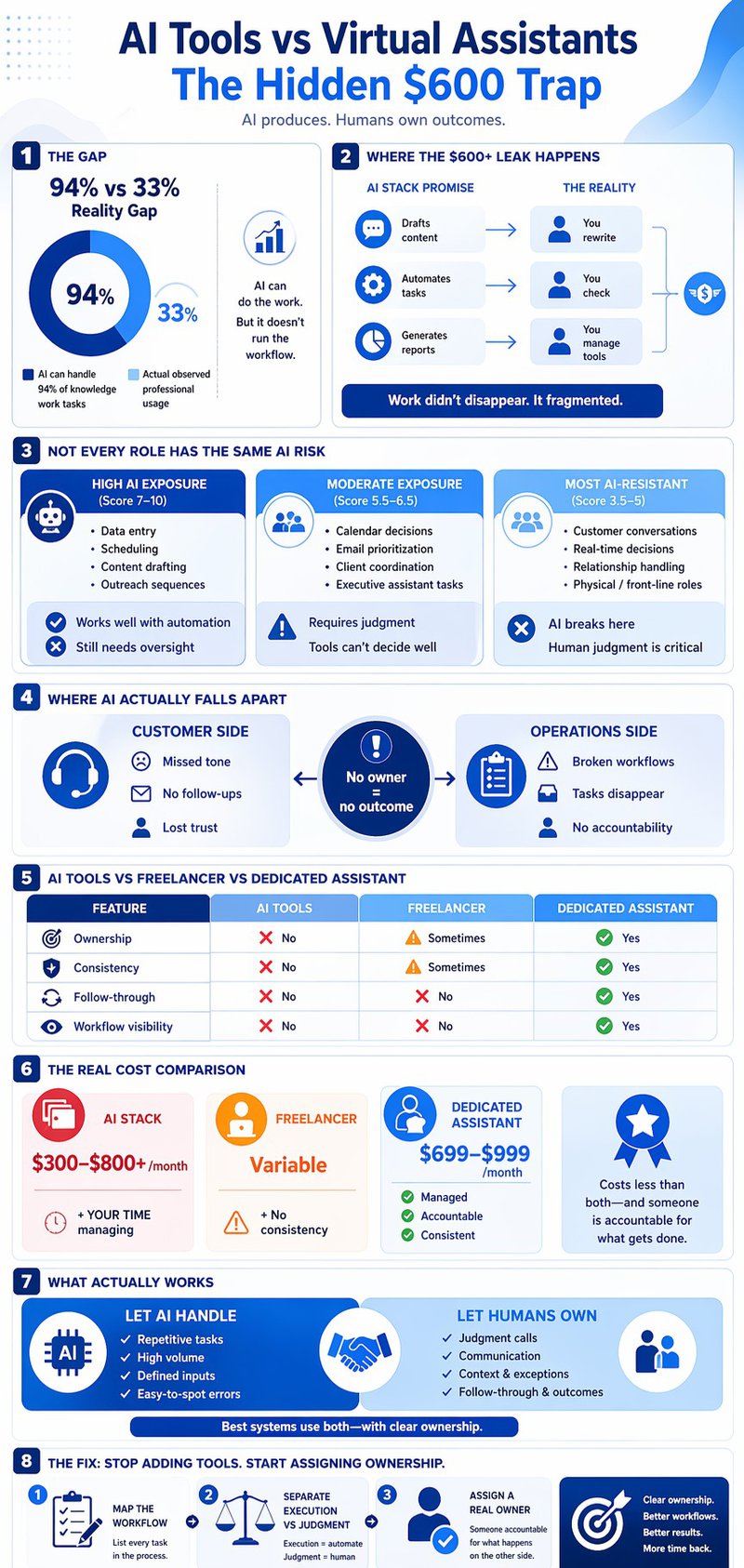
Anthropic published research on this directly. Their study, "The Macroeconomic Impact of AI on Occupations" (September 2024), found AI can theoretically handle 94% of tasks in computer and knowledge work roles. Actual observed professional usage sits around 33%.
That 61-point gap isn't the technology failing. It's the reality of how work actually runs: legal constraints, workflow complexity, exceptions that don't fit any pattern, and the constant need for judgment in places that look automated on paper.
For most founders, it plays out like this:
- AI drafts the email. You still rewrite it.
- AI logs the data. You still check it.
- AI generates the report. You still interpret it.
- The "automated" task still has a human in the loop, just a frustrated one managing a tool instead of doing the work.
The cost didn't go down. It moved and got invisible.
Not Every Role Has the Same AI Risk
The mistake most businesses make is treating AI exposure as uniform across all roles, then automating things that needed judgment or keeping manual what could run on its own.
The data tells a more specific story.
AI Exposure Tiers: Task and Role Comparison
| Exposure Level | AI Exposure Score | Characteristics | Example Tasks | Example Roles |
|---|---|---|---|---|
| High AI Exposure | 7–10 | Screen-based, pattern-driven, defined inputs; AI performs most reliably | Data entry, scheduling, content drafting, outreach sequences | Administrative assistants, lead generation assistants, social media assistants |
| Moderate Exposure | 5.5–6.5 | Relationship-heavy, judgment-dependent coordination | Calendar management, correspondence, prioritization decisions | Executive assistants |
| Most AI-Resistant | 3.5–5 | Physical presence, real-time interaction, emotional judgment | Front-line client communication, live situation assessment | Dedicated receptionist, client-facing coordinators |
Automating the top tier where AI genuinely performs well makes sense. Applying that same logic to the middle and bottom tiers is where execution quietly starts breaking.
Where AI Actually Falls Apart
The damage from misapplied AI rarely announces itself. It accumulates.
In customer-facing work, a customer service rep handling a live complaint isn't just resolving a ticket. They're deciding on tone, reading the relationship, figuring out whether to escalate or absorb. AI generates a reply. It doesn't carry the conversation, track what was promised, or notice three days later that nothing was followed up on.
The customer doesn't tell you they felt like they were talking to a bot. They just don't come back.
In back-office and admin work, the failure is different but just as costly. AI tools produce things. First drafts, formatted data, summary reports. But producing something and owning it aren't the same thing. When an automated workflow breaks, nobody gets an alert. Tasks disappear into a queue nobody checks. Follow-through evaporates.
That's the pattern underneath most "the AI isn't working" complaints. It's not that the tool failed technically. It's that nobody is accountable for what comes out the other side.
Freelancers Have the Same Gap, Different Reason
Some founders skipped AI tools and went straight to freelancers. Same result, different path.
Freelancers deliver output when asked. They don't track what's in motion, catch what's slipping, or stay consistent when your workload spikes. Context lives with you, not them. When something falls through between tasks, nobody's watching for it.
Both AI tools and freelancers leave the same thing unresolved: who owns execution when you're not in the room?
That's what a managed assistant answers. Not just "who does the task," but "who's responsible for what happens next."
What Actually Works
The founders running the tightest operations right now didn't choose between AI and people. They drew a clear line between what AI handles reliably and what a person needs to own.
AI runs well on high-volume, repeatable, defined work. The tasks in that top exposure tier, where speed matters more than judgment and errors are easy to catch.
A dedicated virtual assistant handles everything that requires continuity: client communication, live judgment calls, follow-through on anything with real stakes, and owning outcomes end to end rather than just completing tasks. One person who knows your business, your clients, your preferences, and catches things before you have to ask.
How do I know if I should use AI or a virtual assistant? If a task requires judgment, relationship context, or accountability for outcomes, assign it to a virtual assistant; if it's repeatable, pattern-based, and low-stakes, AI tools can handle it effectively.
That's the structural difference. AI produces. A dedicated assistant owns.
Key Features of Managed Virtual Assistants
What separates a managed virtual assistant service from DIY hiring or freelance platforms:
- Dedicated training: Assistants are trained on your tools, workflows, and preferences before day one
- Accountability for outcomes: Your assistant owns results, not just task completion
- Managed support: A dedicated success manager and QA layer handle issues without requiring your involvement
- Continuity protection: If something isn't working, replacements are handled seamlessly
- Consistent availability: No bidding, no rotating roster, no hoping your person is available this week
This Is Where Wing Is Different
Wing isn't a marketplace. No bidding, no rotating roster, no hoping your person is available this week.
Every Wing assistant is trained before they start, supervised throughout, and backed by a dedicated success manager and QA layer. If something isn't working, it gets fixed without you managing that process. Replacements are handled. Continuity is protected.
"Wing Assistant is essential to our business. The assistants are excited to work and have a great work ethic. The leadership goes out of their way to make the relationship with the assistant and our business successful." — Chris R., President, Insurance, 5-star review on Capterra
Feature Comparison: Wing vs. AI Tools vs. Freelancers
| Wing | AI Tool Stack | Freelancer | |
|---|---|---|---|
| Dedicated to your business | Yes, one assigned assistant | No, shared tools across users | Sometimes, depends on availability |
| Managed and supervised | Yes, with QA layer and success manager | No, self-managed | No, you manage directly |
| Onboarded within 24–48 hrs | Yes, trained and ready | N/A | Varies, often 1–2 weeks |
| Accountable for outcomes | Yes, owns results end-to-end | No, produces output only | Rarely, delivers when asked |
| Cost vs US full-time hire | 65–80% less | Varies, plus hidden management time | Varies, plus your coordination time |
The comparison most founders don't run until it's too late:
- US full-time admin hire: $4,000–$6,000/month
- AI tool subscriptions: $200–$600/month in direct costs, plus 5–10 hours weekly in management time you never track
- Wing general virtual assistant: $699/month part-time or $999/month full-time, fully managed
The AI stack looks cheaper until you count your own hours maintaining it. Wing costs less than both, and unlike either, someone is accountable for what actually gets done.
Wing holds a 4.7-star rating on Capterra across hundreds of verified reviews.
Book a free consultation and see what it costs for your workflow.
Real Results From Wing Clients
| Client | Industry | Result |
|---|---|---|
| Idaho Legal Estates | Legal | 100+ hours reclaimed, 13+ hrs/week freed on intake and scheduling |
| Carty Custom Builders | Construction | 80+ admin hours saved, bookkeeping and CRM fully offloaded |
| My Personal Mentors | Coaching | 30+ closed deals/month, 3,600+ clients supported |
| European Leather Works | E-commerce | 150%+ ROI, $120K+ annual payroll savings, 70% YoY growth |
"We were able to increase our volume output. The onboarding was quick, and they're always on task." — Jesse R. Thomas, Founding Attorney, Idaho Legal Estates
How to Know Where Your Workflow Is Actually Broken
Before buying another tool or another subscription, run this against your three most frustrating recurring workflows:
- Write out every task inside the workflow, not the role title
- Ask per task: does a good outcome require judgment, or just execution?
- Judgment-required (live communication, exceptions, shifting context): keep a person on it
- Execution-only (defined, repeatable, low-stakes): automate it
Most founders find their AI stack is running things that didn't need it, and the tasks that actually break execution still have no clear owner. The fix isn't more tools. It's someone accountable for what happens on the other side of every handoff.
The Real Cost Calculation
An AI subscription that quietly adds management overhead every week isn't saving anything. It moved the cost from a salary line to your calendar, where nobody tracks it.
A dedicated, managed assistant who owns execution, frees 10 to 20 hours a week, and starts at $699/month part-time or $999/month full-time is a different calculation entirely. The work gets done. You don't manage the process. Someone is accountable when it doesn't.
"I've been with Wing for about two years and my assistants, they're all fantastic." — Ashley Jones, La Jolla Group, via wingassistant.com/reviews
Book a free consultation and find out what that looks like for your business.
Frequently Asked Questions
What tasks should AI handle vs. a virtual assistant?
AI handles best when tasks are repeatable, pattern-based, and low-stakes, like data entry, scheduling, or first-draft content. A virtual assistant should handle tasks requiring judgment, relationship context, or accountability for outcomes.
How much does a virtual assistant cost compared to AI tools?
AI tool subscriptions typically run $200–$600/month plus 5–10 hours weekly in management time. A Wing virtual assistant costs $699/month part-time or $999/month full-time, fully managed with no hidden time costs.
How do I know if I should use AI or a virtual assistant?
If the task requires live judgment, client relationships, or follow-through with real stakes, use a virtual assistant. If it's defined, repeatable, and errors are easy to catch, AI tools can handle it.
Can I use both AI tools and a virtual assistant together?
Yes. The most effective operations use AI for high-volume, pattern-driven tasks while a virtual assistant manages judgment calls, client communication, and owns outcomes end-to-end.
What makes a managed virtual assistant different from a freelancer?
A managed assistant is trained on your workflows, supervised with QA oversight, and accountable for results, not just task completion. Freelancers deliver output when asked but don't own continuity or catch what slips between tasks.

Dianne Florendo is a content writer who creates engaging SEO content about virtual assistants, outsourcing, and business productivity.