

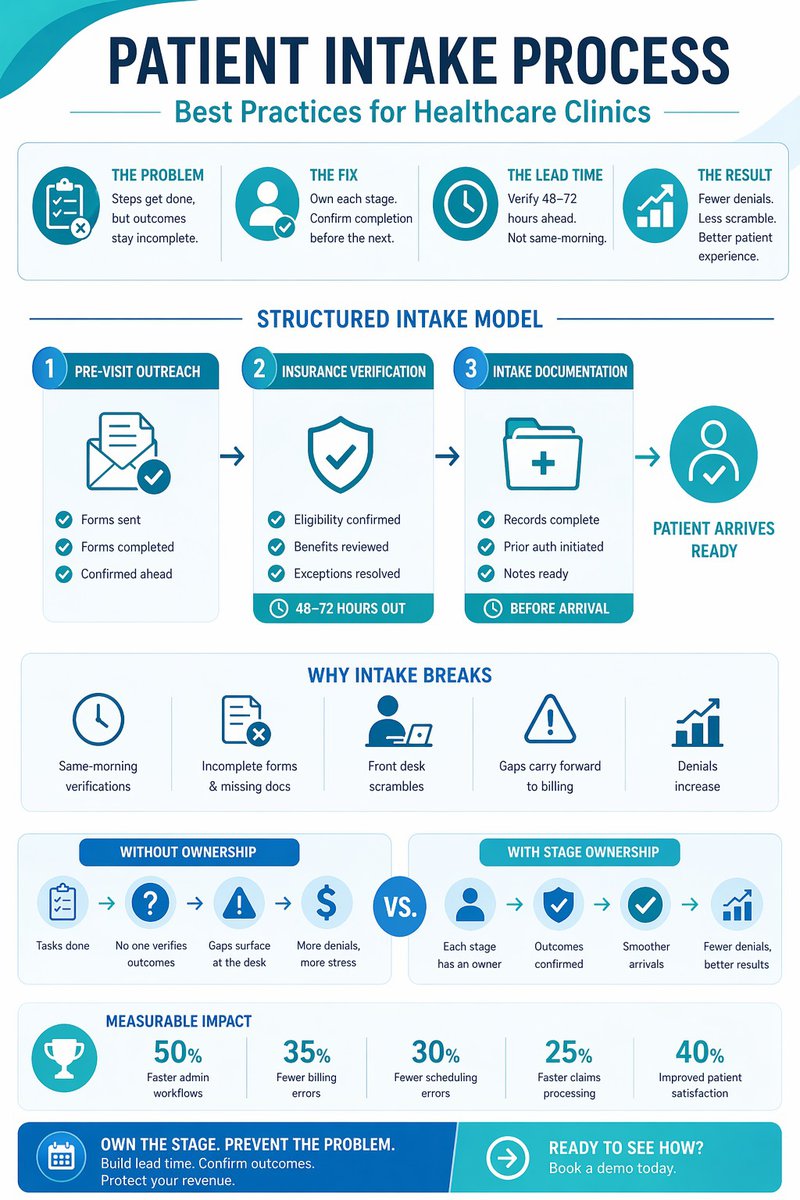
What’s already happening: Most clinics are sending forms, verifying insurance, and prepping records; the steps exist, and staff are following them. Why it still breaks: No one owns what happens between steps, tasks get checked off while the stage stays incomplete, and errors carry forward quietly until they hit billing or the front desk. What actually fixes it: Stage ownership, someone accountable for confirming each phase is fully done before the next begins, with verification built in 48–72 hours ahead, not same-morning. What that produces: Fewer claim denials, less front desk scramble, and a patient experience that doesn’t start with missing information and waiting room delays.
Intake breaks not because steps are skipped, but because no one knows whether each step was actually finished before the next one started.
Studies on outpatient administrative waste estimate that coordination gaps in intake, incomplete verification, missing documentation, and late eligibility checks drive nearly 25–30% of claim denials. That’s a billing number with an intake cause.
In this article, we break down where the patient intake process fails, why the common fixes don’t hold, and what structured ownership across each stage actually looks like, including how Wing’s Healthcare Virtual Assistants help clinics build and maintain that structure end-to-end.
When Intake Looks Fine But Still Breaks Down
Every clinic has an intake process. Forms go out. Insurance gets verified, eventually. Documentation gets pulled before the visit, most of the time. On the surface, the workflow exists.
But the signs of breakdown are consistent across clinics:
- Patients arrive with incomplete forms that should have been confirmed days earlier
- Eligibility checks run the same morning instead of 48–72 hours out
- Front desk staff spend the first hour catching up on prep work, not managing arrivals
- Claims go out with missing or mismatched information
- Denial rates climb without a clear point of origin
The process is there. The results aren’t.
That gap, between having a process and having a functioning one, is where most patient intake problems actually live. It’s not a tool problem. It’s not a staffing problem. It’s a structural one: tasks exist, but no one owns the outcome between steps.

The Default Fix Doesn’t Address the Right Problem
Why the usual responses fall short
When intake breaks down repeatedly, the instinct is to add. And the additions are always reasonable:
- Hire another front desk person to cover the gaps
- Write a more detailed SOP so nothing gets missed
- Buy software that automates reminders and follow-ups
None of these is wrong. They’re just aimed at the wrong variable.
More staff without defined roles doesn’t reduce errors; it distributes them. A longer SOP doesn’t improve execution if no one is accountable for following it end-to-end. Software reminders only help if someone is responsible for acting on them.
The missing variable isn’t capacity. It’s ownership per stage.
The structural variable most clinics skip
Most intake workflows are built around task lists — send the forms, check the insurance, pull the records. What they don’t define is who is responsible for confirming each stage is complete before the next one begins.
That distinction matters:
- Task completion = the action was taken
- Stage ownership = someone verified the outcome before the handoff
A task can be logged as done while the stage it belongs to is still incomplete. Without that accountability layer, errors don’t get caught; they get inherited by the next step and surface later as billing gaps or desk-level scrambles. Learn more about affordable virtual medical assistant.
How Intake Failures Form and Why They Stay Hidden
It builds quietly across steps
No single intake failure is dramatic. The gaps look like ordinary daily friction:
- A form reminder doesn’t go out because the staff member was pulled to cover phones
- Insurance verification gets pushed to the next morning because the afternoon ran long
- A missing document doesn’t get flagged because no one reviewed the record before the visit
Each gap is small. Each has a reasonable explanation. And because none of them surface immediately, they feel like exceptions, not a pattern.
Reinforcement loops that normalize the problem
The problem stays hidden because the front desk staff absorbs it. When they catch intake gaps at arrival, filling in missing information, re-verifying insurance at the desk, calling the patient for documents, the visit still happens. The day continues. It looks like the system is working.
But that catch-and-fix loop carries real costs:
- Desk workload spikes during the hours it should be most manageable
- Billing risk increases when the quick fix at arrival isn’t thorough enough
- The workflow learns to tolerate gaps instead of preventing them upstream
Leadership often reinforces this without meaning to. When the success metric is “did the patient get seen,” the pre-visit breakdown stays invisible. Intake looks functional because the front end is absorbing the failure until volume grows, and it can’t anymore.

The Model That Actually Fixes It
Task transfer vs. authority transfer
Most intake improvement efforts focus on task transfer, assigning more steps to more people. The structural fix is different: it requires authority transfer, meaning someone owns the outcome for each stage, not just the tasks within it.
Each intake stage needs a defined owner responsible for confirming completion before the next begins:
- Pre-visit outreach — forms sent, completed, and confirmed ahead of the visit
- Insurance verification — eligibility confirmed, benefits reviewed, exceptions flagged and resolved
- Intake documentation — records complete, prior auth initiated, clinical notes accessible before arrival
Without that ownership layer at each stage, tasks get completed while outcomes stay incomplete.
Structured intake as a system
When intake runs as a system with defined handoffs, not a list of tasks, three things change:
- Errors get caught at the stage boundary, not at the desk on arrival
- Accountability is clear when something isn’t done
- The front desk operates on confirmed information instead of reacting to gaps
Lead time is what makes this work in practice. Insurance verification run 48–72 hours out creates room to resolve exceptions before they affect the appointment. Forms confirmed 24 hours ahead mean clinical staff can review records before the patient walks in. These aren’t preferences; they’re the difference between intake that holds and intake that absorbs failure quietly.
Patient Intake Checklist: 8 Steps to Follow
Turning the model above into something your team can run week to week comes down to eight steps, followed in order:
- Send intake forms 3–5 days before the visit — not same-week, so patients have time to complete them without a same-day scramble.
- Confirm form completion 48 hours out — flag incomplete forms early enough to follow up before the visit.
- Run insurance eligibility checks 48–72 hours ahead — verify coverage, benefits, and any prior authorization requirements before the desk needs the answer.
- Resolve eligibility exceptions before the visit — work denials, lapsed coverage, or missing authorization same-week, not at check-in.
- Pull and review clinical documentation 24 hours out — get records, referrals, and prior notes ready for the provider before the patient arrives.
- Assign one owner per stage — make someone accountable for confirming each step is fully done, not just logged as sent.
- Flag gaps at the stage boundary — catch missing information before handoff, not at the front desk on arrival day.
- Track completion rates by stage — measure where forms, verifications, or documentation consistently fall behind, and fix that stage specifically.
Clinics that run these steps as a system, not a checklist to skim, are the ones that stop absorbing intake failures at the desk.
Manual Intake vs. VA-Assisted Intake
The difference between task-based intake and stage-owned intake shows up directly in the numbers:
| Metric | Manual Front-Desk Intake | VA-Assisted Intake |
|---|---|---|
| Time per patient (pre-visit admin) | 12–15 minutes, often compressed into same-day catch-up | 5–7 minutes, spread across the 48–72 hour lead window |
| Error rate (missing or mismatched info reaching billing) | Higher — errors caught late, at the desk or in billing | Lower — Provida Family Medicine saw a 35% drop in billing errors after shifting to VA-owned intake stages |
| No-show correlation | Incomplete pre-visit verification correlates with higher no-show and last-minute reschedule rates | Confirmed forms and eligibility ahead of time correlate with fewer last-minute cancellations and smoother check-in |
| Scheduling error rate | Higher during high-volume weeks | 30% fewer scheduling errors (Provida Family Medicine case study) |
The pattern holds across clinics: when someone owns verification ahead of the visit instead of reacting to it at the desk, both the error rate and the time cost drop together, not one at the expense of the other.
How Wing Owns Intake So Your Team Doesn’t Have To
Most virtual assistant models handle discrete tasks, send this form, update this record. Wing’s healthcare VAs are built differently. They work directly inside EMRs, scheduling platforms, and payer portals, owning each intake stage end-to-end as a continuous workflow rather than a set of isolated to-dos.
Which intake steps Wing’s Healthcare VAs own:
- Form collection — Medical Intake Specialists send, track, and confirm completion of pre-visit intake forms
- Eligibility checks — Medical Insurance Verification Specialists complete verification 48–72 hours out, with exceptions flagged and resolved before they reach the desk
- Appointment prep — Clinical Documentation Specialists and Prior Authorization Specialists pull records, confirm authorization status, and make sure charts are visit-ready
- Stage ownership — one Wing VA accountable for each stage above being complete, not just attempted
The results are measurable. Provida Family Medicine, a growing primary care practice dealing with scheduling delays, billing bottlenecks, and rising patient volume, partnered with Wing for dedicated healthcare administrative support. Within weeks:
- Admin workflows ran 50% faster
- Billing errors dropped by 35%
- Scheduling errors fell by 30%, with claims processing 25% faster
- Patient satisfaction improved by 40%
“The recruitment process was absolutely wonderful. Everyone at Wing was knowledgeable and friendly.” — Carlos Baltazar, Manager of Office Operations & HR, Provida Family Medicine
Frequently Asked Questions
Intake usually isn’t slow because of the steps themselves — it’s slow because verification and documentation get pushed to the same morning instead of started 48–72 hours ahead. When eligibility checks, form confirmations, and record pulls happen with lead time, the visit-day process shortens dramatically. Wing’s Medical Intake Specialists and 24/7 Scheduling VAs own that lead time directly, so the visit-day version of intake is confirmation, not collection.
Digitizing intake means moving forms, eligibility checks, and documentation into digital workflows (online forms, EMR-integrated verification, e-signature) so nothing depends on paper or same-day manual entry. The bigger shift, though, is pairing digital tools with someone accountable for confirming each stage is actually complete — a form sent isn’t the same as a form confirmed. Wing’s Medical Intake Specialists and Clinical Documentation Specialists work directly inside your EMR to run that confirmation layer, not just the digital forms.
A complete patient intake form typically includes: demographic and contact information, insurance details, medical history, current medications and allergies, reason for visit, consent and HIPAA authorization forms, and emergency contact information. Clinics adding prior authorization or referral requirements should collect that upfront too, not at check-in. Wing’s Medical Records Retrieval Specialists and Clinical Documentation Specialists handle pulling and reconciling that information before it reaches the provider.
Yes. Most billing errors trace back to incomplete verification or missing documentation — execution failures, not system failures. Wing’s Medical Insurance Verification Specialists, Prior Authorization Specialists, and Coding Specialists close that gap upstream, before errors reach the billing stage.
When pre-visit stages are owned and completed ahead of arrival, the front desk shifts from reactive catch-up to confirmation. Wing’s Medical Intake Specialists, Healthcare Receptionists, and 24/7 Scheduling VAs handle the upstream load directly — so the desk manages arrivals, not gaps.
When staff are absorbing the same gaps repeatedly and denial rates are climbing. That’s the signal. Wing’s Patient Care Coordinators, Medical Administrative VAs, and Denials Management Specialists are built to own specific stages at that point — rather than spreading the problem further across existing staff.
What Structural Clarity Changes
Intake breakdowns aren’t staff failures; they’re the predictable result of a workflow that assigns tasks without assigning accountability for outcomes between steps.
The fix is straightforward: own the stage, not just the task. Confirm completion before handoff. Build enough lead time to catch exceptions before they reach the desk or the billing cycle.
Clinics that run intake this way stop absorbing failures and start preventing them.
Ready to see what that looks like with Wing? Book a demo, and we’ll walk you through how our healthcare VAs take ownership of intake end-to-end, so your team doesn’t have to.

Dianne Florendo is a content writer who creates engaging SEO content about virtual assistants, outsourcing, and business productivity.