

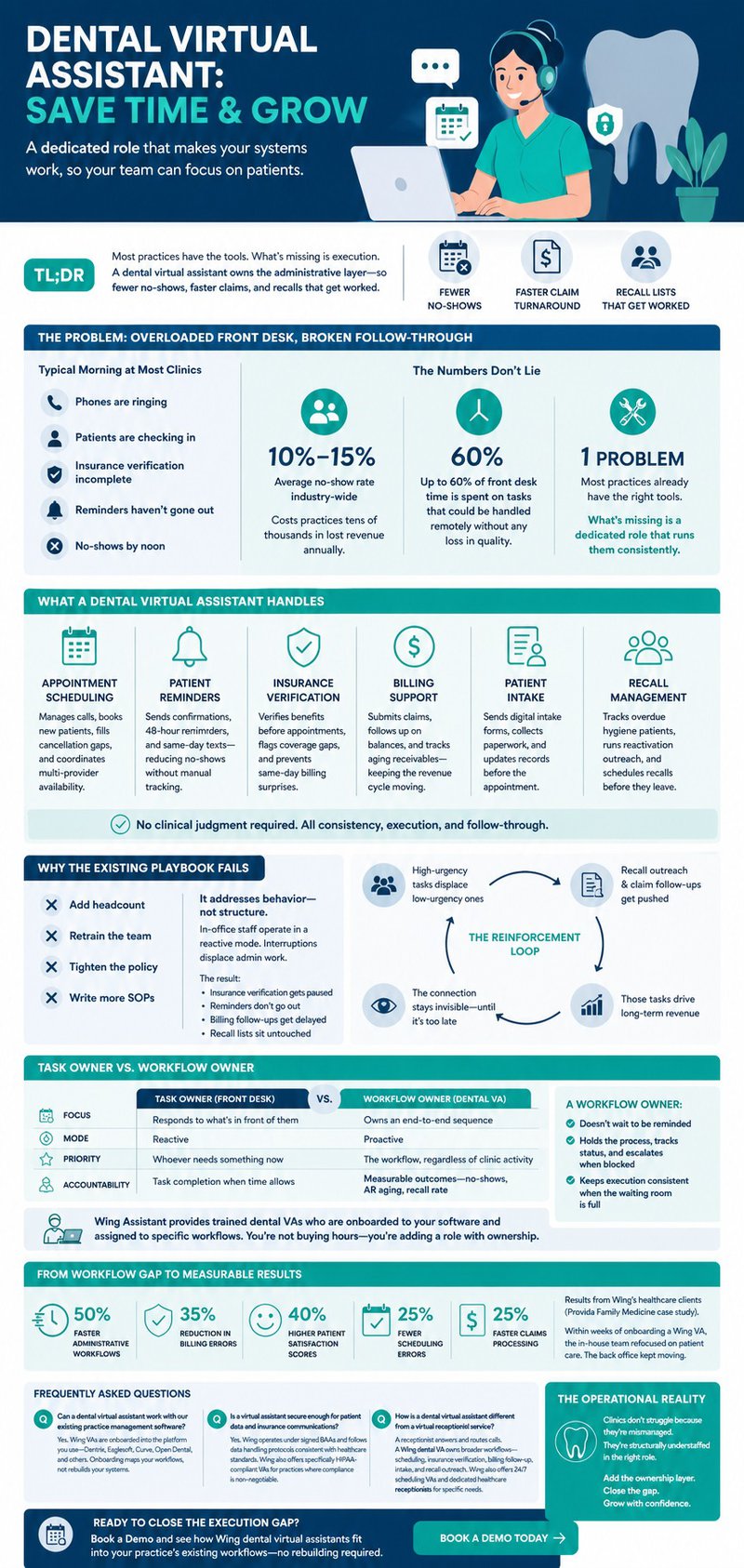
You’ve got the tools, practice management software, a billing system, and intake forms. Most practices do. The stack isn’t the problem. What keeps breaking is that the person running all of it is also answering phones, managing walk-ins, and handling whatever just walked through the door. The follow-through suffers. A dental virtual assistant owns the administrative layer as a dedicated function, not a secondary task squeezed in between everything else. Practices that make this shift see it in measurable places: fewer no-shows, faster claim turnaround, and recall lists that actually get worked.
Running a dental practice means managing a large administrative load beneath the clinical work, confirming appointments, verifying insurance, submitting claims, and following up on lapsed patients. Most of that work lives in your software already. The problem is execution.
The numbers reflect it. No-show rates industry-wide average between 10% and 15%, costing practices tens of thousands in lost revenue annually. Front desk staff spend up to 60% of their time on tasks that could be handled remotely without any loss in quality.
This article breaks down where the breakdown happens and how a dental virtual assistant closes the gap, and how Wing Assistant provides trained, practice-ready VAs who take ownership so your in-office team stays focused on the patient in front of them.

The Front Desk Is Overloaded — But That’s Not the Root Problem
Walk into most dental clinics at 9 a.m., and the front desk is already behind. A patient is checking in, the phone is ringing, yesterday’s insurance verification is still incomplete, and appointment reminders haven’t gone out. By noon, two patients no-showed, and a third arrived with no idea what they’d owe.
The instinct is familiar:
- Hire another front desk person
- Rewrite the cancellation policy
- Build better SOPs
Each of these addresses behavior — not structure. In-office staff are reactive by design. Every interruption competes with whatever administrative task was already in progress. The result is predictable:
- Insurance verification gets paused mid-task
- Reminder sequences don’t trigger on time
- Recall lists sit untouched for days, then weeks
Most practices already have the right tools. What they’re missing is a dedicated role that runs those tools consistently — without competing priorities pulling it in six directions at once. Hire dental assistant.
What a Dental Virtual Assistant Actually Handles
A dental virtual assistant is a trained remote professional, not an AI chatbot, who owns specific administrative workflows that currently fall through the cracks of a busy front desk.
- Appointment Scheduling. Manages inbound calls, books new patients, fills cancellation gaps, and coordinates multi-provider availability without pulling clinical staff into the conversation.
- Patient Reminders. Sends confirmation messages, 48-hour reminders, and same-day texts — reducing no-shows without requiring staff to track and trigger each one manually.
- Insurance Verification. Verifies benefits before appointments, flags coverage gaps, and eliminates same-day billing surprises for patients and staff alike.
- Billing Support. Submits claims, follows up on outstanding balances, and tracks aging receivables — keeping the revenue cycle moving without delay.
- Patient Intake. Sends digital intake forms, collects completed paperwork before arrival, and updates records in your practice management system ahead of the appointment.
- Recall Management. Tracks overdue hygiene patients, runs reactivation outreach, and schedules recalls before patients drift to a competitor.
None of these tasks requires clinical judgment. All of them require consistent execution — something your in-office team frequently cannot provide when the waiting room is full and three lines are ringing. Learn more about amazon seller assistant for hire.
Why the Existing Playbook Fails to Fix It
The standard response to scheduling breakdowns and rising no-shows usually looks like this:
- Add headcount
- Retrain the team
- Tighten the cancellation policy
- Write more detailed SOPs
None of it sticks, because it addresses behavior, not structure. The real issue is capacity allocation. In-office staff operate in a reactive mode by default:
- A patient walks in
- A phone rings
- A provider needs something
Each interruption displaces the administrative task already in progress. Insurance verification gets paused. Reminders don’t go out. Billing follow-ups get pushed to tomorrow, then next week.
The mistaken belief is that better processes fix inconsistent follow-through. They don’t. Consistent follow-through requires someone whose entire role is follow-through — not someone splitting attention across clinical support, front-desk coverage, and administrative tasks simultaneously.
How the Operational Breakdown Forms Over Time
The pattern rarely starts with failure. It starts with growth:
- Scheduling volume increases
- A new provider joins, and the payer mix expands
- Recall lists grow longer than anyone realistically works through
Each shift adds load gradually enough that it doesn’t feel structural; it just feels like a busy week.
The reinforcement loop sets in quickly:
- High-urgency tasks (live patients, ringing phones) displace low-urgency ones
- Recall outreach and claim follow-ups get pushed
- Those tasks happen to be the ones driving long-term revenue
Leadership often reinforces the loop without realizing it, measuring what’s visible (filled chairs, answered phones) rather than the upstream inputs that determine next month’s schedule. No-shows don’t get attributed to reminder gaps. Lost patients don’t get traced to recall failures. The connection between today’s administrative shortfall and next quarter’s revenue stays invisible until it’s large enough to hurt.

The Structural Model: Task Owner vs. Workflow Owner
The fix isn’t more staff — it’s the right role. The distinction comes down to how responsibility is structured:
| Task Owner (Front Desk) | Workflow Owner (Dental VA) | |
|---|---|---|
| Focus | Responds to what’s in front of them | Owns an end-to-end sequence |
| Mode | Reactive | Proactive |
| Priority | Whoever needs something now | The workflow, regardless of clinic activity |
| Accountability | Task completion when time allows | Measurable outcomes — no-shows, AR aging, recall rate |
A dental virtual assistant operates as a workflow owner. That means:
- They don’t wait to be reminded
- They hold the process, track the status, and escalate when something is blocked
- Their attention doesn’t split when the waiting room fills up
Wing Assistant provides trained dental VAs who are onboarded to your existing practice management software and assigned to specific workflows — scheduling, insurance verification, billing follow-up, recall outreach. You’re not buying hours. You’re adding a role with defined ownership and clear scope.
The result is simple: the systems you already have start working the way they were built to.
From Workflow Gap to Measurable Results
Most dental practices don’t need a bigger team; they need the right role to fill the right gap. That’s where Wing Assistant comes in.
Wing provides trained dental virtual assistants who are onboarded directly into your existing practice management software and assigned to specific workflows. You’re not buying hours. You’re adding a role with defined ownership and a clear scope.
The results from Wing’s healthcare clients reflect the shift:
- 50% faster administrative workflows
- 35% reduction in billing errors
- 40% higher patient satisfaction scores
- 25% fewer scheduling errors and 25% faster claims processing
(Source: Provida Family Medicine, Wing Assistant case study)
Provida Family Medicine, a primary care practice facing the same scheduling delays, billing bottlenecks, and administrative overload common in clinical settings, saw these results within weeks of onboarding a Wing VA. The in-house team refocused on patient care. The back office kept moving.
That’s the structural shift. Not more effort from the same people — a dedicated role that owns execution so your team doesn’t have to.
Yes. Wing’s dental virtual assistants are onboarded directly into the platform you already use — Dentrix, Eaglesoft, Curve, Open Dental, and others. The onboarding period maps your workflows, not rebuilds your systems. If billing is the priority, Wing also offers a dedicated medical billing specialist for practices that need focused revenue cycle support. HIPAA compliance applies to any party handling protected health information, including virtual assistants. Wing operates under signed BAAs and follows data handling protocols consistent with healthcare standards, and offers specifically HIPAA-compliant virtual assistants for practices where compliance is non-negotiable. Confirm this before engagement with any VA provider, it’s a baseline requirement, not a bonus feature. A virtual receptionist handles inbound call coverage, answering phones, routing messages. A Wing dental virtual assistant holds broader workflow ownership: scheduling, insurance verification, billing follow-up, patient intake, and recall outreach. For practices that need round-the-clock coverage, Wing also provides a 24/7 scheduling VA and a dedicated healthcare receptionist, each scoped to a specific function rather than general availability.Frequently Asked Questions
The Operational Reality, Restated
The clinics that struggle with no-shows, slow billing cycles, and underutilized chair time aren’t mismanaged; they’re structurally understaffed in the right role. Adding a dental virtual assistant doesn’t patch a broken team. It adds the ownership layer that was always missing. Once that layer exists, the systems you already have start working the way they were built to.
Ready to close the execution gap? Wing dental virtual assistants are trained, scoped, and operational, so your front desk can focus on patients while the administrative layer runs reliably in the background.
Book a Demo and see how Wing fits into your practice’s existing workflows, no rebuilding required.

Dianne Florendo is a content writer who creates engaging SEO content about virtual assistants, outsourcing, and business productivity.