

Most therapy practices run on a mix of clinicians doubling as schedulers and front desk staff fielding intake, billing, and follow-ups all at once. That split works until it doesn’t, patient volume grows, things slip through, and the people doing clinical work are burning hours on admin catch-up. A mental health virtual assistant takes that admin layer off the clinical team entirely, with dedicated ownership of scheduling, intake, insurance, and follow-ups. Sessions stay protected, patients get faster responses, and the practice can actually scale without adding internal headcount.
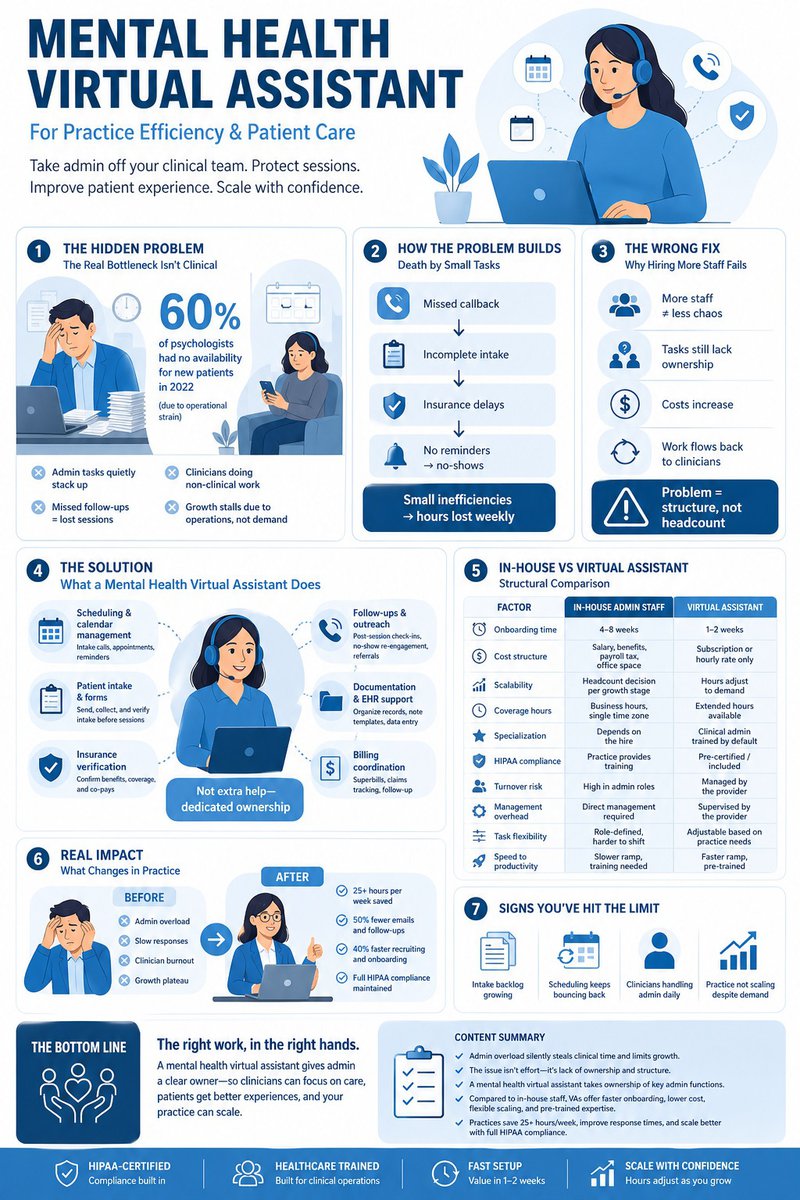
Mental health demand has outpaced most practices’ ability to keep up. According to the American Psychological Association, 60% of psychologists reported no availability for new patients in 2022, not from lack of interest, but from operational strain.
The bottleneck is rarely clinical. It’s administrative.
This guide covers what a mental health virtual assistant does, how it compares to in-house hiring, and how practices use Wing Assistant to offload admin work without adding full-time overhead.
The Admin Load That Quietly Compounds
Therapists and practice managers aren’t losing time to one big disruption. The bleed is gradual, small tasks, each seeming manageable, stacking until they’re not:
- A new patient callback that sat in the queue for two days
- An intake form that wasn’t followed up on before the first session
- An insurance verification that stalled because no one owned it
- A reminder that didn’t go out, and an appointment that didn’t show
None of these feels like an emergency in the moment. Across a full week, they add up to hours that should have gone toward patients or recovery.
The response is usually to absorb it. A front desk staffer takes on more. A clinician fields admin messages between sessions. The calendar fills up. At some point, the practice stops growing and starts just holding. That’s the signal. The work isn’t hard; the distribution is wrong.

The Wrong Fix Most Practices Reach For
The default response is hiring another receptionist, a part-time coordinator, and a biller. It’s a reasonable instinct, but it solves the wrong problem. The issue isn’t headcount. It’s that administrative work has no clear owner, so it lands wherever there’s capacity, usually on clinical staff. Learn more about best scribe company.
Adding people without restructuring how tasks flow creates new problems:
- More staff means more coordination, not less friction
- Admin responsibilities stay undefined, so they keep drifting back to clinicians
- Costs scale up while the underlying distribution problem stays intact
The structural variable that’s missing isn’t another body. It’s a dedicated function with a defined scope and follow-through ownership. That’s what a mental health virtual assistant is actually built to deliver. Learn more about amazon seller assistant outsourcing.
How the Overload Pattern Forms
It rarely starts as a crisis. It builds quietly, one workaround at a time:
- A clinician covers scheduling when the front desk is out
- An intake email gets handled during a lunch break
- A billing question gets answered between sessions
Each fix seems reasonable in the moment. But workarounds get normalized. What starts as a temporary gap becomes a standing habit, and the habit becomes load-bearing.
The reinforcement loop is hard to break because it runs on good intentions. Leadership steps in to keep things moving instead of designing a system that moves without intervention. Patients adjust to the informal setup. Referral partners lean on it. Over time the expectation sets, and undoing it requires explicit reassignment rather than just good intentions.
By the time it becomes visible, it has been running for months.
When the Pattern Becomes Undeniable
The inflection point usually hits at one of two moments:
- A growth push that exposes the gap — a practice adds providers and suddenly can’t process intake volume manually
- A fatigue shift where task density finally outpaces capacity — not from neglect, but from sheer volume
The trigger is often a failed step-back. A clinician tries to hand off scheduling, does it informally, and finds it back on their plate within a week. That moment makes the real issue clear: the handoff wasn’t structural. It was a request, not a redesign.
If that sequence sounds familiar, the practice isn’t broken. But the fix it needs is different from the one it has been applying.
What a Mental Health Virtual Assistant Actually Does
The term gets used loosely. In practice, a mental health virtual assistant is a remote administrative professional with defined task ownership in clinical operations — not a generalist VA, not a chatbot. A person handling a specific function set within a healthcare-adjacent context.
Core task areas include:
- Scheduling and coordination — new patient intake calls, appointment setting, calendar management, and reminder workflows
- Patient intake support — sending and collecting intake forms, verifying completion before first sessions
- Insurance verification — confirming benefits, plan coverage, and co-pay details before appointments
- Follow-up and outreach — post-session check-ins, missed appointment re-engagement, and referral communication
- Documentation support — organizing records, preparing session note templates, and managing EHR data entry
- Billing coordination — superbill preparation, billing follow-up, and claims status tracking
This isn’t a task list the clinician manages. It’s a function that runs with defined ownership. The difference is accountability, not activity.
Outsourcing vs. In-House Hiring: The Structural Comparison
Both models add admin capacity. What they solve for is different, and the gap between them widens as a practice grows.
In-house staff makes sense when volume is stable, the role is full-time, and the practice has bandwidth to manage onboarding, training, and compliance setup. A virtual assistant makes sense when coverage needs to flex, cost predictability matters, and the practice wants a trained operator without the overhead of a full employee.

Here is how they compare across the factors that matter most:
| Factor | In-House Admin Staff | Mental Health Virtual Assistant |
|---|---|---|
| Onboarding time | 4 to 8 weeks | 1 to 2 weeks |
| Cost structure | Salary, benefits, payroll tax, office space | Subscription or hourly rate only |
| Scalability | Headcount decision per growth stage | Hours adjust to demand |
| Coverage hours | Business hours, single time zone | Extended hours available |
| Specialization | Depends on the hire | Clinical admin trained by default |
| HIPAA compliance | Practice provides training | Typically pre-certified or included |
| Turnover risk | High in admin roles | Managed by the VA provider |
| Management overhead | Direct management required | Supervised by the provider |
| Task flexibility | Role-defined, harder to shift | Adjustable based on practice needs |
| Speed to productivity | Slower ramp, internal training needed | Faster ramp, pre-trained on clinical tasks |
The core difference is fixed versus variable. An in-house hire locks in cost and structure regardless of patient volume. A virtual assistant scales with the practice, up or down, without a hiring cycle attached to each decision.
Why Mental Health Practices Choose Wing Assistant
Administrative overload in mental health settings isn’t a new problem, but most practices are still solving it the wrong way. Wing Assistant offers a different model: trained healthcare virtual assistants with defined task ownership, built specifically for clinical operations.
Bryant West Psychology, a Manhattan-based mental health practice, is a direct example. Scheduling, billing, and documentation were consuming over 25 hours per week across the clinical team. After partnering with Wing, they saw:
- 25+ hours per week saved on clinic admin
- 50% fewer emails and manual follow-ups
- 40% faster recruiting and onboarding
- Full HIPAA compliance maintained throughout
Wing assistants come pre-trained in healthcare administrative tasks, arrive HIPAA-certified, and integrate into existing workflows without the onboarding overhead of a full hire. For practices that need defined task ownership, not just extra hands, it’s a structure that scales with patient volume rather than against it.
Yes — with the right safeguards in place. Reputable providers require HIPAA training and Business Associate Agreements before any patient communication is handled. Wing’s HIPAA-compliant virtual assistants are pre-certified and trained specifically for healthcare environments, so compliance is built in from day one rather than something the practice has to configure. A general VA handles broad administrative work without a healthcare context. A mental health virtual assistant is trained specifically in clinical admin tasks, patient intake, insurance verification, EHR support, scheduling, and follow-up workflows that require familiarity with how healthcare operations actually run. Wing also offers specialized roles like medical intake specialists, medical billing specialists, and patient care coordinator VAs, depending on where the practice needs the most coverage. Solo practitioners and small group practices — typically two to ten clinicians — see the clearest gains. Enough volume to need dedicated admin coverage, but not enough scale to justify a full-time in-house hire. Wing’s healthcare virtual assistants and 24/7 scheduling VAs are built for exactly this stage: functional ownership without the fixed cost of a full employee.Frequently Asked Questions
The Right Work in the Right Hands
Practices that struggle with admin overload aren’t failing because their teams aren’t working hard. The distribution is wrong; clinical bandwidth doing administrative work by default.
A mental health virtual assistant fixes the structure, not just the workload. Once admin work has a dedicated owner, clinical time goes where it was always supposed to go.
Wing Assistant makes that transition straightforward, with pre-trained healthcare VAs, HIPAA compliance built in, and a setup process that doesn’t require months of onboarding.
If the pattern described in this guide sounds familiar, the next step is a conversation. Book a demo with Wing and see how a dedicated mental health virtual assistant fits into your practice.

Dianne Florendo is a content writer who creates engaging SEO content about virtual assistants, outsourcing, and business productivity.