






TL;DR
- Most telemedicine practices staff their admin layer the same way a brick-and-mortar clinic would, one or two in-house people handling everything.
- That works until volume picks up. Then scheduling slips, insurance verification lags, and follow-ups fall through, not because the staff is bad, but because the workload wasn't built for remote-first scale.
- A telemedicine virtual assistant takes on the operational tasks that pile up behind the scenes: scheduling, EHR entry, insurance checks, and patient communication, handled remotely, within HIPAA guardrails.
- Practices that route work correctly stop firefighting and start running at actual capacity.
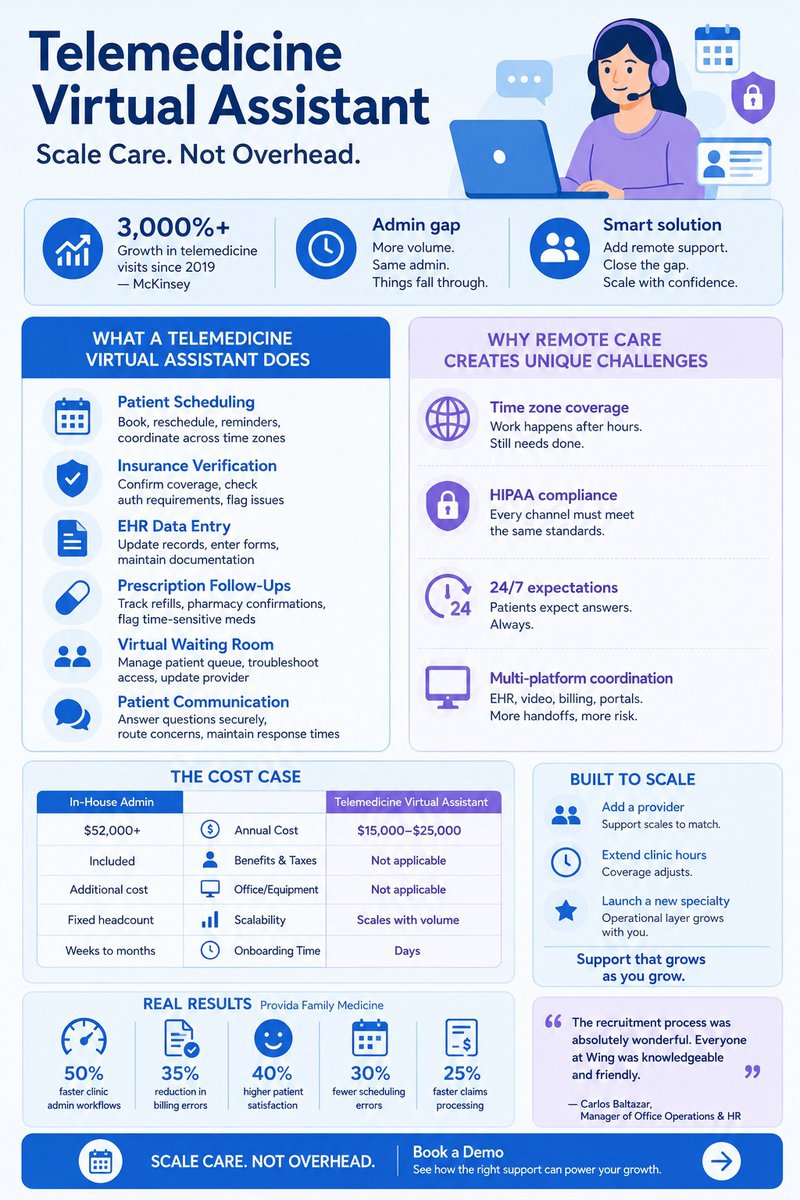
Telemedicine visits in the U.S. have grown by over 3,000% since 2019, according to McKinsey, and administrative infrastructure hasn't kept pace. Most practices scaled patient volume without scaling the operational layer behind it.
This article breaks down what a telemedicine virtual assistant actually handles, why remote healthcare creates a distinct admin problem, and how practices use virtual support to grow without adding fixed overhead.
Wing provides telehealth-trained virtual assistants built for exactly this operational model.
The Operational Gap Most Practices Don't See Coming
Running a telemedicine practice looks simpler than it is. The front desk disappears, but the administrative workload doesn't. It relocates.
Every appointment generates a chain of tasks:
- Scheduling confirmation and reminders
- Insurance verification and prior authorization
- EHR data entry and documentation
- Prescription follow-up and pharmacy coordination
- Patient communication and query routing
In a high-volume remote setup, that chain runs across dozens of patients, time zones, and platforms simultaneously.
Clinics that start small manage it manually. Clinics that grow can't. The ceiling usually shows up as something dropped:
- A missed prior authorization
- A follow-up that never went out
- A billing error that surfaces weeks later
The problem isn't staffing effort. It's that the administrative layer wasn't built to scale with remote-first volume. Learn more about appointment setting assistant.
What a Telemedicine Virtual Assistant Actually Does
A telemedicine virtual assistant is a remote administrative professional trained to handle the specific operational workflows that keep a telehealth practice functioning. This isn't general admin support, it's work scoped to the demands of remote healthcare: HIPAA-compliant communication, platform familiarity, and the kind of follow-through that prevents patient dropout.
- Patient Scheduling: Managing appointment calendars, handling rescheduling requests, sending reminders, and coordinating across time zones without gaps in provider availability.
- Insurance Verification: Confirming telehealth coverage before appointments, checking prior authorization requirements, and flagging issues before they become billing disputes.
- EHR Data Entry: Updating patient records, entering intake forms, and maintaining documentation standards across whatever EHR platform the practice uses.
- Prescription Follow-Ups: Coordinating refill requests, tracking pharmacy confirmations, and flagging time-sensitive prescriptions that need provider attention.
- Virtual Waiting Room: Managing the patient queue during live clinic hours, troubleshooting platform access issues, and keeping providers informed of wait times.
- Patient Communication: Handling inbound questions via secure messaging, routing clinical concerns to providers, and maintaining response times that prevent patients from disengaging.
These aren't tasks that require clinical licensure. They require reliability, system familiarity, and the discipline to execute consistently under volume pressure.
Why Remote Healthcare Creates a Distinct Admin Problem
In-person clinics have a physical constraint that naturally limits intake volume. Telemedicine doesn't. A single provider can see patients across multiple states in a single day, but that flexibility expands the administrative surface area in every direction at once.
A few specific pressures that don't exist in traditional clinic settings:
- Time zone coverage. A practice based on the East Coast serving West Coast patients has a four-hour operational window mismatch. Administrative work that happens after Pacific business hours still needs processing before the next clinic day.
- HIPAA compliance across channels. Every communication channel, email, messaging platform, and patient portal must meet the same standards as an in-person setup. That's not optional, and it doesn't simplify because the work is remote.
- 24/7 availability expectations. Patients expect responses outside standard business hours. Without dedicated coverage, that pressure lands on the provider or gets ignored, neither is sustainable.
- Multi-platform coordination. Telehealth practices often run across multiple tools, including EHR, video platform, billing system, and patient portal. Every handoff between systems is a point where something can fall through.
A virtual assistant trained in telehealth operations understands these boundaries. They know which tasks belong in which channels, where the compliance lines are, and where the handoff to a licensed provider begins.
The Cost Case for Hiring Virtually
Hiring in-house administrative staff carries a fixed cost structure, salary, benefits, payroll taxes, and equipment. That structure doesn't flex when patient volume drops or when the practice is building out a new service line.
Here's how the numbers compare:
| In-House Admin | Telemedicine Virtual Assistant | |
|---|---|---|
| Annual Cost | $52,000+ | $15,000–$25,000 |
| Benefits & Taxes | Included | Not applicable |
| Office/Equipment | Additional cost | Not applicable |
| Scalability | Fixed headcount | Scales with volume |
| Onboarding Time | Weeks to months | Days |
Beyond the cost difference, there are a few structural advantages worth noting:
- No hiring ahead of demand. Virtual assistant arrangements let you start part-time and expand as patient volume grows. You match support to actual workload, not projected workload.
- Shorter ramp time. A VA placed through a telehealth-specialized service arrives already familiar with EHR systems, insurance workflows, and HIPAA-compliant communication. Less onboarding, fewer early errors.
- No overhead creep. No equipment to provision, no desk to fill, no benefits administration. The cost is the work — nothing else.
The math isn't complicated. The question is whether the practice is structured to take advantage of it.
Scale Without Adding Structural Complexity
The typical growth pattern for a telemedicine practice hits a specific ceiling: the provider can see more patients, but the administrative layer can't keep up. The usual response is one of two things, both problematic:
- Hire another in-house admin. Adds fixed cost, management overhead, and a hiring cycle that doesn't move as fast as patient volume does.
- Let the provider absorb more admin work. Not sustainable. Not a good use of licensed clinical time.
The cleaner model is to treat administrative capacity as something that scales independently of headcount decisions:
- Add a new provider — support scales to match.
- Extend clinic hours — coverage adjusts accordingly.
- Launch a new specialty — the operational layer expands without rebuilding from scratch.
This is what structural scalability looks like in practice: support grows in proportion to patient load, not in fixed jumps tied to hiring decisions.
Wing is built for this model. Telehealth-trained virtual assistants can be added part-time or full-time, scoped to the practice's actual workload, and expanded as volume grows, without the overhead of a traditional hire.
Where Wing Fits in This Model
Wing provides virtual assistants specifically trained for healthcare operations. That means the work covered, scheduling, insurance, EHR support, and patient communication, is handled by someone who already understands the compliance environment and workflow logic of remote care.
The results from practices that have made this shift are measurable. At Provida Family Medicine, partnering with Wing produced:
- 50% faster clinic admin workflows
- 35% reduction in billing errors
- 40% higher patient satisfaction
- 30% fewer scheduling errors and 25% faster claims processing
“The recruitment process was absolutely wonderful. Everyone at Wing was knowledgeable and friendly.”
— Carlos Baltazar, Manager of Office Operations & HR
For practices that are scaling, Wing's model allows support to expand without rebuilding the administrative infrastructure from scratch each time.
Assistants are placed part-time or full-time, scoped to the practice's actual workload, and adjusted as volume grows, without the overhead of a traditional hire.
Frequently Asked Questions
Can a telemedicine virtual assistant handle HIPAA-compliant tasks?
Yes, when properly trained and operating within compliant systems. Virtual assistants handling telehealth operations should be familiar with PHI handling protocols, use HIPAA-compliant communication platforms, and sign Business Associate Agreements (BAAs) with the practice. Wing's HIPAA-Compliant Virtual Assistants are trained specifically for this environment, PHI handling, compliant communication channels, and BAA requirements are built into the placement, not added as an afterthought.
How is a virtual assistant different from an automated scheduling tool?
Automated tools handle predictable inputs, a patient selects a time slot, a confirmation goes out. A virtual assistant handles the exceptions: the last-minute reschedule, the insurance issue that needs a human follow-up, the prescription request that doesn't fit a template. Wing's 24/7 Scheduling VA and Patient Care Coordinator VA are built for exactly this, judgment-layer work that automation can't cover.
What telemedicine-specific roles can a virtual assistant fill?
More than most practices realize. Beyond general admin, Wing offers roles scoped to specific telehealth workflows, including Prior Authorization Specialists, Medical Billing Specialists, Medical Insurance Verification Specialists, and dedicated Telehealth VAs. Each role arrives already oriented to the compliance environment and operational demands of remote care.
The Practice That Scales Is the One That Structured Support Early
Most telemedicine practices don't fall behind because of clinical limitations. They fall behind because the administrative layer wasn't built to scale alongside patient volume. That's a structural gap, and it's fixable.
A telemedicine virtual assistant closes the distance between what a provider can clinically deliver and what the practice can operationally support. The practices that get this right early don't just run smoother, they scale faster.
Book a Demo to see how Wing's telehealth-trained virtual assistants can fit into your practice.

Dianne Florendo is a content writer who creates engaging SEO content about virtual assistants, outsourcing, and business productivity.