
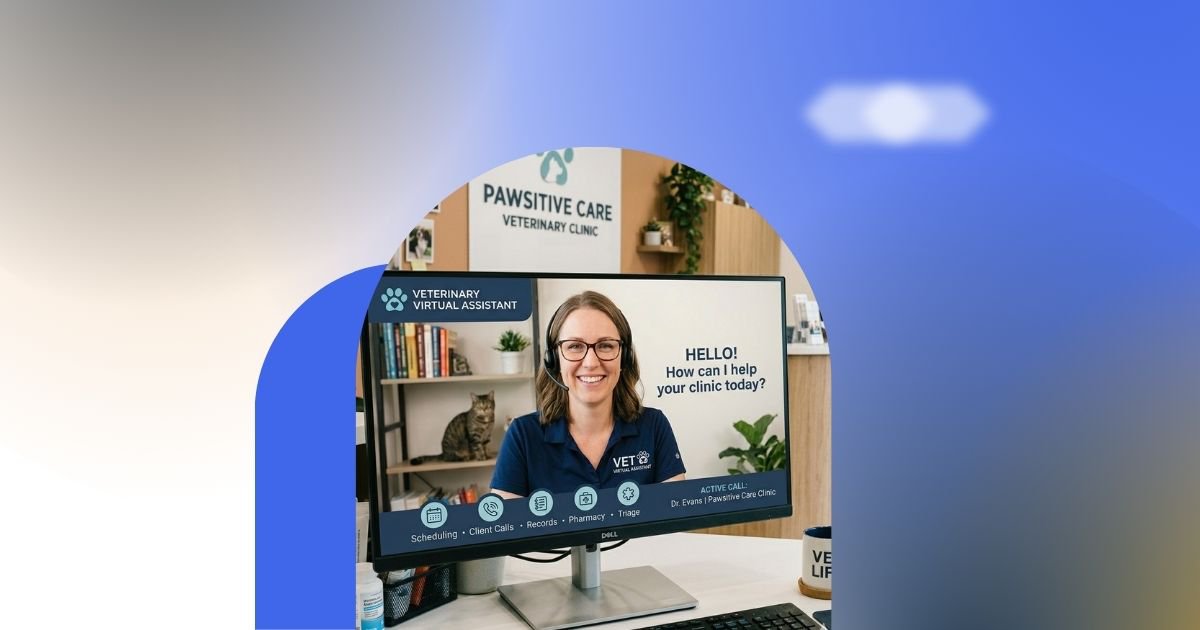
Most veterinary clinics dealing with admin overload hire another front desk person or hand more to the staff already there. It buys a few months. Then the same gaps come back, because the work got redistributed, but no one actually owns it. A veterinary virtual assistant doesn’t just take tasks off the pile, it holds specific workflows end-to-end, so nothing falls through when the front desk is slammed. The clinic stops running on whoever notices the problem. It runs on structure.
Administrative tasks consume nearly 30% of staff time in a typical veterinary practice, according to the AVMA, and most of that time isn’t going toward anything clinical.
This article covers what a veterinary virtual assistant actually does, why the usual fixes don’t hold, and how Wing gives clinics a way to offload the admin layer without rebuilding their entire operation.
The Admin Load Isn’t a Staffing Problem
Most veterinary clinics hit a wall somewhere between 300 and 600 active clients. Not because the team is underperforming, but because the coordination volume outpaces what any front desk can absorb informally.
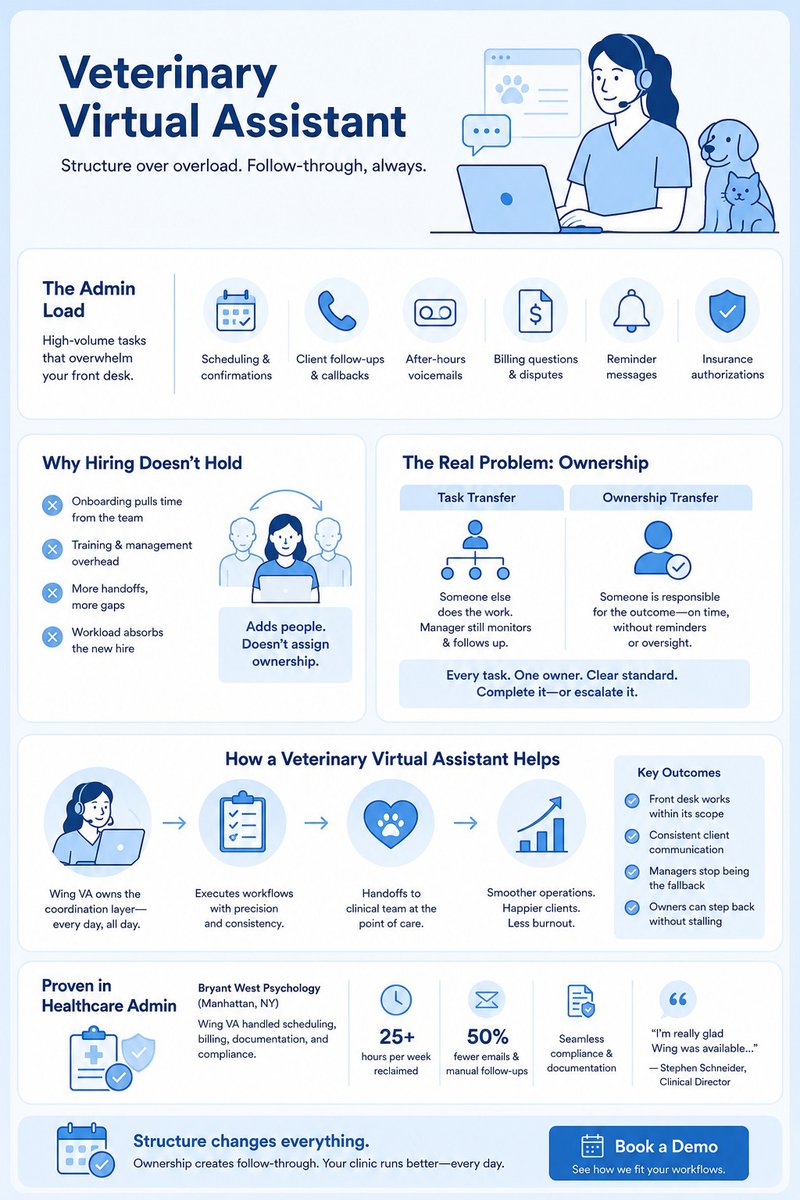
The daily pile looks like this:
- Appointment scheduling and confirmation calls
- Client follow-ups and callback queues
- After-hours voicemails that carry into the next morning
- Billing questions that sit until someone has a window
- Reminder messages that go out late, or don’t go out at all
The instinct is to hire. But most clinics that add front desk staff find the same thing six months later: the workload absorbed the new hire, and the problem resets.
That’s not a people problem. It’s a structural one. A veterinary virtual assistant doesn’t solve hiring; it solves the underlying architecture that keeps making more hires necessary. Learn more about best virtual assistant.

Why Hiring Another Receptionist Doesn’t Fix It
The default move looks reasonable
When the front desk is overwhelmed, adding someone feels like the obvious fix. More volume, more hands. The logic holds—until you watch it play out.
Here’s what actually happens after the hire:
- The new person needs onboarding, pulling time from whoever is already stretched
- Management absorbs training overhead for weeks
- Once they’re live, coordination between two people adds its own friction, handoffs, overlap, and gaps in task ownership
- Within a few months, the workload has absorbed the new hire, and the problem resets
The variable that got missed isn’t headcount. It’s follow-through ownership, who is actually responsible for making sure the reminder is sent, the callback is logged, and the billing dispute is resolved.
In most clinics, that answer is implicit. It defaults to whoever noticed the gap. And whoever noticed the gap is usually already overloaded.
Adding staff spreads the task load. It doesn’t assign ownership. That’s why the problem keeps coming back. Learn more about amazon seller assistant services.
How the Pattern Forms
It starts with volume, not neglect
A new clinic with 80 clients can absorb most coordination tasks informally. The front desk person knows regulars by name. Reminders go out because there aren’t that many. Follow-ups happen because someone has time.
As the client base grows, the informal system doesn’t break immediately. It bends. A reminder gets sent a day late. A callback waits until the afternoon. Billing questions get deferred. Each of these individually seems like a minor slip, not a systemic failure.
Why does it feel manageable?
The volume increase is gradual. Staff adapts by working faster, staying later, and skipping non-urgent tasks. The clinic starts confusing “we’re handling it” with “the system is working.” No one flags the issue because the clinic is still running.
What reinforces it
Leadership sees high appointment fill rates and assumes operations are stable. The real metrics, callback lag, after-hours voicemail volume, and billing delay time, aren’t being tracked. So the reinforcement loop continues: more clients, more informal task absorption, more silent backlog.
When the System Becomes Undeniable
The threshold isn’t dramatic
Most clinics don’t have a single collapse moment. The system just gets harder to ignore, front desk visibly at capacity, staff turnover climbing, client satisfaction quietly slipping.
The inflection point is usually one of these three:
- A key front desk person leaves, and the informal task-handling knowledge walks out with them
- A practice manager tries to step back and realizes the clinic stalls without them personally catching the fallthrough
- Client volume spikes after a promotion or expansion, and the backlog becomes visible overnight
By this point, the task load has already converted into decision load. Staff aren’t just doing more, they’re making judgment calls dozens of times a day about what to prioritize, what to defer, what to let slip. That cognitive overhead is what causes fatigue. And that fatigue is what drives turnover.
The Real Problem Is Ownership, Not Output
Task transfer versus authority transfer
Most clinics treat overload as a throughput problem. Move more tasks through the system faster, and the problem resolves. That’s why SOPs get written, checklists get built, and new hires get trained.
But throughput isn’t the bottleneck. Ownership is.
The difference looks like this:
- Task transfer: Someone else does the work, but the manager still monitors, follows up, and catches anything that slips
- Ownership transfer: Someone else is structurally responsible for the outcome, on time, without a reminder, without oversight
Most clinics are running on task transfer while believing they’ve delegated. The manager is still the fallback. That’s not delegation—it’s distribution.
The model that works
Structured ownership is simple: every task has an assigned owner, a defined completion standard, and a clear escalation path. No one else has to notice it. The owner completes it or escalates it; those are the only two outcomes.
A veterinary virtual assistant operates inside this model:
- Scheduling isn’t just answered—it’s owned
- Follow-ups aren’t just sent—they’re tracked
- Billing queries aren’t just noted—they’re logged and resolved
The clinic doesn’t supervise the task. It confirms the outcome.

Where a Veterinary Virtual Assistant Fits Structurally
Operational continuity across the full day
A Wing veterinary virtual assistant takes ownership of the recurring coordination layer—the work that has to happen every day, on time, regardless of what else is going on at the front desk:
- Appointment scheduling and confirmation calls
- Client follow-up and callback management
- Reminder messaging for appointments and treatments
- Insurance authorization tracking
- Billing support and query resolution
- After-hours call handling
These aren’t judgment calls. They’re precision tasks that need consistent execution. Wing assistants integrate into your existing tools, practice management software, phone systems, and scheduling platforms, and operate within defined workflows. The handoff to clinical staff happens where it should: at the point of medical judgment, not admin coordination.
What does this change at the clinic level?
Once the coordination layer has a dedicated owner, the ripple effect is immediate:
- The front desk stops triaging and works within its actual scope
- Managers stop being the default fallback for missed tasks
- Client communication stays consistent whether it’s a quiet Tuesday or a slammed Friday
- Practice owners can step back without the clinic stalling
This isn’t a staffing solution. It’s a structural one. Overhead per client drops. Follow-through rate rises. The system runs without someone having to notice the gap.
Wing’s Track Record in Healthcare Admin
Wing has worked across healthcare settings where the admin pattern looks nearly identical to what veterinary clinics face: high patient volume, scheduling pressure, billing complexity, and a front desk that can’t absorb it all.
Bryant West Psychology, a Manhattan-based mental health practice, was spending over 25 hours per week on scheduling, billing, and documentation—time the clinical team couldn’t afford to lose. Wing placed a HIPAA-trained healthcare VA who handled patient scheduling, insurance billing, payment recording, and compliance tracking. The outcome:
- 25+ hours per week reclaimed from clinic admin
- 50% fewer emails and manual follow-ups
- Seamless compliance and documentation management
Testimonial:
“I’m really glad Wing was available to assist me with a well-trained, highly functioning assistant who integrated easily into our practice.”
— Stephen Schneider, Clinical Director
The throughline across both cases is the same as it is in veterinary clinics: the problem wasn’t effort, it was that high-volume, precision admin work was sitting inside a structure that wasn’t built to hold it. Wing’s healthcare assistants are trained to own that layer, so clinical teams don’t have to manage it alongside everything else.
Wing’s Veterinary Virtual Assistants follow defined scripts and escalation protocols for sensitive situations—client complaints, billing disputes, or emotionally charged calls. Anything outside the defined scope routes to clinical or managerial staff immediately. Wing also offers a Healthcare Receptionist and Medical Call Center Specialist for clinics that need dedicated front-of-house communication coverage. The assistant handles volume; clinical judgment stays in-house. Yes. Wing assistants are trained to operate within platforms like Avimark, Cornerstone, ezyVet, and others. Depending on your clinic’s needs, Wing can place a Healthcare Virtual Assistant, Medical Administrative VA, or Medical Billing Specialist to handle scheduling, record updates, and billing tasks within your existing system—no migration required. Onboarding typically takes one to two weeks. For most clinics, yes. A trained Wing assistant costs significantly less than a part-time W-2 hire when factoring in benefits, onboarding time, and turnover risk. Wing also offers role flexibility—clinics can combine a 24/7 Scheduling VA for after-hours coverage, a Prior Authorization Specialist for insurance workflows, or a HIPAA-Compliant Virtual Assistant for compliance-sensitive tasks. The assistant is fully operational from day one—no ramp period where productivity is partial and supervision is high.Frequently Asked Questions
What Changes When the Structure Changes
The problem was never the team. It was a structure that required someone to notice every gap before anything got caught.
When admin tasks have explicit owners, the clinic stops depending on whoever has a free moment. Follow-through becomes the default, not the exception.
That’s the shift a veterinary virtual assistant makes possible. Not more headcount. More structure.
Book a Demo and see how Wing fits into your clinic’s existing workflows.

Dianne Florendo is a content writer who creates engaging SEO content about virtual assistants, outsourcing, and business productivity.