

The core difference between AI tools and human assistants: AI produces outputs, while human assistants own outcomes and accountability for what happens after the output is generated.
You’ve already moved past the “should we try AI” conversation. You’ve probably tried it. Maybe tried outsourcing too, or brought in freelancers to plug gaps. Something worked for a while. Then complexity grew, someone turned over, a priority shifted, and you were back to being the person holding execution together.
That’s not a resourcing problem. It’s a structure problem. And it shows up identically regardless of what you tried.
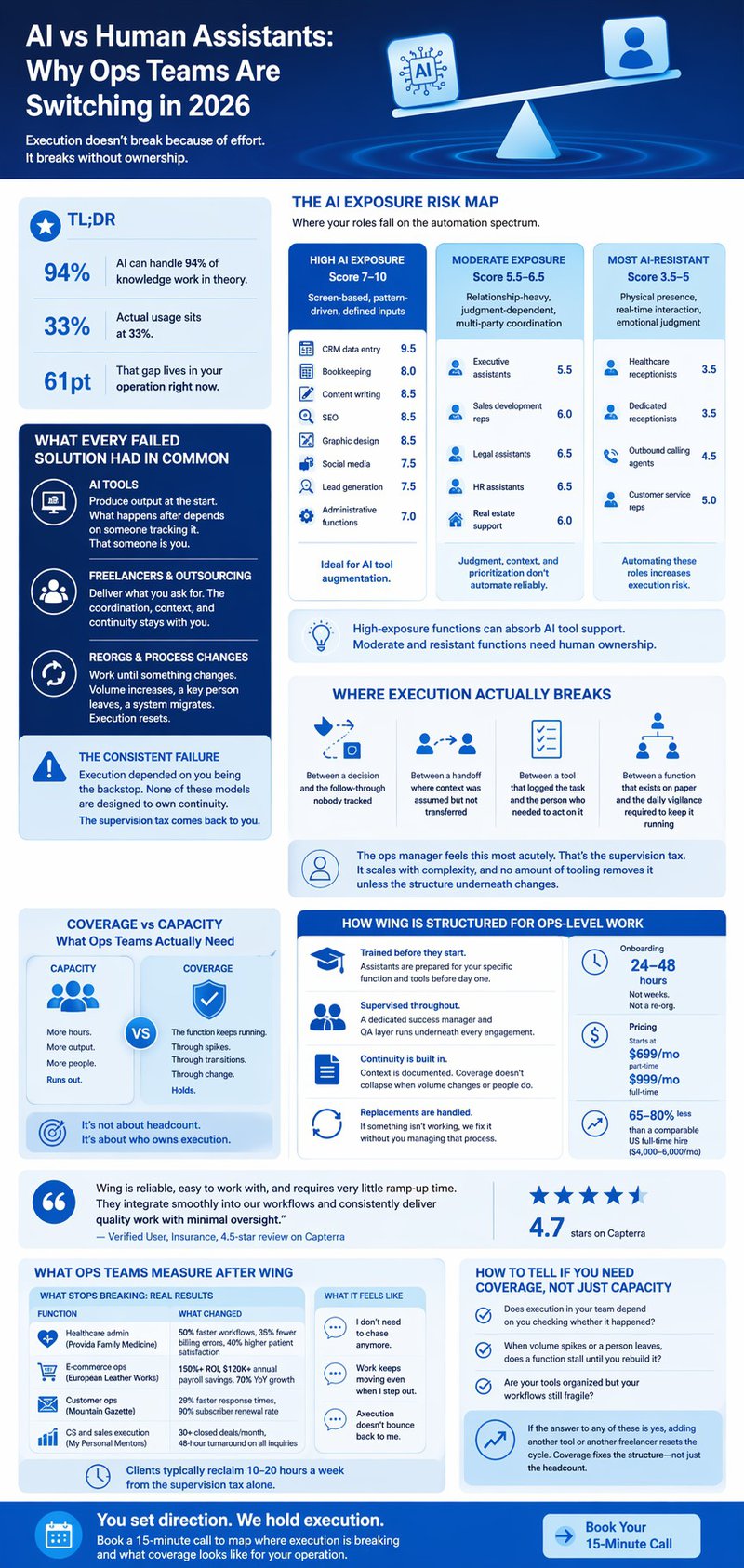
Start With the Data. It Maps Where Your Operation Is Fragile.
Anthropic published research on AI’s actual vs theoretical impact on knowledge work (“The Anthropic Economic Index,” January 2025). The headline finding: AI can theoretically handle 94% of tasks in computer and knowledge work roles. Observed professional usage in practice sits around 33%.
That 61-point gap isn’t skepticism or slow adoption. It’s the part of operational work that genuinely can’t be handed to a tool: exceptions, context that only makes sense inside a specific business, judgment calls that shift day to day, and the coordination that nobody formally owns but everyone depends on.
For an ops manager, that gap is a risk map. Here’s how it breaks down across the roles most relevant to your team:
| AI Exposure Level | Score Range | Example Roles | Task Characteristics | Recommended Approach |
|---|---|---|---|---|
| High exposure | 7–10 | CRM data entry (9.5), bookkeeping (8.0), content writing (8.5), SEO (8.5), graphic design (8.5), social media (7.5), lead generation (7.5), administrative functions (7.0) | Screen-based, pattern-driven, defined inputs | AI tools with human oversight for output ownership |
| Moderate exposure | 5.5–6.5 | Executive assistants (5.5), sales development reps (6.0), legal assistants (6.5), HR assistants (6.5), real estate support (6.0) | Relationship-heavy, judgment-dependent, multi-party coordination | Human assistant with AI tool support |
| Most AI-resistant | 3.5–5 | Healthcare receptionists (3.5), dedicated receptionists (3.5), outbound calling agents (4.5), customer service reps (5.0) | Physical presence, real-time interaction, and emotional judgment | Human assistant required |
What this map tells an ops manager: your high-exposure functions can absorb AI tool support well. Your moderate and resistant functions need human ownership.
The mistake most operations teams make is applying the same logic across all three tiers, then wondering why execution keeps breaking in the same places.

What Every Failed Solution Had in Common
If you’ve run outsourced ops, brought in freelancers, or leaned heavily on AI tools, the failure mode was probably the same each time, even if the surface looked different.
AI tools produce output at the start of a workflow. What happens after depends on someone tracking it, chasing it, noticing when it didn’t land right. That someone defaults to you.
Freelancers and outsourcing vendors: deliver what you ask for. The coordination, context, and continuity across what came before and what comes next stay with the ops manager. You become the manager again.
Internal re-orgs and process changes: work until something changes. Volume increases, a key person leaves, a system migrates. Execution resets. You rebuild.
The consistent failure across all three: execution depended on you being the backstop. None of those models is designed to own continuity. That responsibility defaults back to whoever is watching the whole picture. Usually, the head of ops.
“Everything requires chasing.” “Nothing is owned end-to-end.” “It works until something changes.” These aren’t complaints about specific tools or vendors. They’re the structural signature of a continuity problem—when no single person or system owns the thread of execution across handoffs, context shifts, and follow-through.
Where Execution Actually Breaks
Growing operations don’t fail because people aren’t working. They fail in predictable places:
- Between a decision and the follow-through, nobody tracked
- Between a handoff where context was assumed but not transferred
- Between a tool that logged the task and the person who needed to act on it
- Between a function that exists on paper and the daily vigilance required to keep it running
The ops manager feels this most acutely. You’re the escalation path. You’re the one who noticed when something drifted three days ago. You’re the one quietly checking whether it actually got done.
The supervision tax is the hidden cost of managing AI tools and other solutions rather than doing the work directly, the time spent checking, chasing, correcting, and coordinating that doesn’t show up in any productivity metric but consumes hours every week. It scales with complexity, and no amount of tooling removes it unless the structure underneath changes.
Coverage vs Capacity: What Ops Teams Actually Need
Most solutions sell capacity. More hours, more output, more people available on demand.
Coverage is different. Here’s how they compare:
| Attribute | Capacity | Coverage |
|---|---|---|
| Definition | More hours, output, or people available on demand | Continuous ownership of execution across workflows |
| What it provides | Task completion when assigned | Function stability through volume spikes, transitions, and complexity |
| Ownership model | You assign and track | The assistant owns and reports |
| When it fails | When you stop managing it | Rarely—continuity is built into the structure |
| Use case | Project-based work, overflow tasks | Ecommerce operations, customer service, CRM management, project coordination |
Execution coverage means a function keeps running, accurately and consistently, without requiring the ops manager to hold it together. Capacity runs out. Coverage holds.
The difference isn’t headcount. It’s whether the ownership of execution lives with your team or with the system you’ve embedded into your workflows.

How Wing Is Structured for Ops-Level Work
Wing isn’t a marketplace, and it isn’t an outsourcing vendor. A managed execution service is a staffing model where trained assistants are embedded into your workflows with built-in supervision, quality assurance, and continuity, removing the management burden from your team. Wing is built specifically around the continuity problem.
Every Wing virtual assistant is embedded into your existing tools and workflows with clear ownership of defined execution areas. Not parachuted in to complete a task list. Embedded, with context, accountability, and responsibility for what happens on the other side of every handoff.
Behind each assistant is the structure that removes management burden from your team:
- Trained before they start. Assistants are prepared for your specific function and tools before day one.
- Supervised throughout. A dedicated success manager and QA layer runs underneath every engagement.
- Continuity is built in. Context is documented. Coverage doesn’t collapse when volume changes, or people do.
- Replacements are handled. If something isn’t working, Wing fixes it without you managing that process.
- Onboarding takes 24 to 48 hours. Not weeks. Not a re-org.
For healthcare operations where compliance and patient-facing accuracy are non-negotiable, that structure isn’t a nice-to-have. It’s the only version that actually holds.
Wing is rated 4.7 stars on Capterra. Pricing starts at $699/month part-time or $999/month full-time for a general virtual assistant. Fully managed. 65 to 80 percent less than a comparable US full-time hire at $4,000–$6,000/month.
“Wing is reliable, easy to work with, and requires very little ramp-up time. They integrate smoothly into our workflows and consistently deliver quality work with minimal oversight.” — Verified User, Insurance, 4.5-star review on Capterra
Book a 15-minute call. We’ll map where execution is breaking in your operation and what coverage looks like for your team.
What Ops Teams Measure After Wing
The ops managers running Wing describe the shift in two ways: numbers and felt stability. Both matter.
What stops breaking:
| Function | What Changed |
|---|---|
| Healthcare admin (Provida Family Medicine) | 50% faster workflows, 35% fewer billing errors, 40% higher patient satisfaction |
| E-commerce ops (European Leather Works) | 150%+ ROI, $120K+ annual payroll savings, 70% YoY growth |
| Customer ops (Mountain Gazette) | 29% faster response times, 90% subscriber renewal rate |
| CS and sales execution (My Personal Mentors) | 30+ closed deals/month, 48-hour turnaround on all inquiries |
What it feels like:
- “I don’t need to chase anymore.”
- “Work keeps moving even when I step out.”
- “Execution doesn’t bounce back to me.”
Clients typically reclaim 10 to 20 hours a week from the supervision tax alone. That’s not productivity language. That’s structural relief.
“With the top-notch support I get from my dedicated assistants, I can rely on my marketing and social media channels to grow while I focus on customers and overall growth.” — Sacha Hason, Owner, European Leather Works
How to Tell If You Need Coverage, Not Just Capacity
Use this diagnostic checklist to determine whether your operation needs coverage or capacity:
- Does execution in your team depend on you checking whether it happened?
- Yes → You need coverage (ownership is missing)
- No → Capacity may be sufficient
- When volume spikes or a person leaves, does a function stall until you rebuild it?
- Yes → You need coverage (continuity is missing)
- No → Your current structure may be adequate
- Are your tools organized but your workflows still fragile?
- Yes → You need coverage (the tools work, but no one owns the execution)
- No → Consider whether capacity alone solves your bottleneck
Interpretation: If you answered “yes” to any of these questions, adding another tool or another freelancer resets the cycle. The structure is what’s missing, not the headcount.
Wing enters through a specific execution gap, a contained area where work is stalling or ownership is unclear. From there, the function stabilizes. Context accumulates. Coverage expands naturally as complexity grows, without adding coordination burden to your team.
You set the direction. Wing holds execution.
Book a 15-minute call to map where execution is breaking and what coverage looks like for your operation.
Key Takeaways
- AI produces. A dedicated assistant owns. The gap between AI’s theoretical capability (94%) and actual usage (33%) is where execution breaks.
- The cost didn’t go down—it moved and got invisible. The supervision tax of managing AI tools and freelancers consumes 10–20 hours weekly for most ops managers.
- Coverage holds. Capacity runs out. The difference between a function that survives transitions and one that collapses is ownership, not headcount.
- All failed solutions share the same failure point: no one owns what happens between decisions, handoffs, and follow-through.
- Structure beats tools. Embedded, managed execution coverage removes the ops manager as the default backstop.
Use AI tools for high-exposure tasks (score 7–10) like data entry, content drafting, and bookkeeping, where outputs are pattern-driven and well-defined. Use human assistants for moderate and AI-resistant tasks (score 3.5–6.5) that require judgment, relationship management, or real-time coordination. Most operations benefit from a hybrid approach where AI handles initial output, and humans own execution and accountability. Wing places Data Entry VAs, Content Writers, and Bookkeeping Assistants on the AI-augmented side, while a General Virtual Assistant can own the judgment calls AI can’t make alone. Tasks requiring physical presence, real-time human interaction, and emotional judgment are most AI-resistant. These include healthcare reception, dedicated receptionist roles, outbound calling, and customer service. These functions score 3.5–5 on AI exposure because automating them increases execution risk rather than reducing it. Wing staffs these exact functions with dedicated humans: a Healthcare Receptionist, a Dedicated Receptionist, an Outbound Calling Agent, and a Customer Service Representative. The hidden cost is the supervision tax—the time spent checking, chasing, correcting, and coordinating AI outputs that doesn’t appear in productivity metrics. This typically consumes 10–20 hours weekly for ops managers and scales with operational complexity. The cost didn’t disappear with automation; it moved from visible labor to invisible management burden. This is exactly the gap a Project Manager or Executive Assistant from Wing is built to close, since they absorb the coordination work instead of adding to it. Capacity means more hours, output, or people available on demand—it runs out when you stop managing it. Coverage means continuous ownership of execution across workflows, where functions keep running through volume spikes and personnel changes without requiring the ops manager to hold them together. Wing’s General Virtual Assistant and Executive Assistant roles are structured for coverage, not just capacity, with backup and QA built into the engagement. With a managed execution service like Wing, onboarding takes 24 to 48 hours. Assistants are trained on your specific function and tools before day one, with supervision and quality assurance built into the engagement from the start. Whether you need a General Virtual Assistant, an Administrative Assistant, or a role specific to your industry, you can schedule a call with Wing to get started.Frequently Asked Questions
Bottom Line: When AI can theoretically handle 94% of knowledge work but actual usage sits at 33%, the gap isn’t a technology problem; it’s an ownership problem. The question isn’t whether to use AI or human assistants; it’s who owns what happens after the output is generated. AI produces. A dedicated assistant owns.

Dianne Florendo is a content writer who creates engaging SEO content about virtual assistants, outsourcing, and business productivity.