

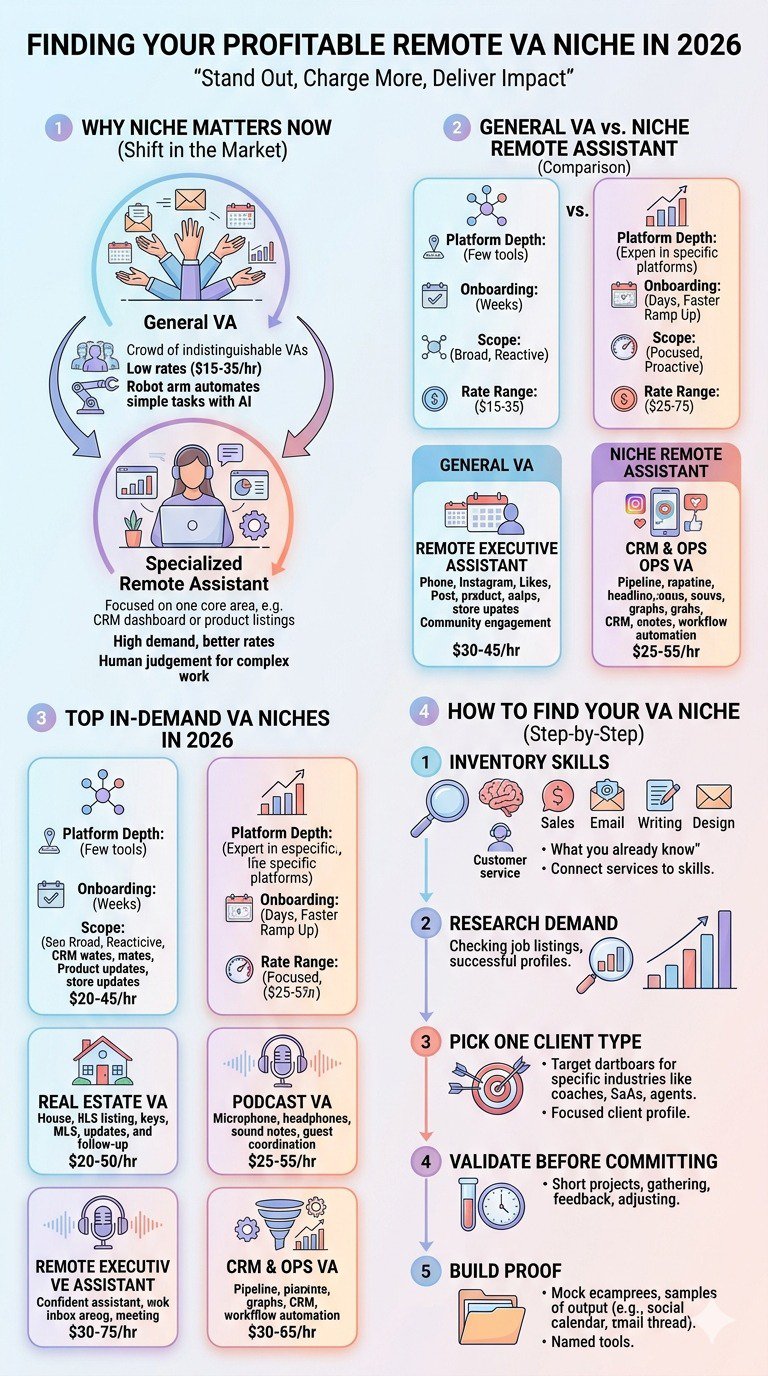
Most VAs entering the market position themselves as generalists to appeal to more clients. The problem is that supply of general VAs has exploded, pushing rates down while businesses now expect someone who contributes from day one, not someone they have to train from scratch. The fix is narrowing to a specific niche plus client type (e.g. “ecommerce VA for Shopify DTC brands” instead of “virtual assistant”), which cuts onboarding from weeks to days and justifies higher rates. Result: faster hiring decisions, less oversight needed, and pay that reflects real platform and industry depth instead of generic hourly rates. That specialization is exactly how Wing structures its roster, matching businesses to specialists like a CRM & Automation Specialist instead of a generic hire.
Choosing the right VA niche as a remote virtual assistant can reshape your business. The assistants who stay fully booked and charge higher rates tend to share one thing: they stopped trying to do everything and focused on doing one thing well. For businesses, the shift to hiring niche remote assistants rather than general admins reflects the same logic: targeted support delivers better results with less management overhead.
Wing Assistant has supported over 1,000 virtual assistants and worked with businesses across more than 20 industries. The pattern is consistent: both assistants and the companies hiring them get better outcomes when the work is focused. This guide covers how to identify the right VA niche, evaluate whether it’s profitable, and position yourself so the right businesses find you.
What Is a Remote Assistant? (And Why VA Niche Matters Now)
Defining the Role
A remote assistant is a professional who provides specialized support to businesses, executives, or teams from outside the organization, typically working independently or through a managed service. The term covers a wide range of roles: remote administrative assistants, remote executive assistants, remote support assistants, and niche specialists in areas like ecommerce, real estate, or CRM operations.
What separates a remote assistant from a traditional employee is the working model: no office, no fixed headcount, and often flexible engagement—hourly, retainer, or project-based. What separates a niche remote assistant from a general VA is depth: they bring platform expertise, industry familiarity, and workflow knowledge that businesses no longer want to train from scratch.
How the VA Market Has Changed
A few years ago, general admin work, email sorting, scheduling, and data entry were enough to keep a VA pipeline full. That window has closed. Businesses now expect remote support assistants to step in and contribute from day one. They’re not looking for someone to train; they’re looking for someone who already understands their tools, their workflow, and the outcomes they’re trying to hit.
Two forces accelerated this shift. First, the supply of general VAs exploded—hundreds of new entrants enter the market weekly, which pushed down rates and pushed up expectations. Second, AI tools automated the most repetitive, low-skill admin tasks. What’s left for human assistants is higher-judgment work: strategy execution, client-facing communication, platform-specific operations, and anything that requires continuity and context. Those tasks reward specialists. Learn more about medical assistant.
How AI Is Changing How Businesses Hire Remote Assistants
AI has changed not just what businesses need, but how they find remote assistants. Search and matching systems—Google AI Overviews, Perplexity, Upwork’s algorithm, LinkedIn’s hiring filters—reward clarity. A profile that says “Virtual Assistant” blends into a long list. A profile that says “Shopify Ecommerce VA” or “Remote Executive Assistant for Founders” surfaces in the right searches.
The same principle applies to business-side research. When a company searches for remote support options, AI tools surface results that match specific terms. VA niche positioning isn’t just a marketing tactic, it’s a discoverability strategy. Hire a podcast producer.

Why Businesses Hire Specialized Remote Assistants
The Business Case for VA Niche Remote Support
From a hiring standpoint, a VA niche remote assistant reduces risk. When a business brings in a generalist, they absorb the cost of onboarding, training, and early mistakes. A specialist with platform depth or industry experience cuts that ramp time significantly, often from weeks to days.
Specialized remote assistants also tend to perform better on the tasks that directly affect revenue. A CRM VA who already knows HubSpot pipelines, a remote executive assistant who can manage a complex calendar without being told twice, or an ecommerce virtual assistant who can update product listings without supervision, or an virtual marketing assistant who handles SEO and contents, each of these roles has a direct operational impact that’s easier to measure and justify than general admin support. Learn more about SEO content writing services.
What Remote Assistants Do That AI Still Can’t
AI handles volume. It can draft emails, summarize documents, and run reports at scale. What it can’t do is make judgment calls, manage relationships, or navigate ambiguous situations. The tasks that still require human remote assistants fall into a few clear categories:
- Client-facing communication that requires tone, empathy, and situational awareness
- Executive support that involves discretion, context, and institutional knowledge
- Platform operations where errors have real financial consequences (Shopify orders, MLS listings, CRM pipelines)
- Project coordination that involves multiple stakeholders and shifting priorities
- Creative tasks where judgment and brand understanding are required
These are the roles where niche remote assistants are hired, retained, and paid well. Businesses have already cut what AI could replace. What remains is the work that requires a human who knows what they’re doing. Learn more about IT support as a service.
How Businesses Evaluate Remote Assistant Skills
When a business reviews candidates for a remote assistant role, they’re looking for a short onboarding curve and clear evidence of relevant experience. The signals they look for:
- Platform proficiency—can you name the tools and explain how you use them?
- Industry familiarity—do you understand the workflow and pace of their business?
- Scope clarity—can you define exactly what you handle and what you don’t?
- Proof of output—samples, client references, or measurable results from similar work
- Communication quality—is your written communication clear, prompt, and professional?
General profiles fail on most of these. VA niche profiles answer all of them immediately. Learn more about real estate cold calling service.
Remote Assistant vs. General VA: Key Differences
The distinction matters for both sides of the hiring equation. Here’s how they compare across the dimensions businesses care about most:
| Skill Area | General VA | Niche Remote Assistant | Why It Matters |
|---|---|---|---|
| Platform depth | Familiar with common tools | Expert in 2–3 niche platforms (e.g., HubSpot, Shopify) | Less training time; immediate output |
| Industry knowledge | Generalist | Knows the workflow, terminology, and pace of one industry | Fewer mistakes; better judgment calls |
| Onboarding time | 2–4 weeks | 3–7 days | Businesses hire for speed; specialists deliver faster |
| Scope of work | Broad, reactive | Focused, proactive within a defined lane | Clearer expectations; easier to manage |
| Rate range | $15–$35/hr | $25–$75/hr depending on niche | Specialization commands a premium |
For businesses, the calculus is simple: a niche remote assistant costs more per hour but delivers faster, requires less oversight, and produces more consistent output. For assistants, specialization is the clearest path to higher rates and better-fit engagements.

The Most In-Demand VA Niches for 2026
Not every VA niche pays equally or stays consistently busy. The ones below have staying power because they’re tied to operational functions businesses can’t pause, sales pipelines, customer communications, platform management, and executive bandwidth.
| Niche | Key Tasks | Typical Rate | Best For (Businesses) | Why It’s In Demand |
|---|---|---|---|---|
| Social Media VA | Scheduling, captions, community engagement, basic reporting | $20–$45/hr | Brands, agencies, coaches | Online presence is table stakes; few owners have time to manage it daily |
| Ecommerce VA | Product uploads, order handling, store updates (Shopify, WooCommerce, Amazon) | $25–$60/hr | DTC brands, Amazon sellers | Platform-specific work is hard to hand off without someone who knows the tools |
| Real Estate VA | MLS updates, lead follow-ups, appointment setting, transaction coordination | $20–$50/hr | Independent agents, brokerages | Agents stay busy; they need consistent admin support without a full-time hire |
| Remote Executive Assistant | Inbox triage, calendar management, meeting prep, ops support | $30–$75/hr | Founders, C-suite, busy executives | High-trust role where continuity and judgment matter; AI can’t replace it |
| Podcast VA | Audio edits, episode uploads, show notes, guest coordination | $25–$55/hr | Podcasters, media brands | Podcast output is growing; production is time-consuming without dedicated support |
| CRM & Ops VA | CRM updates, pipeline tracking, workflow automation, reporting | $30–$65/hr | Sales teams, agencies, SaaS companies | Data hygiene and CRM discipline directly affect revenue; businesses pay for accuracy |
A Closer Look at Remote Executive Assistant Work
The remote executive assistant role is both the highest-paid and the most misunderstood. This isn’t scheduling meetings and booking travel—though it includes both. A strong remote executive assistant manages an executive’s attention: filtering what gets on the calendar, what gets a response, what gets delegated, and what gets dropped.
The skills that matter most in this role are judgment, discretion, and pattern recognition. An executive assistant who’s been in the role for six months understands how their executive thinks. That context can’t be recreated quickly, which is why businesses pay to keep strong remote executive assistants and why rates in this niche start above $30/hr and can reach $75/hr or more for experienced operators.
For remote administrative assistants moving up, this is the natural progression. The transition requires learning to manage up rather than just execute tasks, and building the kind of trust that comes with consistent, low-maintenance performance.
How to Find Your VA Niche: Step-by-Step
Step 1: Inventory Your Existing Skills
The fastest path to a viable va niche is through what you already know. Professional backgrounds in customer service, sales, real estate, accounting, marketing, or operations all translate directly to in-demand remote assistant roles. You don’t need new certifications, you need to connect your existing skills to the problems businesses are actively paying to solve.
Start by listing the tasks you’ve done professionally and the tools you’ve used confidently. Common VA services that map to VA niches:
- Admin and calendar management → Remote executive assistant or remote administrative assistant
- CRM updates and lead tracking → CRM and ops VA
- Social media scheduling and content → Social Media Assistant
- Product listing and order management → Ecommerce VA
- Client communication and follow-up → Real estate VA or customer support VA
- Bookkeeping basics → Finance support VA or Bookkeeping Virtual Assistant
- Research and reporting → Operations or executive support VA
- Healthcare and Medical → Virtual Assistant Healthcare
Ask yourself: which of these tasks are easier for you than most people? Which ones have you done without needing much guidance? That’s your starting point.
Step 2: Research Demand
A niche is only useful if businesses are actively hiring for it. Before committing, verify demand by browsing job posts on Wing Assistant, Upwork, and OnlineJobs. Look for recurring request patterns, if you see the same role or task description appear across multiple listings, that’s a signal the niche has legs.
Also, look at what successful remote virtual assistants in your target niche are charging. If rates consistently sit above $25–$30/hr for a specific role, the market values that specialization. If rates are flat or job volume is thin, widen your search before narrowing your focus.
Step 3: Pick One Client Type
The most effective niche isn’t just a service category, it’s a service category plus a client type. “Social media VA for SaaS startups” is more useful than “social media VA.” “Remote executive assistant for solo founders” is more specific than “executive assistant.” The narrower your client definition, the faster the right businesses recognize you as the obvious hire.
You don’t have to commit permanently. Pick one client type, test it for 60–90 days, and adjust based on what you see.
Step 4: Validate Before You Fully Commit
Run a few small test projects before repositioning entirely. Take on 1–2 jobs in your target niche, price them fairly, and pay attention to the feedback. Does the work come naturally? Does the engagement go smoothly and lead to referrals? Validation doesn’t require a big audience—it requires real output with real buyers.
If the test goes well, update your profile to reflect the niche. If it doesn’t, you’ve learned something useful without burning your existing client relationships.
Step 5: Build Proof
The fastest way to get hired in a niche is to show work that looks like what the business needs. A mock social media calendar, a sample Shopify product upload, a redacted email thread, or a before/after of an inbox organization system, any of these signals competence faster than a general service list.
Wing Assistant evaluates thousands of VA profiles. The ones that consistently perform best share a few traits: a niche stated in the first sentence, one or two concrete examples of output, named tools, and a clear description of the client type they serve.
Specialized Remote Assistant Tools and Platforms
Platform proficiency is one of the primary things businesses look for when hiring a niche remote assistant. Knowing which tools are standard in your target niche and being able to name them confidently shortens the evaluation conversation significantly.
Common platforms by niche:
- Remote executive assistant: Google Workspace, Notion, Calendly, Superhuman, Slack, Asana
- Ecommerce VA: Shopify, WooCommerce, Amazon Seller Central, Gorgias, Klaviyo
- Real estate VA: Follow Up Boss, MLS platforms, DocuSign, REI BlackBook, Dotloop
- Social media VA: Buffer, Later, Hootsuite, Canva, Meta Business Suite, Sprout Social
- CRM and ops VA: HubSpot, Salesforce, Pipedrive, Monday.com, Airtable, Zapier
- Podcast VA: Descript, Riverside, Buzzsprout, Podbean, Audacity, Notion for show notes
Pick two or three tools in your target niche and learn them well enough to answer specific questions about workflows. Businesses don’t need you to know everything—they need you to demonstrate that you won’t require a full tour.
Pricing Your Niche Remote Assistant Services
Niche remote assistants charge more because their work has a direct operational impact, and businesses recognize that. Pricing depends on three variables: the niche’s complexity, the level of responsibility, and your experience in that domain.
- Hourly: best for project-based or irregular work; easier to start with
- Monthly retainer: best for ongoing support roles; provides income stability
- Per-project: best for defined deliverables like content batches or onboarding setups
When setting rates, ask: how much does a mistake in this role cost the business? The higher the operational impact, the more the role commands. A remote executive assistant managing a founder’s calendar and communications affects every meeting, decision, and relationship that the executive handles. That impact justifies rates in the $40–$75/hr range for experienced operators.
Starting rates are typically lower while you build proof, but moving up is straightforward once you can show results. Businesses that see the value don’t negotiate over $5–$10/hr increments.
How Wing Assistant Supports Niche Remote Assistants
Wing Assistant connects businesses with skilled remote virtual assistants across a wide range of specialized roles. Rather than matching companies with generalists, Wing focuses on niche alignment—pairing businesses with assistants who already understand the relevant platforms, workflows, and expectations.
Wing’s track record:
- 1,000+ virtual assistants placed across specialized roles
- 95% client satisfaction rating driven by niche-aligned matching
- Specialized VAs working with Wing saw up to a 40% increase in client engagement after narrowing their focus
- Active in 20+ industries, including ecommerce, real estate, SaaS, professional services, and agency support
- Onboarding, niche-specific training, and practical guidance so assistants can step into roles without a long ramp-up
For businesses, Wing eliminates the sourcing and vetting burden. For remote assistants, it provides access to companies that are already looking for the kind of support they provide.
Ready to Find Your Remote Assistant Niche?
The market for niche remote virtual assistants is growing. Businesses are actively moving away from generalist support toward remote assistants with specific skills, platform experience, and industry familiarity. For assistants, the path to better engagements and higher rates runs through focus, not scope expansion.
If you’re ready to narrow your focus, build your skill set, or connect with businesses that need exactly the kind of support you provide, Wing Assistant can help.
Frequently Asked Questions
The niches with the most consistent demand and strongest rates are executive assistance, ecommerce operations, CRM and pipeline management, and social media. These roles are tied directly to revenue-generating functions, which means businesses prioritize them even when budgets are tight. Wing Assistant offers dedicated specialists across all of these—including Ecommerce Virtual Assistants, CRM & Automation Specialists, and Social Media Assistants—so businesses can hire into a niche without sourcing from scratch. For assistants just starting out, social media VA and remote administrative assistant work are strong entry points with lower technical barriers.
A remote administrative assistant handles structured, repeatable tasks: scheduling, document management, data entry, and general coordination. A remote executive assistant works more closely with senior leadership, managing their time, communications, and often acting as a gatekeeper for their attention. Executive assistant roles require more judgment, carry more responsibility, and command higher rates, typically $30–$75/hr versus $18–$40/hr for administrative support. Wing offers both: a dedicated Executive Assistant for high-trust leadership support and an Administrative Virtual Assistant for structured operational tasks, making it easy to match the right role to the right need.
Most businesses start with a specific pain point, an overloaded inbox, a chaotic calendar, a neglected CRM, or a social media presence that’s going stale. They search for remote support through platforms like Upwork, through managed services, or increasingly through AI-powered search tools. Wing Assistant simplifies the process by matching businesses directly with niche-aligned remote assistants across more than 100 specialized roles—from Real Estate Virtual Assistants to Lead Generation VAs to Bookkeeping Virtual Assistants. What converts a search into a hire is specificity: businesses move faster when the assistant’s profile clearly describes the exact kind of work they need done, and Wing’s matching process is built around that principle.
The market for niche remote virtual assistants is growing. Businesses are actively moving away from generalist support toward remote assistants with specific skills, platform experience, and industry familiarity. For assistants, the path to better engagements and higher rates runs through focus, not scope expansion.
If you’re ready to narrow your focus, build your skill set, or connect with businesses that need exactly the kind of support you provide, Wing Assistant can help.

Dianne Florendo is a content writer who creates engaging SEO content about virtual assistants, outsourcing, and business productivity.