

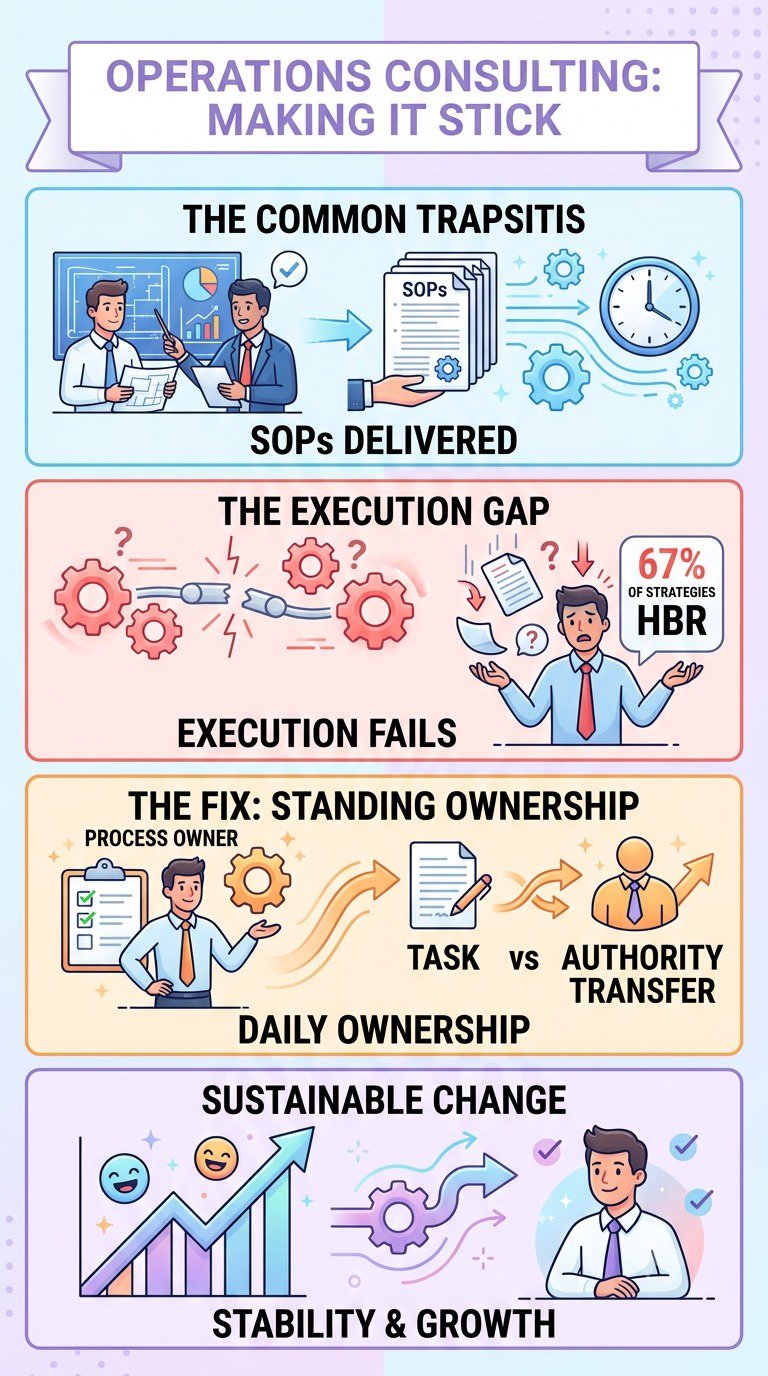
What most founders do: Bring in a consultant, get a solid diagnosis, walk away with a stack of SOPs. The problem: Nobody’s actually responsible for running the new process once the consultant’s gone, so it quietly slips back to old habits. The fix: Someone needs standing ownership of execution, not just a document telling people what to do. The outcome: The change actually holds, instead of getting re-diagnosed (and re-paid for) every year.
Research cited by Harvard Business Review found that 67% of well-formulated strategies fail because of poor execution, not poor strategy. Consulting isn’t the weak link, what happens after the deck gets handed over usually is.
Every founder eventually hires an operations consultant, gets a sharp diagnosis, and watches the fix decay within two quarters. The pattern repeats because the diagnosis was never the problem; the missing owner was. Consultants map bottlenecks, write SOPs, and hand over a deck, then leave. Someone has to run the new process, adjust it under pressure, and enforce it when it’s inconvenient. That person rarely exists once the engagement ends, so the founder absorbs the gap by default.
The recommendations weren’t wrong; there was just no one left to make them stick. Founders who treat consulting as a one-time purchase keep re-buying the same diagnosis every year or two. Founders who separate diagnosis from execution build something that survives past the engagement.
This article covers the operations consulting lessons that actually matter: why that gap forms, why more SOPs or a second consultant won’t close it, and what does, separating diagnosis from ongoing execution ownership. It also touches on where a resource like Wing Assistant fits, not replacing consulting, but covering the standing execution layer that most engagements never account for.

The Fix That Doesn’t Outlast the Invoice
The pattern is familiar to anyone running a company with more than ten employees:
- Onboarding takes too long.
- Handoffs slip between departments.
- The same fire gets put out every few weeks.
A consultant gets hired, spends a few weeks mapping the workflow, and delivers a set of process changes with real logic behind them. For a month or two, things run cleaner. Then the friction returns, not identical, but structurally the same. The specific breakdown changes; the underlying gap doesn’t.
Founders usually read this as a quality problem: wrong consultant, wrong framework, wrong timing. That reading keeps the search going for a better version of the same purchase, which is exactly why the pattern repeats instead of resolving. Hire founder assistant.
The Missing Piece Isn’t a Better SOP
The default response to a stalled fix is usually one of three moves:
- Hire a new consultant for fresh eyes.
- Delegate harder to free up time.
- Write more detailed SOPs to reduce ambiguity.
Each option seems reasonable. None of them addresses the actual gap.
- A consultant’s job ends with the recommendation.
- Delegation without someone accountable for adjusting the process just moves the same unowned task to a different desk.
- An SOP is a static document; it doesn’t notice when a step stops working, doesn’t update when volume shifts, and doesn’t enforce itself when someone’s tempted to skip it under pressure.
The missing variable isn’t better instructions. It’s ongoing execution authority, someone whose job is to run the process, watch where it breaks, and adjust it before it becomes a fire. Without that role, even a correct diagnosis has no mechanism to stay correct. This is one of the operations consulting lessons that rarely make it into the deck: SOPs without an owner to execute them are just shelfware with good formatting.
The Quiet Loop That Traps the Founder
This gap doesn’t appear all at once. It builds in small increments that each feel manageable on their own:
- A process gets documented, but no one is assigned to maintain it.
- The founder checks in occasionally to make sure it’s being followed.
- That check-in becomes routine.
- Over time, the founder isn’t just checking; they’re catching exceptions, resolving edge cases, and quietly redoing steps that got skipped.
None of this feels like a failure of the consulting engagement. It feels like normal founder involvement.
The reinforcement loop is simple: the founder steps in because no one else has the standing authority to do so, and stepping in repeatedly signals to the team that the founder is the actual owner of the process, regardless of what the SOP says. That belief, once set, is hard to unwind without a structural change, not just a new document.

When You Can’t Step Back Anymore
The shift becomes visible at a specific threshold — usually when the company crosses a growth stage that adds volume or complexity faster than the founder’s personal bandwidth can absorb.
- Early on: the cost is task load — more emails, more approvals, more one-off exceptions. That’s tolerable.
- Later on: the cost becomes decision load — the founder isn’t just doing more, they’re the only one who can decide how an edge case should be handled. That’s a different kind of fatigue, and it doesn’t resolve by working faster.
The trigger event is usually one of the following:
- A vacation where things slipped.
- A hire who couldn’t get traction without the founder’s constant input.
- A growth spurt that exposed how many decisions were still routed through one person.
At that point, the gap stops being an inconvenience and becomes visibly structural.
Handing Off Work vs. Handing Off Authority
The sharper model here separates two things that get treated as one: task transfer and authority transfer.
| Task Transfer | Authority Transfer | |
|---|---|---|
| What moves | The work itself | The right to decide, adjust, and enforce |
| Who typically provides it | A consultant’s engagement | Someone inside the company |
| Duration | Ends when the contract ends | Continuous |
| What it produces | A process, documented once | A process, maintained and corrected over time |
Consulting engagements are built almost entirely around task transfer, they hand over a process. They rarely hand over standing authority because a consultant isn’t positioned to hold it after the contract ends.
Operational stability requires operations consulting lessons and someone inside the company holding that authority continuously:
- Living inside the process daily.
- Catching drift before it compounds.
- Having the standing to change something without needing sign-off each time.
That’s decision rights with structured ownership, and it’s the piece consulting engagements are structurally unable to deliver on their own.
The Assistant Who Replaced the Fire Drill
This is where the model applies practically, not just conceptually. A consulting engagement diagnoses the bottleneck. What closes it is someone with continuous ownership over execution, running the process daily, adjusting it as conditions change, and holding the follow-through that a one-time engagement can’t provide.
Carty Custom Builders, a custom homebuilding firm in Austin, Texas, ran into the same structural gap. As their client base grew, admin work, invoicing, budget tracking, and CRM upkeep kept pulling the founders off the job site. A part-time Wing Assistant took over that ongoing execution layer directly:
- 80+ admin hours saved
- 10+ hours saved weekly on bookkeeping
- 22+ hours saved weekly on CRM upkeep
- QuickBooks management and reporting streamlined
- Leadership is free to focus on project delivery
As one of the firm’s co-founders put it: “Working with our Wing Assistant has allowed us to focus on building and less on office work.” That’s the distinction this article is built on, not a better diagnosis of the admin backlog, but someone with standing ownership to keep running it.
The alignment isn’t about outsourcing being cheaper than consulting, though it usually is over time. It’s that ongoing ownership is a different kind of resource than a one-time diagnosis, and the two solve different halves of the same problem.
An operations consultant diagnoses inefficiencies, maps workflows, identifies bottlenecks, and recommends process changes or SOPs. One of the most common operations consulting lessons founders learn the hard way: the engagement typically ends at the recommendation stage, not at ongoing execution or maintenance of the new process. That’s usually where a role like a Technical Ops Specialist or Project Manager picks up, running the process day to day instead of just documenting it. Costs vary widely by scope and consultant tier, but engagements are typically project-based rather than ongoing. The recurring cost founders underestimate isn’t the fee; it’s the time spent re-implementing the same fix when no one owns follow-through. A dedicated Administrative Virtual Assistant or Executive Assistant through Wing fills that ongoing gap at a fraction of a repeat consulting fee. Often, yes, but the comparison isn’t quite apples to apples. A consultant diagnoses; a VA or ops assistant executes and maintains. Most founders eventually need both at different points in the process. Wing’s General Virtual Assistant role is built specifically for that ongoing execution layer.Frequently Asked Questions
Nothing Was Wrong With the Diagnosis
None of this means past consulting engagements were wasted, and it doesn’t mean the founder did anything wrong by hiring one. The diagnosis was likely accurate. What was missing was never obvious in the moment; there simply wasn’t a role built to hold the fix in place after the engagement ended.
The shift isn’t about finding a better consultant next time. It’s recognizing that diagnosis and ownership are two separate jobs, and operational stability only holds when both are staffed. Once that distinction is visible, the same bottleneck stops looking like a hiring problem and starts looking like what it always was: a structural gap waiting for someone to hold it. That’s the core of the operations consulting lessons worth carrying forward.
Ready to close that gap? Book a demo with Wing.

Dianne Florendo is a content writer who creates engaging SEO content about virtual assistants, outsourcing, and business productivity.