







TL;DR: Most teams handle time-zone gaps by writing more SOPs and telling everyone to "over-communicate." That just moves the wait somewhere else; someone's still stuck sitting on a decision until the right person logs back on. What actually fixes it is giving one person real ownership of those hours, not just another task to check off. Once someone owns the window, the "waiting on someone" problem stops repeating.
Every distributed team hits the same wall eventually: work keeps moving, but decisions don't, because no one's actually there to make them.
Microsoft's Work Trend Index found that after-hours work communication keeps climbing, with employees now exchanging close to 60 chats a day outside working hours as teams try to informally patch over coverage gaps. That's not a sign of a hardworking team; it's a sign the gap has no real owner.
This article breaks down why async work limitations persist despite better tools and documentation, and argues that the fix is structural: assigning real-time ownership of the hours your team can't cover. Wing Assistant's dedicated VA model is one way to put an actual owner on that gap instead of patching it with after-hours effort.
The Real Cost of Waiting on Async Replies
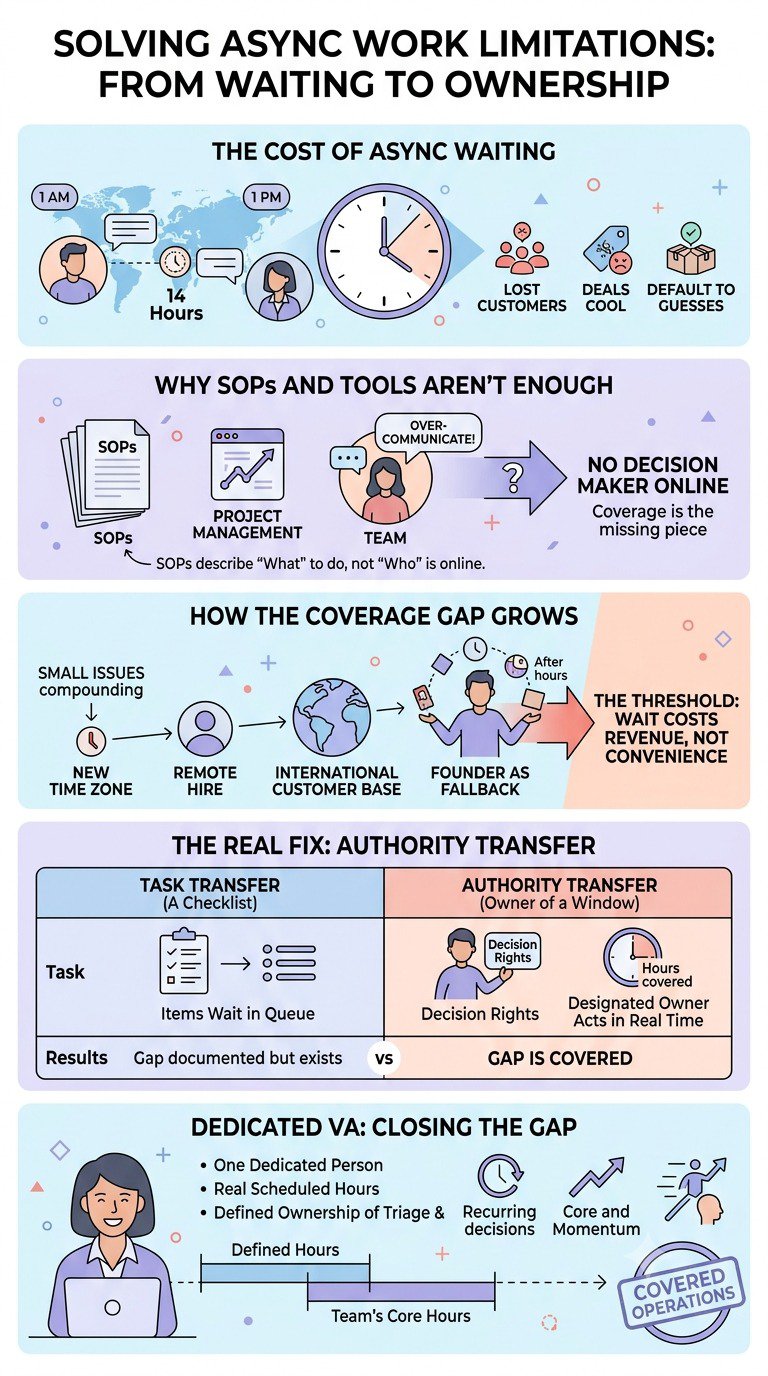
A founder sends a Slack message at 4 p.m. It needs a decision by the end of the day. The reply comes back fourteen hours later, once the relevant person is finally online again.
By then, the moment has usually already passed:
- The customer moved on
- The deal cooled
- The team defaulted to a guess instead of waiting
This isn't a one-off. It's the default operating rhythm of async-first teams once they cross a certain size or time-zone spread. Every handoff carries a built-in delay, and the delay compounds with every additional person in the chain.
The pattern isn't about slow people. It's about a structure with no one covering the gap.
Why More SOPs Won't Fix It
The standard response is to tighten process:
- Write clearer SOPs
- Add a project management tool
- Ask the team to "over-communicate" so decisions don't stall waiting on context
This feels reasonable because it's the lever founders can pull without hiring anyone. Documentation is cheap, tools are cheap, and "communicate better" sounds like leadership.
But none of it changes who is actually present when a decision needs to be made. SOPs describe what should happen. They don't cover the hours when nobody with authority is online to make it happen.
The missing variable isn't information; it's coverage. Async work limitations don't come from a lack of documentation. They come from a lack of someone accountable during the gap.
How the Coverage Gap Quietly Grows
How the Gap Forms
The gap starts small: one time zone, one late reply, no real cost. It grows quietly as the team scales:
- A contractor added in a new time zone
- A remote hire covering different hours
- An international customer base spreading demand across the clock
Nobody notices because each individual delay looks minor. It's only the accumulation, dozens of small waits stacking across a week, that turns into real lost momentum.
Why It Reinforces Itself
Founders model the behavior they're trying to avoid. They answer messages at odd hours themselves, which papers over the gap without actually closing it.
That habit becomes the informal coverage plan: the founder as the fallback for anything urgent. It works until volume outpaces one person's ability to be everywhere, and by then the gap is load-bearing infrastructure nobody planned for.
When the Gap Becomes Too Costly to Ignore
The pattern becomes undeniable at a specific threshold: when the business adds enough customers, leads, or time zones that "wait until someone's online" starts costing real revenue, not just convenience.
The shift shows up as a change in what's being delayed:
- Early stage: small tasks — a reply, a file, a minor update
- Later stage: actual decisions — approvals, escalations, judgment calls that only a person, not a doc, can make
The trigger is usually a failed step-back: a founder tries to disconnect for a day, and something breaks that only they could have caught in real time. That's the moment the informal fallback plan gets exposed as the only plan.
The Real Fix: Task Transfer vs. Authority Transfer
Handing Off Tasks vs. Handing Off Ownership
Most delegation advice is about task transfer, handing off a checklist. That helps, but it doesn't solve async work limitations, because tasks aren't the bottleneck. Decisions are.
What actually closes the gap is authority transfer: giving someone real-time ownership of a defined slice of the operation, with the standing to act during the hours the founder can't.
| Task Transfer | Authority Transfer | |
|---|---|---|
| What’s handed off | A checklist of to-dos | Ownership of a decision window |
| Who acts during the gap | No one — items wait in a queue | A designated owner, in real time |
| What it fixes | Volume of work | The actual bottleneck: decisions |
| Founder’s role | Still the fallback for anything urgent | Freed from being the only fallback |
| Result | The gap still exists, just documented | The gap is covered |
Decision Rights as the Real Structure
This reframes the problem:
- Not "who can do this task"
- But "who holds the decision rights during this window"
Once ownership of a window is assigned to someone specific, the gap stops being a gap. It's covered.
That's the sharper model: async limitations aren't fixed by more documentation. They're fixed by structured, real-time ownership of the hours async alone can't cover.
How Wing Closes the Coverage Gap
This is the layer a dedicated virtual assistant is built for. A Wing General Virtual Assistant isn't a pooled, async-only contractor picking up tickets when they get to them; it's one dedicated person, working real hours, with defined ownership over inbox triage, scheduling, customer follow-up, and the recurring decisions that used to wait on the founder.
That continuity is the point. The same person owns the same window every day, which means the "waiting on someone" pattern has an actual owner instead of a queue. Wing's model, a dedicated assistant, matched and trained for the role, with a customer success manager overseeing the fit, is designed around exactly this: real-time coverage during the hours your core team can't be everywhere at once.
Case in point: Quistem
Cathy Fisher, founder of automotive quality consultancy Quistem, was splitting her time between high-level client work and the admin that kept piling up between calls, inbox, scheduling, and internal workflows. Wing paired her with a dedicated Executive Assistant who took ownership of that window instead of just clearing a task list:
- 25% of the CEO's time reclaimed
- 9 recurring admin tasks offloaded to a single owner
- 1,000+ workdays of executive support delivered
Fisher's own framing captures the shift from task transfer to authority transfer: the support freed her to focus on value creation instead of a thousand little tasks, rather than just moving the same tasks onto someone else's queue.
For founders whose bottleneck is specifically decision-making rather than task volume, an Executive Assistant plays the same structural role at a higher level, owning the calendar, the inbox, and the follow-through so approvals don't sit for fourteen hours waiting on a single person's timezone.
Frequently Asked Questions
Is a virtual assistant just another async team member?
No, the difference is ownership of defined hours. A dedicated Wing General Virtual Assistant or US-Based VA works scheduled, overlapping hours with your team, giving you a real-time point of contact during the window your core team can't cover, not another person adding to the async queue.
Won't adding another person just add another handoff?
Only if the role is task-based. A Wing Executive Assistant owns a specific decision window, inbox, scheduling, follow-up, so there's no additional handoff. The gap that used to sit empty now has a single accountable owner.
How is this different from just writing better SOPs?
SOPs describe what should happen; they don't cover who's present when it needs to happen. A Wing Project Manager or Executive Assistant adds real-time coverage during the hours async work limitations create, which documentation alone can't provide.
Covering the Gap Instead of Working Around It
None of this means the team was doing it wrong. Async work limitations aren't a discipline problem; they're a structural one, and structural problems don't get fixed by trying harder.
The shift is simple: stop looking for better documentation and start looking at who owns each hour of the day. Once the gap has a name and an owner, it stops being a recurring fire and becomes a covered part of the operation.
From here, the next step is straightforward: book a demo and map out which hours in your operation are currently uncovered.

Dianne Florendo is a content writer who creates engaging SEO content about virtual assistants, outsourcing, and business productivity.