

Most growing practices handle this the same way: they post a job for a medical marketing specialist and hire one person to own content, reviews, and visibility. The problem shows up the first time that person is out. Marketing doesn’t slow down; it stops, because nobody else knows the login, the calendar, or what’s already been tried. The fix isn’t finding a better hire. It’s putting the role on a team that keeps running whether or not one specific person is at their desk. Content ships every week, reviews get answered on schedule, and the practice stops finding out how thin its marketing coverage was every time someone takes PTO.
Patient acquisition cost for most specialties now runs $150 to $600 per patient, and healthcare marketing specialist salaries average around $69,000 a year before benefits and tools. That’s the real backdrop behind every “should we hire one or outsource it” conversation.
This piece breaks down why the in-house version of this role tends to work for a while, then quietly stalls, and where a team-backed setup like Wing Assistant closes that gap without adding headcount risk.

Why In-House Marketing Hires Stop Working After a Few Months
The trigger is almost always the same. A practice grows past the point where the front desk or an office manager can keep posting content, answering reviews, and running patient acquisition campaigns on the side. Someone finally says the practice needs a medical marketing specialist.
- The job gets posted, a hire gets made, and for a few months it works.
- Content ships on schedule, reviews get responses, local search visibility that had gone quiet starts moving again.
- Then that person takes leave, or leaves entirely, and the whole function stops in the same week they do.
Nothing was broken about the hire. Something was broken about how the role was built.
Why Hiring a Better Medical Marketing Specialist Won’t Fix It
The default response is to treat this as a hiring problem:
- Find someone more experienced next time.
- Write a tighter job description.
- Add a second marketing coordinator once budget allows.
That logic holds up on the surface, because the visible symptom really is a skills or capacity gap. A generalist office manager can’t run local SEO, reputation management, and patient acquisition campaigns at the depth a specialist can, so adding the right specialist looks like the complete fix.
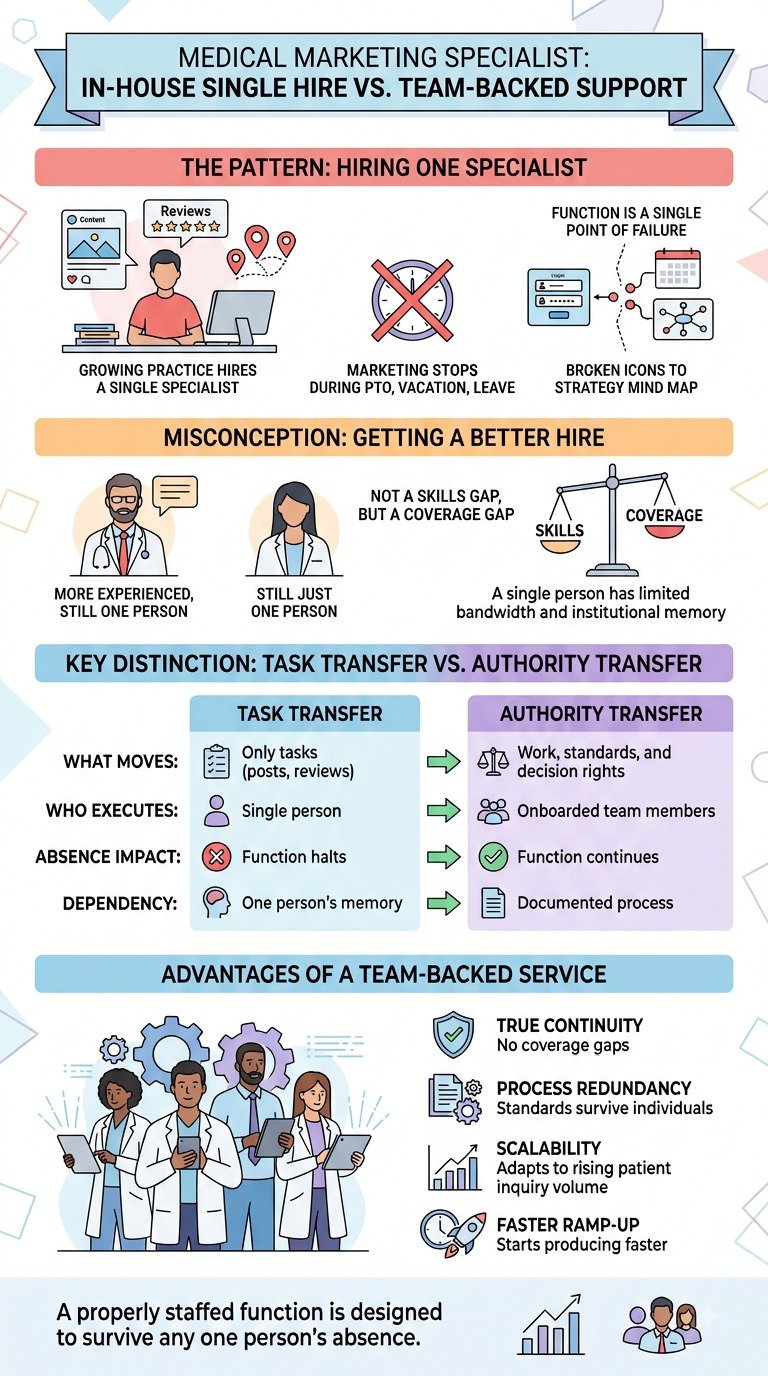
It isn’t. A single hire, however skilled, is still a single point of failure. The practice hasn’t added marketing capability so much as it’s concentrated an entire function inside:
- One person’s calendar.
- One person’s login credentials.
- One person’s institutional memory of what’s already been tried.
The missing variable isn’t skill. It’s coverage. A role built around one irreplaceable person will fail the same way regardless of who fills it next.

How the Marketing Coverage Gap Actually Forms
This forms gradually, not as a single hiring mistake. Marketing tasks get added to whoever has bandwidth:
- The office manager writes a few posts.
- A front-desk lead starts requesting reviews.
- Someone finally builds a content calendar.
Each addition feels manageable in isolation, and it feels normal because none of it looks like a structural gap while the practice is small.
The reinforcement loop kicks in once a dedicated hire is made: leadership sees consistent output and reads that as proof the role is solved, so no one builds a second layer of coverage, a documented process, or a backup plan. The leadership behavior that locks this in is treating “we hired someone for this” as the finish line rather than the starting point. Ownership gets assigned. Redundancy never does.
When a Growing Practice Hits the Breaking Point
The pattern becomes visible at a specific threshold: when patient inquiry volume outpaces the practice’s ability to produce content and manage reputation at the same pace.
- A healthcare marketing specialist’s average base salary runs roughly $62,000 to $76,000, with total compensation near $75,000, according to Salary.com’s compensation data, and that figure starts to look like a rounding error next to what’s lost during a coverage gap.
- 2026 benchmarks place average patient acquisition cost in the $150 to $600 range for most specialties, with wider swings by specialty and channel.
- A few weeks of stalled content and unanswered reviews doesn’t just pause growth; it raises the cost of every patient acquired afterward.
The fatigue shift that follows is from task load to decision load. It’s no longer about whether the posts go out. It’s about who owns the function when the person who owned it is unavailable, and whether anyone besides that one person could answer that question today.
Task Transfer vs. Authority Transfer: The Real Difference
The useful distinction here is task transfer versus authority transfer. Hiring a medical marketing specialist transfers tasks: content, campaigns, review requests. It doesn’t automatically transfer the authority, documentation, and decision rights that let someone else pick up those tasks without a two-week ramp-up.
| Task Transfer (typical in-house hire) | Authority Transfer (structured ownership) | |
|---|---|---|
| What moves | The work itself: posts, campaigns, review requests | The work, the standards behind it, and the right to make calls on it |
| Who can execute it | Only the person holding the job | Anyone on the team who’s been onboarded to the process |
| What happens if that person is out | The function stops | The function continues at the same standard |
| What it depends on | One person’s memory and habits | Documented process, not one person’s recall |
A role is properly staffed only when the tasks, the standards behind them, and the ability to execute them are separable from any one person holding the job. That’s structured ownership:
- The function keeps running because it was built to be handed off.
- Coverage doesn’t depend on one specific hire happening to be reliable.
- Standards live in a process, not in someone’s head.
This reframes the original question. It’s not “who should we hire for this role.” It’s “what happens to this function the next time that person is out.”
Where an Outsourced Medical Marketing Specialist Fits
This is the structural gap outsourcing closes that a single in-house hire generally can’t. Working with a trained specialist backed by a broader team means the practice isn’t dependent on one person’s calendar for content, local visibility work, or reputation management. Coverage during turnover, illness, or vacation comes from the bench rather than from a scramble to fill a seat.
Provida Family Medicine, a growing primary care practice, faced the same underlying strain: rising patient volume was outpacing what the in-house team could keep up with, and administrative and communication gaps were starting to affect patient experience.
Bringing on a Wing healthcare assistant to absorb that load produced measurable results:
- 50% faster clinic admin workflows
- 35% reduction in billing errors
- 40% higher patient satisfaction
- 30% fewer scheduling errors
- 25% faster claims processing
Office Operations & HR Manager Carlos Baltazar noted the process itself was straightforward and consistent, which is the same standard a marketing function should be held to: not “did we find one good person,” but “does the process hold up regardless of who’s executing it.”
The alignment with the structural model above is direct: outsourcing doesn’t just add capacity, it adds redundancy. That’s the variable a single hire, by definition, can’t provide.
The Real Fix: A Role That Outlasts Any One Hire
None of these points to a bad hiring decision. It points to a role that was structured around one person instead of around continuity. That’s an easy pattern to fall into, because a single hire genuinely does solve the problem for a while.
The sharper model holds regardless of who’s in the seat: a marketing function is properly staffed when it can survive any one person’s absence, not just when it’s currently being handled well.
Ready to see what that looks like for your practice? Book a demo with Wing.
An in-house hire’s fully loaded cost includes salary, benefits, tools, and training, typically landing well above the base salary figure alone. Wing’s Medical Marketing Specialist is priced at a flat monthly rate that already includes coverage and tooling, which tends to work out lower than the fully loaded cost of one dedicated employee. For a short period, yes, but it doesn’t scale. Once patient inquiry volume rises, marketing tasks get deprioritized behind patient-facing front-desk work. That’s the gap a dedicated Digital Marketing Virtual Assistant or Social Media Assistant from Wing is built to fill, so front-desk staff isn’t stretched across two jobs at once. An outsourced specialist typically starts producing within the first one to two weeks, since the account is backed by a team and existing processes rather than a single new employee learning the role from scratch. Wing’s HIPAA-Compliant Virtual Assistant roles follow this same model, so compliance training and onboarding don’t add extra ramp time. A new in-house hire usually needs 30 to 60 days to reach the same output.Frequently Asked Questions

Dianne Florendo is a content writer who creates engaging SEO content about virtual assistants, outsourcing, and business productivity.