

TL;DR: Most founders are still running on outsourcing myths and horror stories from years ago the ones about missed handoffs and vendors who ghosted mid-project. That old story keeps people white-knuckling tasks they should’ve handed off months ago, just to avoid a repeat. The vetting, matching, and oversight behind outsourcing today isn’t the same free-for-all it used to be. Founders who actually try it get their time back without the mess they were bracing for.
The reasons people outsource have quietly flipped. Cost reduction was the top driver for 70% of executives back in 2020; today it’s down to just 34%, with access to specialized talent taking its place (Deloitte Global Outsourcing Survey). In other words, the “cheap but risky” story most founders are running on is already out of date.
If you’ve gotten this far in considering outsourcing, you’ve probably already run into the objections, from a colleague, an old blog post, or your own gut. Most of that resistance was earned.
Outsourcing five or ten years ago often did mean spotty communication, inconsistent quality, and vendors who disappeared the moment something got complicated. That reputation didn’t come from nowhere.
But the model has changed faster than the narrative around it. The tools, the vetting, and the operational structure behind outsourcing today look nothing like what shaped those early horror stories. Below are the ten myths that still hold founders back, and what’s actually true now.
This article walks through the 10 outsourcing myths still holding founders back: quality, control, security, communication, cost, and what’s actually true now, with real Wing Assistant client examples as proof.
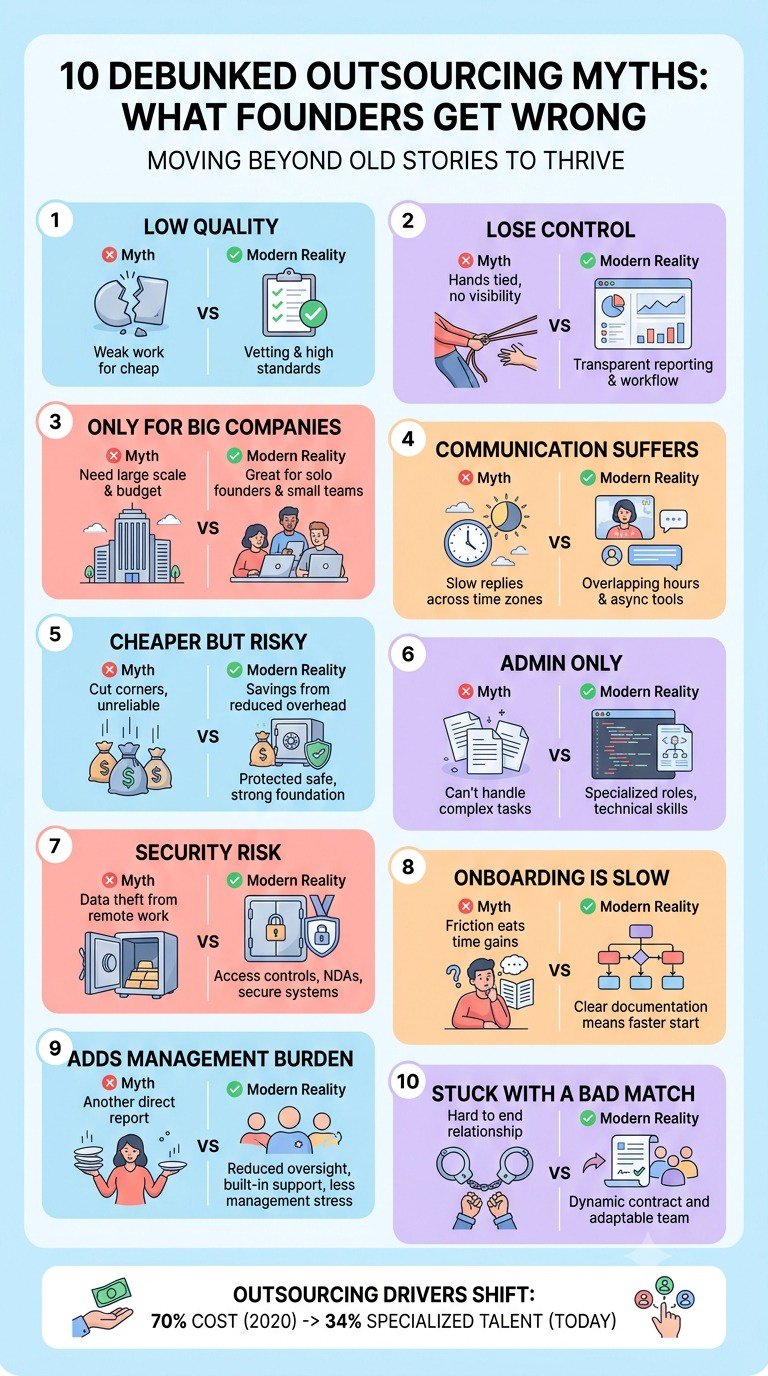

1. Outsourcing means lower quality
The myth: You get what you pay for, and cheaper help means weaker work.
The reality: Quality has always been a function of vetting and management, not geography. Wing runs candidates through structured skills assessments and matches them to role-specific requirements before a founder ever sees a profile, the same rigor you’d expect from an in-house hiring pipeline, just faster.
Proof point: Cathy Fisher of Quistem didn’t scale back her quality standards to bring on outsourced support; she used Wing’s general virtual assistant service specifically because the vetting matched what she required for client-facing work.
2. You lose control once you outsource
The myth: Handing off tasks means losing visibility into how they get done.
The reality: Control was never really about who does the task; it’s about whether you have clear reporting, defined processes, and a direct line to the person doing the work. A well-structured VA relationship gives you more visibility than an overloaded in-house employee juggling five roles at once.
Proof point: Dylan Schiemann of Living Spec kept full oversight of his operations by building clear workflows around his Wing executive assistant; delegation didn’t dilute control; it made the process legible for the first time.
3. Outsourcing is only for big companies
The myth: You need scale and budget before outsourcing makes sense.
The reality: Small operators often need delegation more urgently than large companies, because there’s no team to absorb the overflow. Wing’s model was built around solo founders and small teams specifically, not enterprise procurement cycles.
Proof point: Carty Custom Builders brought on outsourced support as a small, founder-led operation, not after reaching enterprise scale, proof that the entry point is lower than most founders assume.
4. Communication will suffer across time zones
The myth: Working with someone outside your time zone means slow replies and missed context.
The reality: Time zone overlap is a scheduling variable, not an inherent flaw. Most Wing placements are matched with overlapping working hours, and async workflows (shared docs, recorded loom walkthroughs, structured handoff notes) solve for the rest, the same way distributed in-house teams already operate.
5. It’s cheaper but riskier
The myth: Lower cost has to come with a hidden tradeoff in reliability.
The reality: The cost advantage comes from overhead, no office space, no benefits administration, no full-time salary for part-time need, not from cutting corners on reliability. Reliability is a function of the vetting and management layer sitting behind the hire, which is exactly what a structured BPO partner provides instead of a freelance marketplace.

6. VAs can’t handle specialized or technical work
The myth: Outsourced support is limited to basic admin tasks.
The reality: The “VA” label undersells the range of what’s available today. Wing places candidates into specialized lanes, from technical support to industry-specific roles, matched on actual skill sets, not a generic admin pool.
Proof point: Living Spec’s engagement with Wing extended well past basic scheduling into structured operational work, which is exactly the kind of “specialized” task founders assume can’t be delegated.
7. Security is a risk with sensitive data
The myth: Handing data to an outsourced worker is a security liability.
The reality: Security depends on the access controls and protocols in place, not on where the person sits. Structured outsourcing partners build in the same access-tiering, NDAs, and monitoring that any responsible in-house hire would be subject to.
8. Onboarding takes too long to be worth it
The myth: The ramp-up time eats up any efficiency gained.
The reality: Onboarding friction is usually a symptom of unclear processes, not the outsourcing model itself. Founders who document their workflows before bringing someone on see a fraction of the ramp-up time compared to informal, undocumented handoffs, outsourced or not.
9. Founders have to manage a VA the same way they’d manage an employee
The myth: Outsourcing adds another direct report to your plate.
The reality: A structured VA partnership is designed to reduce management overhead, not add to it, with built-in check-ins and support layered around the placement so the founder isn’t the only line of accountability.
10. If it doesn’t work out, you’re stuck
The myth: A bad match means a drawn-out, expensive exit.
The reality: Flexibility to reassign or adjust scope is one of the core differences between a structured outsourcing partner and a direct hire; the commitment is far lighter than a full-time employment relationship.
Myth vs. Reality vs. What Wing Clients Actually Experience
| Outsourcing Myths | Reality | What Wing Clients Experience |
|---|---|---|
| Lower quality | Vetting drives quality, not geography | Structured skills assessments before matching |
| Loss of control | Clear process = more visibility | Defined reporting lines and workflows |
| Only for big companies | Small teams need it most | Founder-led businesses as core client base |
| Time zones hurt communication | Overlap + async tools solve it | Matched working-hour overlap |
| Cheaper means riskier | Cost savings come from overhead, not corners cut | Managed vetting layer, not freelance marketplace |
| Can’t handle specialized work | Skill-matched placements | Role-specific and technical assignments |
| Data security risk | Access controls, not location, matter | NDAs and access-tiering built in |
| Onboarding too slow | Friction comes from unclear process | Faster ramp-up with documented workflows |
| Adds management burden | Designed to reduce oversight load | Built-in support layer around placements |
| Hard to exit a bad match | Flexible reassignment | Lighter commitment than direct hire |
Safety comes down to the access controls and agreements in place, not the outsourcing model itself. Wing’s bookkeeping virtual assistant and data entry VA roles are built around NDAs, access-tiering, and monitoring comparable to any in-house hire. Often more so than for larger companies, small teams have the least room to absorb overflow work themselves, and no internal team to fall back on. Wing’s general virtual assistant and virtual assistant for consultants roles are built with exactly that stage of business in mind. Reliability depends on the vetting and management structure behind the placement. Wing’s executive assistant and personal assistant roles build in ongoing oversight that ad hoc freelance hiring doesn’t. A structured partner like Wing handles vetting, matching, and ongoing support; freelance marketplaces typically leave all of that responsibility on the founder. Wing’s US-based VA and administrative virtual assistant roles are placed and supported this way from day one.Frequently Asked Questions
See for yourself
None of this is meant to argue you out of your hesitation; it’s meant to update it. The version of outsourcing that created these myths isn’t the version available today. If you want to see how a structured match actually works before committing to anything, book a quick look at Wing Assistant.

Dianne Florendo is a content writer who creates engaging SEO content about virtual assistants, outsourcing, and business productivity.