

We’ve got Zapier running for most of the repetitive stuff already: lead alerts, spreadsheet updates, Slack pings. The problem is nobody’s actually looking at the exceptions those Zaps kick out, so they just pile up until we notice from a customer instead of a dashboard. What’s missing isn’t another filter or a longer SOP; it’s a person with the standing authority to open those exceptions and make the call. With that in place, the Zaps keep doing what they’re good at, and someone’s finally catching what falls through before it costs us anything.
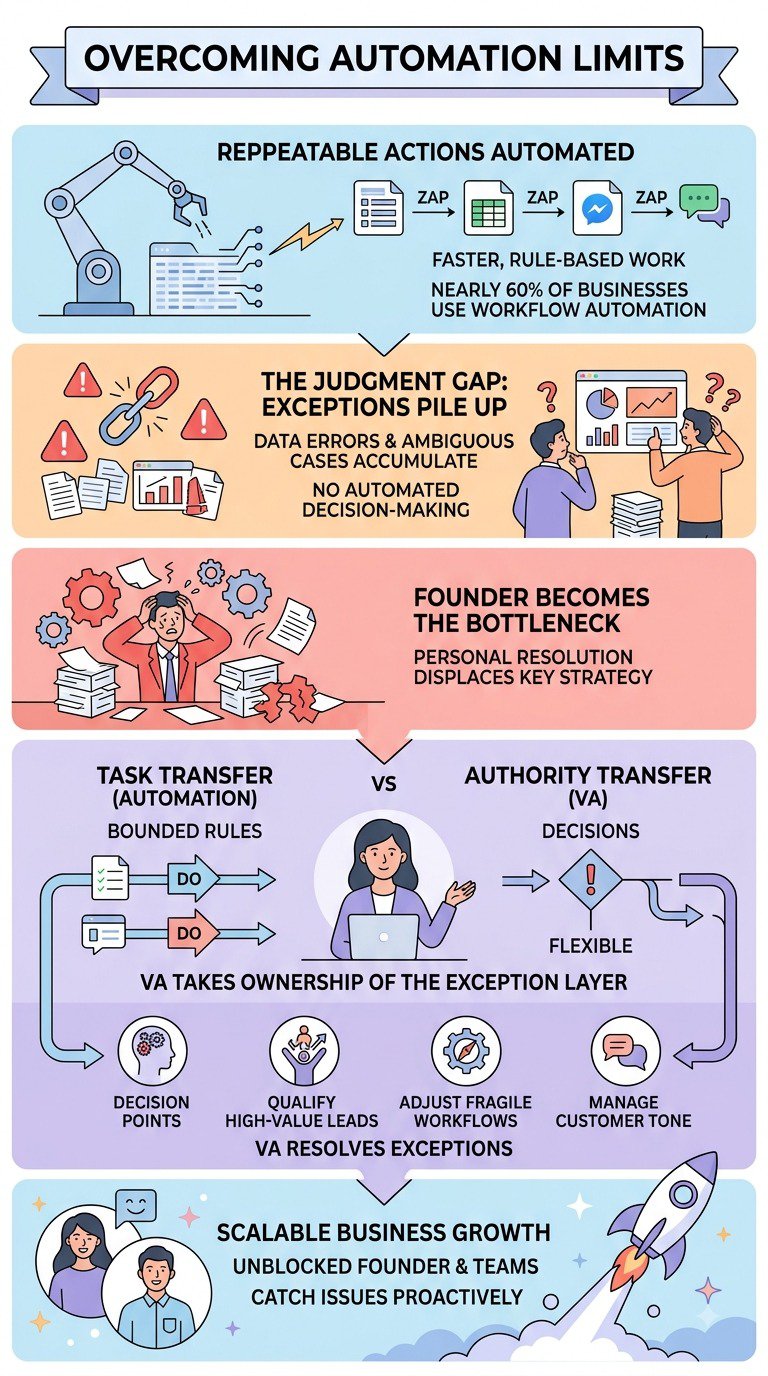
Nearly 60% of businesses now run some form of workflow automation, and most small teams get there the same way: one Zapier at a time, solving one problem at a time.
What doesn’t scale with it is the judgment those Zaps can’t apply on their own, the exceptions, the tone, the “is this actually worth acting on” calls.
This piece breaks down why that gap opens up, when it becomes impossible to ignore, and how a Wing Assistant VA fills it without touching the automation you’ve already built.

Why Your Zapier Stack Still Needs Constant Attention
Every founder who has built out a Zapier stack knows the specific relief of watching a workflow run itself. For a while, it feels like the operational problem is solved:
- A lead comes in, a Zap fires, a Slack message appears.
- A form gets submitted, a spreadsheet updates itself.
- A repetitive step that used to eat up an hour a day just… happens.
Then the exceptions start:
- A lead doesn’t match the trigger conditions cleanly.
- A field is blank where the Zap expects text.
- A “high-value lead” tag fires correctly, but nobody’s actually looked at the lead, qualified it, or responded.
The automation did its job. The business still needs a decision made, and that decision keeps landing back on the founder’s desk, at the exact moments they’re trying to step away from day-to-day tasks.
This isn’t a Zapier problem in the sense of the tool failing. Nearly 60% of businesses have already adopted some form of workflow automation, and for good reason: automation reliably speeds up and standardizes rule-based work. The tension is structural: the more Zaps a founder adds, the more exception cases accumulate underneath them, and there’s no default owner for those exceptions except the person who built the stack in the first place.
More Zaps and SOPs Won’t Fix the Real Problem
The instinct at this point is almost always the same:
- Build a better Zap.
- Add another filter step.
- Write a more detailed SOP so the next person “just knows” what to do.
- Hire a part-time assistant to “watch the dashboard.”
Each of these feels reasonable because each has worked before on a smaller version of the same problem. A tighter filter did reduce false triggers last time. A written SOP did clear up confusion for a week or two. The mistake is assuming this pattern scales linearly, that enough filters and enough documentation eventually cover all the judgment the business needs.
They don’t, and here’s why:
- Filters and SOPs only formalize decisions someone has already made.
- They can’t make a new call when a genuinely ambiguous case shows up.
- Ambiguous cases are exactly what accumulate as a business grows.
The missing piece isn’t more automation logic. It’s a standing decision-maker, someone with actual authority to look at an exception, resolve it, and move on without looping back to the founder. Zapier moves tasks. It does not transfer authority.

How Zapier Exceptions Quietly Pile Up Over Time
This pattern doesn’t arrive all at once. It forms one Zap at a time, and each addition looks like progress because, in isolation, it is:
- A new trigger removes a genuinely repetitive task.
- A new filter cleans up a specific edge case that caused a real problem last month.
- Each fix solves the thing it was built to solve.
What goes unnoticed is the aggregate. The number of “if this doesn’t match, someone needs to look at it” moments grows in proportion to Zap count, not in proportion to available attention. Nobody budgets time for that growth because no single addition seems to require it.
The reinforcement loop that locks it in:
- An exception surfaces.
- The founder resolves it personally, because it’s faster than building the process to hand it off.
- That speed feels efficient in the moment.
- It quietly teaches the system, and the founder, that resolving exceptions personally is the default.
That’s the leadership behavior that keeps this from getting structurally addressed: solving it “just this once,” every time, until “once” is a daily habit.
When Your Automation Stack Outgrows What You Can Manage
The threshold usually shows up around a specific kind of growth:
- Lead volume, support ticket volume, or transaction volume crosses a point where the founder can no longer personally review every exception.
- Reviewing exceptions starts displacing the work only the founder can do.
- The shift is from task load to decision load: task load is bounded by hours, decision load is bounded by attention, and attention doesn’t scale by adding more hours to an already full day.
The trigger event is rarely dramatic on its own:
- A Zap silently stops firing because a connected app changed its API.
- A plan tier change quietly removes a feature the workflow depended on.
- Standard automation plans typically carry no uptime guarantee at all, unlike enterprise tiers, so a broken workflow can sit unnoticed until a customer flags it directly.
That’s the moment the pattern becomes undeniable, not because the automation failed once, but because nobody was structurally positioned to catch it failing.
If this sounds familiar, and you’re the one who finds out about the broken workflow from a customer instead of a dashboard, you’re already past this threshold.
Task Transfer vs. Authority Transfer: The Real Zapier Gap
The useful distinction here is between task transfer and authority transfer:
- Task transfer moves a repeatable action off a person’s plate. This is what Zapier does, and it does it well.
- Authority transfer moves the right to make a bounded decision off a person’s plate, without requiring that person to check the work afterward.
| Task Transfer (Zapier) | Authority Transfer (a VA) | |
|---|---|---|
| What it moves | Repeatable actions | Bounded decisions |
| Handles ambiguity | No, flags it and stops | Yes, resolves it and moves on |
| Needs founder check-in | No, for the task itself | No, that’s the point |
| Example | Tags a lead “high-value” | Decides if the lead is worth chasing, and chases it |
| Scales with | Volume | Judgment |
Zapier, by design, only does the first. It cannot decide:
- Whether a given lead is actually high-value.
- Whether a customer’s tone in a message warrants an apology or an escalation.
- Whether a broken Zap is worth fixing immediately or monitoring for another day.
Those are decision-rights questions, not workflow questions.
The sharper model: automation scales repetition. It does not scale judgment. A business that only invests in automation is investing entirely in the first half of the equation, which is why the founder remains the bottleneck no matter how sophisticated the Zap library becomes. Closing the gap requires giving someone else standing authority over the exception layer, not just more visibility into it.
How a Wing VA Closes the Zapier Exception Gap
This is the layer a Wing VA is built to sit in. Not replacing the automation, and not just watching a dashboard and flagging problems back to the founder, but holding actual ownership of the exception queue: qualifying the lead the Zap flagged, deciding whether a broken workflow needs an immediate fix or a scheduled one, adjusting a Zap’s filter logic when a new edge case appears often enough to warrant it.
Living Spec, a SaaS product-spec platform, is a close match for this exact gap. Co-founder Dylan Schiemann was buried in the admin and communication load sitting underneath his own workflows: the outreach, the task management, the follow-up on leads that automation alone couldn’t qualify or close
The results show what happens when that layer gets an actual owner:
- 3,000+ leads reached through outreach
- 30% month-over-month growth, up from 20%
- 13,140+ hours of executive support delivered
A Wing VA maintains the workflows that already exist, catches what falls through, and handles the judgment call the automation surfaced but couldn’t finish. For businesses running a DIY automation stack built up piece by piece, this is usually the first time the exception layer has an actual owner other than the founder.
The Real Fix for Zapier’s Limits Isn’t More Automation
None of this means the Zapier stack was a mistake. It did exactly what automation is supposed to do: it removed repetition. The gap it left behind isn’t a failure of planning; it’s a predictable structural byproduct of automating tasks without also assigning ownership of the exceptions those tasks generate.
The shift isn’t from “founder who automates” to “founder who automates better.” It’s from “founder who personally resolves every exception” to “founder who owns the system, with someone else holding standing authority over the exception layer.” The Zaps keep running. The difference is that someone is finally positioned to catch it when they don’t.
Ready to close that gap? Book a demo with Wing and see where a VA fits into your stack.
Yes. Wing’s CRM & Automation Specialists review your current Zaps, document what each one does, and take over monitoring and maintenance without rebuilding your stack. The goal is continuity first, then targeted fixes where a Zap is fragile or already causing silent failures. Both. Most engagements start with a CRM & Automation Specialist managing and stabilizing your existing Zaps, since that’s where founders lose the most unseen time. From there, they can build new automations as gaps become clear, based on which exceptions repeat often enough to formalize. If you’re the one discovering broken workflows from a customer complaint rather than a monitoring alert, or if you’re personally resolving the same type of exception weekly, that’s the signal. A General Virtual Assistant from Wing can pick up that exception layer directly, since more filters won’t remove a decision that requires judgment.Frequently Asked Questions

Dianne Florendo is a content writer who creates engaging SEO content about virtual assistants, outsourcing, and business productivity.