

You’ve handed off tasks, inbox, scheduling, and research, and you’re still the last stop on everything. The work moved. The decision authority didn’t. So everything still routes back to you. The fix isn’t delegating more. It’s defining who owns the call, not just the task. When that’s clear, your queue shrinks, not because you’re working less, but because fewer things actually need you.
Most founders hit a ceiling not because they lack capacity, but because they’ve never restructured who holds the right to make routine calls. According to a Harvard Business Review study, founders who struggle to delegate effectively are 50% less likely to scale their companies successfully, and the ones who do delegate often find they’ve only moved the work, not the decision weight behind it.
This article breaks down why the standard delegation playbook falls short, how the founder bottleneck forms and compounds over time, and what structural change actually fixes it.
It also covers where Wing Assistant fits into that model, not as a task-offloading service, but as a way to build execution nodes that run without routing back to you on every routine call.
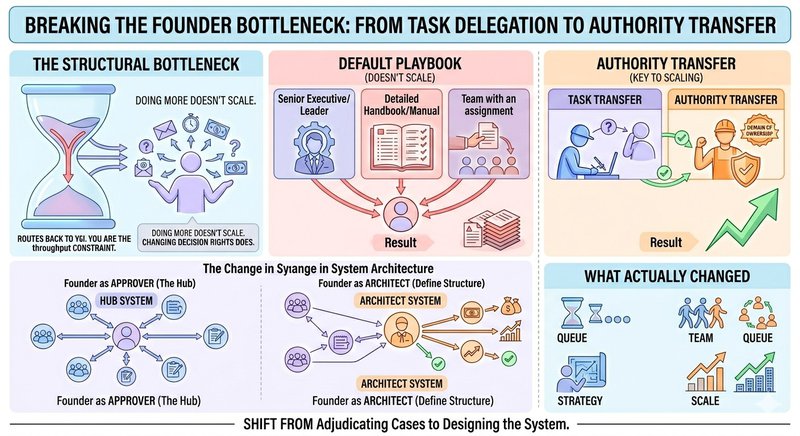
The Founder Bottleneck Is Structural, Not Personal
You’ve read the delegation advice. You know you should be working on the business, not in it. You’ve tried it, handed off calendar management, assigned inbox triage, and built out SOPs. Two weeks later, you’re still the final stop on things that don’t require your judgment.
That’s not a discipline failure. It’s a structural one.
Here’s what’s actually happening:
- Tasks get assigned, but approval authority stays with you
- The team executes when conditions are exactly as specified, and routes everything else back to you
- Each escalation feels reasonable in isolation, so the pattern never gets questioned
- The founder becomes a throughput constraint not by refusing to let go, but because the system was never redesigned to run without them at the center
The founder bottleneck isn’t you. It’s the decision architecture you’re still running.

Why the Default Playbook Doesn’t Fix It
The standard response to founder overload follows a predictable sequence: hire someone more senior, write better SOPs, and learn to delegate more clearly. Each step feels reasonable. None of them addresses the actual problem.
Here’s why each one falls short:
- Hiring a more senior operator gives you a higher-capacity person waiting for the same approvals
- Better SOPs document existing processes, but don’t transfer the authority to deviate when conditions change
- Clearer delegation is still delegation, not ownership
The missing variable is decision rights. Specifically, who holds the standing authority to make a call in a defined domain without escalating to you first?
Without that clarity, every hand-off creates the same dynamic:
- The task moves off your plate
- The decision doesn’t
- Work starts, stalls, and routes back to you the moment something falls outside the script
That’s not delegation. That’s outsourcing your queue while keeping your inbox. Learn more about affordable content assistant.
How the Pattern Forms
In the early stages, founder centralization makes sense. Decisions need to move fast, institutional knowledge lives in one place, and the team is small enough that one approval node doesn’t create meaningful drag.
As headcount grows, the pattern continues by inertia:
- No one redesigns the approval architecture because no single escalation feels like a problem
- Each question routed to the founder seems reasonable; it’s one email, one Slack message, one quick call
- The founder answers because answering is faster than building the system that would make the answer unnecessary
That’s the reinforcement loop:
- Speed optimization at the individual decision level prevents throughput optimization at the system level
- The founder gets good at being the node
- The team gets calibrated to route through them
- Both sides reinforce the pattern without either one choosing it
It doesn’t feel like a structural failure. It feels like a busy week. Learn more about virtual assistants India.

When It Becomes Undeniable
The inflection point is usually a volume event, such as two new clients, a new hire, or a service expansion. The founder’s decision load spikes. Their capacity doesn’t.
The signs are consistent:
- Tasks that used to close in a day now take four because they’re queued behind your availability
- Junior hires with real capability sit underutilized; they’ve learned not to move without a green light
- The team is busy, but nothing is actually advancing
The shift feels like burnout. It isn’t. It’s a throughput failure made visible.
The trigger is usually a miss:
- A client response that came back too late
- A hire that fell through because a decision took too long
- For a week, you were traveling, and nothing moved without you
That’s the moment the cost of the pattern becomes hard to explain away. The founder bottleneck was always there. The volume just made it undeniable. Learn more about virtual assistant services India.
The Distinction That Actually Changes the System
Most founders practice task transfer and assume they’ve done the harder thing. They haven’t.
The difference looks like this:
| Task Transfer | Authority Transfer | |
|---|---|---|
| What moves | The work | The work + the right to make calls within it |
| What the person owns | Execution | A defined domain |
| What they escalate | Anything uncertain | Exceptions only |
| What still routes to you | Most decisions | Edge cases |
The gap between the two is bounded decision rights.
When someone has authority transfer, not just a task, they know:
- What decisions do they own outright
- Where the boundaries of their domain are
- What qualifies as an exception worth escalating
- What doesn’t need to reach you at all
This is what organizational designers call structured ownership. It’s not about seniority or trust level. It’s about scope clarity.
When the scope is clear:
- Routine decisions stop routing upward
- The founder’s queue shrinks, not because less is happening, but because less requires founder input
- The team moves without waiting for a green light on every step
The founder’s role shifts from approver to architect. You’re defining the rules for a domain once, not adjudicating every case that comes up within it.
Where Wing Fits in This Model
Wing assistants are onboarded with defined task ownership, escalation criteria, and scope boundaries from day one. That’s the structural fit, not just task coverage, but decision clarity built into how the role is set up.
What that looks like in practice:
- Quistem founder Cathy Fisher reclaimed 25% of her time after 9 recurring admin decision points were assigned to a dedicated Wing EA with clear ownership — not just a task list
- Living Spec delegated communication and outreach to a Wing General VA with defined scope and grew 30% month-over-month, up from 20%
- Carty Custom Builders reclaimed 80+ admin hours and 22+ hours of weekly CRM upkeep after bringing on a part-time assistant with a structured back-office scope
Start with low-stakes domains where the cost of a wrong call is low and recoverable. Define the authority explicitly, not just the task. A General Virtual Assistant or Administrative Virtual Assistant is a practical starting point, including calendar holds, travel booking, vendor research, and inbox triage. The point isn’t to hand over consequential authority first. It’s to build the muscle of defining scope, then expand it as trust and calibration develop. Seniority doesn’t solve the structural problem on its own. A capable assistant without defined decision rights will still route ambiguous cases back to you, because that’s the rational behavior when boundaries aren’t clear. Wing’s onboarding process builds that clarity from day one. Roles like Executive Assistant and Project Manager are scoped specifically for founders who need an operator, not just a task-taker. Yes — but it requires separating expert judgment from operational execution. The founder, as subject matter expert, still makes high-level calls. What changes is everything around that work: scheduling, communications, research, reporting, CRM upkeep. Roles like Virtual Assistant for Consultants and CRM Data Entry Assistant are built for exactly that split, keeping the expert focused while operations run in the background.Frequently Asked Questions: Founder Bottleneck
What Changes When the Architecture Changes
Removing the founder bottleneck isn’t a mindset shift. It’s a system redesign, one most founders delay not out of reluctance, but because no single moment of friction makes the cost undeniable until it has already been for months.
The founders who exit it cleanest aren’t the ones who learned to delegate more gracefully. They’re the ones who stopped treating every hand-off as a task transfer and started treating some of them as authority transfers.
That’s the shift: you’re not moving work off your plate. You’re redesigning who holds the right to make the call. When that changes, the queue moves on its own.
If you’re past the “should I delegate?” question and ready to see what structured ownership actually looks like in practice, book a demo with Wing, and we’ll walk you through it.

Dianne Florendo is a content writer who creates engaging SEO content about virtual assistants, outsourcing, and business productivity.