

Founders don’t stall because they delegate too little; they stall because they only delegate tasks, not decisions. Work leaves the calendar while every judgment call still routes back to them. Delegation advice that actually works starts with transferring decision authority, not just handing off to-do items.
Founders often delegate the wrong half of the job. Research on organizational effectiveness has found that companies where decisions are made at the appropriate level, rather than centralized with one person, are 2.5 times more likely to be top-quartile performers in terms of speed and execution.
This article walks through why handing off tasks alone doesn’t fix that, how the pattern forms unnoticed, and what it takes to transfer real decision authority, including where a partner like Wing Assistant fits once that boundary is defined.
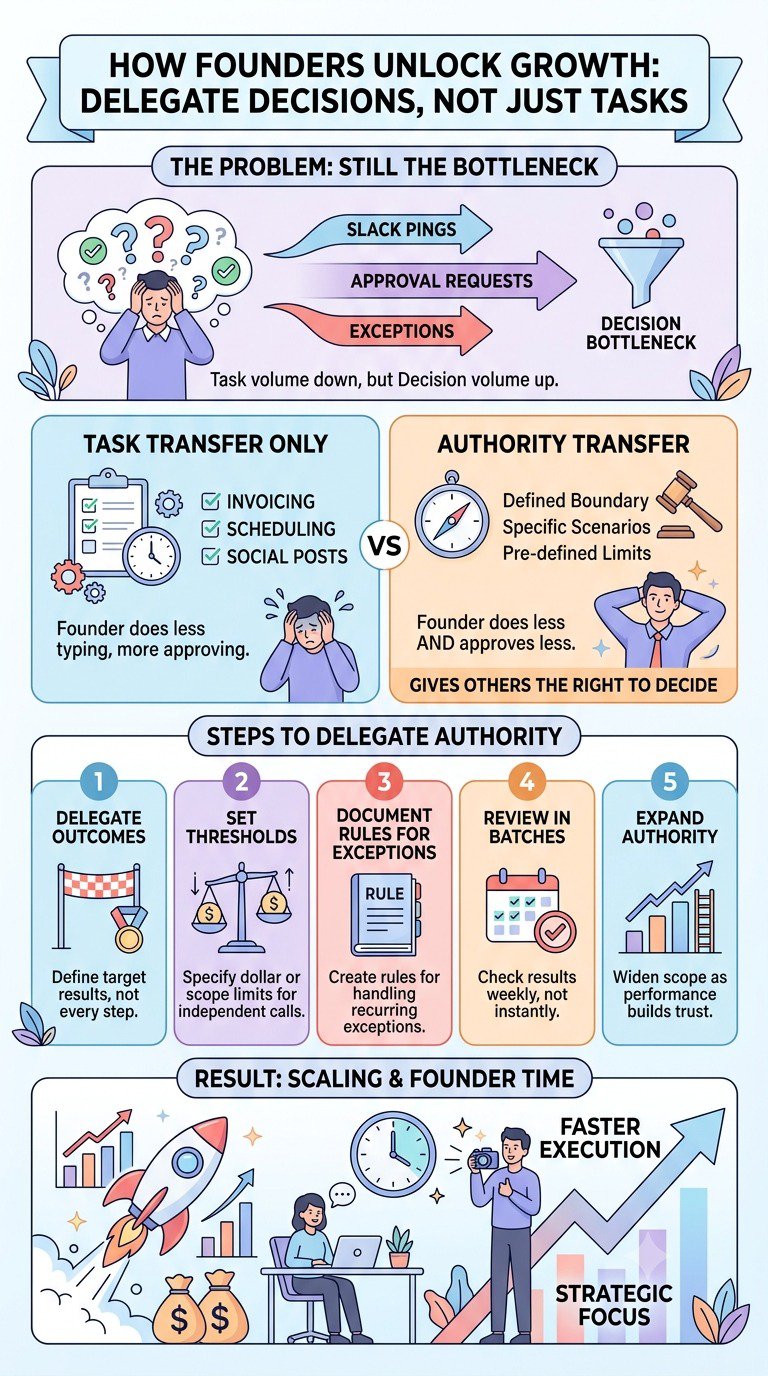
Founders Delegate Tasks but Stay the Bottleneck
A founder hands off invoicing, scheduling, first-pass customer replies, even hiring logistics. The task list gets shorter. The org chart gets a new hire or a virtual assistant. On paper, delegation advice is happening.
But the founder’s week doesn’t open up:
- Slack pings still route through them.
- Every hire’s work still needs a final look before it goes out.
- The founder is doing less typing and more approving, and approving takes almost as much attention as doing.
This is the pattern operators rarely name directly: task volume drops, but decision volume doesn’t. The founder traded hands-on execution for constant judgment calls, and judgment calls don’t compress the way task lists do. One decision can take longer to make than the task itself took to execute.

It also shows up in smaller ways:
- Still reviewing every social post before it goes live.
- Still signing off on every vendor invoice.
- Still fielding every client escalation personally, regardless of who technically owns the task.
The friction shows up as a contradiction: delegation happened, relief didn’t. That gap is the first sign something structural, not just tactical, is driving the bottleneck. Hire founder assistant.
Why Hiring or Better SOPs Doesn’t Fix It
The default fix is more of what already seemed to work: hire another person, write a tighter SOP, delegate one more task off the list. It’s a reasonable instinct; those moves did shrink the task list the first time.
The problem is what those moves don’t touch:
- A new hire still needs someone to make the call on exceptions.
- A better SOP documents how to execute a task, not who’s allowed to decide when the task doesn’t fit the SOP.
- Neither changes who holds final say.
Hiring and documentation solve an execution problem. The founder’s bottleneck is a decision-rights problem; most decisions in the business still require the founder’s approval, regardless of who does the work. Adding people or process to that structure doesn’t remove the approval requirement; it just adds more work that needs approving.
The structural variable missing from most delegation advice is decision authority: who is allowed to decide, not just who is allowed to do. Founders who chase this fix again and again end up with a bigger team and a fuller inbox of approval requests, more capacity to generate decisions, no more capacity to make them.
How the Founder Becomes the Only Approver
In the earliest stage of a business, the founder is the fastest and most accurate person at almost everything, including making calls on ambiguous situations. That’s not ego; it’s a function of being the person who built the product, set the pricing, and knows every client relationship personally.
As the team grows:
- Tasks get handed off first because they’re the easiest to document.
- Decisions stay with the founder because handing off a decision feels riskier than handing off a task.
- A wrong task can be redone; a wrong decision can cost a client or a hire.
Each time an employee escalates an ambiguous call instead of making it, the founder answers it, usually faster than it would take to define a rule for next time. That’s the reinforcement loop: solving the exception in the moment is faster than building the structure that prevents the exception from needing the founder at all.
Over time, this becomes the default operating mode. Nobody decided the founder should approve everything; it accumulated one quick answer at a time.
When Task Load Turns Into Decision Load
The shift becomes visible at a specific threshold: when the team is large enough that task execution runs fine without the founder, but decisions still can’t move without them. Growth stops being limited by how much work the team can do and starts being limited by how fast one person can approve.
The fatigue that shows up here is different from the fatigue of doing tasks. It’s the fatigue of being interrupted for judgment calls all day:
- Pricing exceptions
- Hiring decisions
- Vendor issues
- Client escalations
None individually large, all requiring the founder’s attention to move forward.

The usual trigger event is a failed attempt to step back. A founder takes a week off, or hands a major project fully to a manager, and the business doesn’t stall on execution; it stalls waiting on decisions that only the founder was ever authorized to make. That’s the moment the pattern becomes undeniable: the org can execute without the founder, but it can’t decide without them.
Task Transfer vs. Authority Transfer
Task transfer moves the doing. Authority transfer moves the deciding. Most delegation advice focuses entirely on the first and treats the second as something that will eventually follow on its own. It doesn’t — authority has to be assigned on purpose, the same way a task does.
| Task Transfer | Authority Transfer | |
|---|---|---|
| What moves | The work itself | The right to decide |
| What it requires | Instructions, documentation | A defined decision boundary |
| Who still gets escalated to | The founder, on any exception | No one, within the boundary |
| Result | Founder does less, approves more | Founder does less and approves less |
Structured ownership means defining, in advance, which decisions a role is authorized to make without escalation, and where the line sits before something needs the founder’s sign-off:
- The boundary has to be explicit, not assumed.
- Left implicit, every ambiguous case defaults upward by habit.
- Once set, it should be written down the same way a task SOP would be.
This is the reusable model: delegation isn’t complete until someone else can make a decision the founder used to make, inside a boundary the founder set once. Below is what that looks like in practice.
Delegation Advice That Transfers Authority
- Delegate outcomes, not tasks — define the result you want, not each step to get there.
- Set a decision-authority threshold — specify the dollar amount, scope, or scenario a person can decide on their own before escalating.
- Document the decision once, not the task — a rule for handling a recurring exception is worth more than a step-by-step SOP.
- Start with recurring, low-risk decisions — pricing exceptions under a set amount, standard scheduling conflicts, routine vendor approvals.
- Review decisions in batches, not in real time — check outcomes weekly instead of approving each one as it happens.
- Expand the threshold as trust builds — widen decision authority once a person has a track record on smaller calls.
Where Wing Fits Into Decision-Ready Delegation
A staffing partner or virtual assistant only closes the bottleneck if the decision boundary is defined before the work is handed off. Without it, a new hire, internal or outsourced, just becomes another person waiting on the founder’s approval.
Wing’s model is built around this distinction: matching a founder or operator with a dedicated assistant, then working through which decisions that role owns outright versus which stay with the founder. That structure gets set early, not left to accumulate by default over months of ad hoc escalation.
One example is Quistem, a North Carolina–based automotive consultancy led by CEO Cathy Fisher. Before working with Wing, Cathy was managing high-level client work alongside scheduling, inbox management, and internal process coordination, the same task-and-decision mix that keeps most founders stuck. Wing paired her with a full-time Executive Assistant who took ownership of her inbox, client scheduling, and internal workflows, not just individual tasks.
- 25% of Cathy’s time reclaimed
- 9 recurring admin tasks fully offloaded
- 1,000+ workdays of executive support delivered
Cathy put it simply: her assistant “freed up my brain and my time,” letting her focus on value creation instead of a thousand little tasks, the identity shift this whole piece is built around.
This matters most for founders trying to delegate to an employee versus a staffing partner for the first time. The question isn’t which option is more capable of doing the task, most are. The question is whether the working relationship is set up to define decision authority from day one, or whether it will default back to the founder the same way internal hires often do.
If you’re ready to define what a role owns before you hand it off, schedule time with Wing.
The biggest delegation advice is handing off tasks while keeping every decision. A founder delegates execution, but ambiguous calls, pricing exceptions, vendor issues, and scope changes still route back to them. That keeps the founder as the single point of approval, even after the team grows and the task list shrinks. An Executive Assistant role built around decision boundaries, not just task lists, is one way Wing helps founders avoid this. Start with recurring, low-risk decisions rather than one-off tasks. Anything that repeats weekly and has a bounded downside routine scheduling conflicts, standard invoice approvals, is a safe place to set a decision-authority threshold and let someone else own the call without escalating it. Wing’s Administrative Virtual Assistant and General Virtual Assistant roles are typically where founders start. The choice matters less than whether decision authority is defined upfront. An employee or a virtual assistant both fail the same way if every ambiguous call still escalates to you. Pick the option where the working relationship sets clear decision boundaries from the start, not after months of habit. Wing structures this from onboarding for roles like US-Based EA and Personal Assistant, where ownership of a founder’s calendar and inbox is defined on day one rather than negotiated later.Frequently Asked Questions
From Doing Everything to Deciding What Matters
None of this means the founder failed at delegation. Task transfer is real work, and most founders do it reasonably well. What’s missing isn’t effort; it’s a second, separate step that most delegation advice skips entirely.
The shift is in what the founder sees themselves responsible for. Not the person who has to approve everything that comes through the business, but the person who defines which decisions others are authorized to make on their own. That’s a smaller, more specific job, and it’s the one that actually scales.
Once decision rights are assigned the way tasks are, the calendar clears for the reason it was supposed to clear the first time delegation happened.
Ready to define what a role owns before you hand it off?Book a demo with Wing.

Dianne Florendo is a content writer who creates engaging SEO content about virtual assistants, outsourcing, and business productivity.