






TL;DR
- You hired well, onboarded thoroughly, and you're still the last stop on every real decision.
- The problem isn't the person; it's that you transferred tasks without transferring judgment rights.
- Define where their authority starts and stops at each stage of the ramp.
- That's when they stop asking and start moving.
According to LinkedIn's 2024 Workplace Learning Report, new external hires operate at just 25% productivity in their first month, and many take three months or more to reach full performance.
Most leaders assume that's a people problem. It's usually a structural problem.
This article covers why execution stalls post-hire, how to build a 30–60–90 ramp around decision milestones, and where Wing Assistant fits into keeping the team moving while ownership transfers.
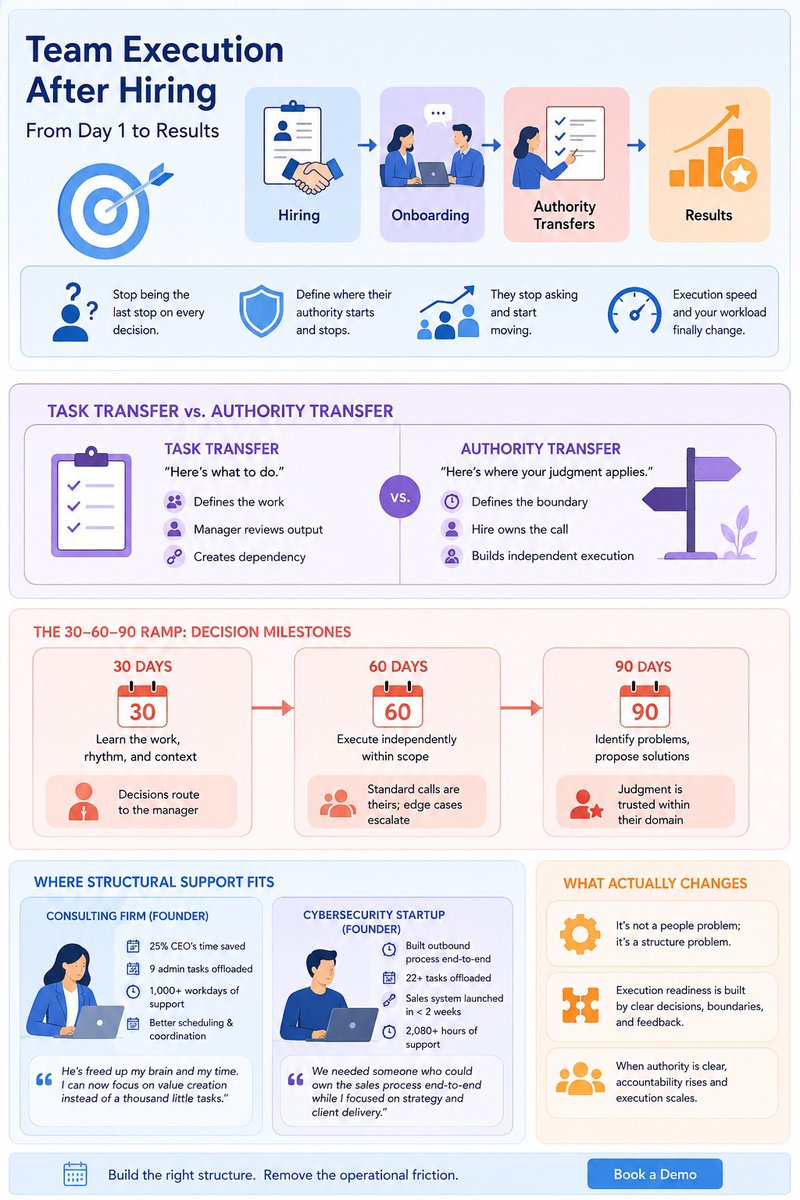
The Gap Nobody Admits to Seeing
The hire cleared every interview. References checked out. They're onboarded and producing, but something still isn't moving. You've seen it show up as:
- Deadlines that keep shifting
- Decisions that keep bouncing back to you
- A workload that was supposed to drop but didn't
The hire looks capable. The work looks like work. But output velocity hasn't changed, and your load hasn't dropped. The most common misread in team scaling: hiring is the finish line. It isn't. Execution is, and it needs its own structure.
Why the Standard Fixes Don't Hold
When ramp stalls, the typical response looks like this:
- Tighten the documentation
- Add more check-ins
- Write clearer briefs
- Delegate more explicitly
All reasonable. None of them fix the actual problem, because they address process detail, not decision rights. More documentation tells a hire what to do. It doesn't tell them how far their authority extends. More check-ins add feedback loops without clarifying when they're expected to stop needing them.
Until a new hire knows where their judgment replaces the manager's, they'll keep escalating. And the manager will keep catching.
How the Pattern Forms, and Why It Holds
It starts normally. Manager assigns tasks, fields questions, and reviews output. That's onboarding. The problem is when it never stops.
Each loop quietly reinforces the wrong dynamic:
- Manager answers a question → hire never had to make that call
- Manager approves output → hire learns to wait for confirmation
- Manager steps in on edge cases → hire stops developing judgment
By week six, the dependency is structural. The hire has learned the work, not the ownership. Escalation at that point isn't a personality trait. It's a behavior the system trained.
Both sides reinforce it: managers feel useful, hires avoid mistakes. The team's throughput erodes slowly enough that nobody calls it.
When It Becomes Undeniable
The inflection point hits around day 45–60. The manager expected to step back. Instead, they're still in the details. The fatigue shift sounds like:
- "I'm still deciding things I thought they owned."
- "I tried stepping back, and the work stalled."
- "I keep getting pulled back in on calls I shouldn't be on."
That last one is the tell. The manager pulls back, quality drops, or the hire freezes, and the manager steps back in. That return confirms it, this isn't a training lag anymore. It's a structural misalignment.
The Structural Model: Task Transfer vs. Authority Transfer
Most ramp-up systems are built around task transfer, defining responsibilities, mapping deliverables, and setting timelines. What they leave out is authority transfer: the right to decide how work gets resolved when something ambiguous comes up.
The difference in practice:
| Task Transfer | Authority Transfer |
|---|---|
| “Here’s what to do.” | “Here’s where your judgment applies.” |
| Defines the work | Defines the boundary |
| Manager reviews output | Hire owns the call |
| Creates dependency | Builds independent execution |
The 30–60–90 framework only works when it's built around decision milestones — not just task completion.
| Stage | Focus | Decision Rights |
|---|---|---|
| 30 days | Learn the work, rhythm, and context | Decisions route to the manager |
| 60 days | Execute independently within scope | Standard calls are theirs; edge cases escalate |
| 90 days | Identify problems, propose solutions | Judgment is trusted within their domain |
When both sides know the boundary, neither has to guess. Accountability without micromanagement isn't a management style; it's what decision-right clarity produces. Learn more about affordable amazon seller assistant.
Where Structural Support Fits
Even when decision boundaries are set, and the 30–60–90 ramp is structured correctly, there's still an operational gap: the day-to-day coordination layer that keeps work moving while the new hire builds independent judgment. That's where teams stall quietly, not because strategy is unclear, but because follow-through has no owner.
Two cases that reflect this directly:
Quistem (Consulting) Founder Cathy Fisher was carrying both high-level consulting and daily admin while her team scaled. Wing's Executive Assistant stepped in and took over:
- 25% of CEO’s time saved
- 9 recurring admin tasks offloaded
- 1,000+ workdays of executive support delivered
- Improved scheduling, coordination, and process management
“He’s freed up my brain and my time. I can now focus on value creation instead of a thousand little tasks.”
— Cathy Fisher, Founder & CEO
Cybersecurity Startup: The founder was still the last stop on outreach, CRM, and proposals while trying to lead growth. Wing embedded a U.S.-based SDR who:
- Built the outbound process end-to-end
- Offloaded 22+ recurring tasks
- Launched a repeatable sales system in under two weeks
- Delivered 2,080+ hours of sales and admin support
“We needed someone who could own the sales process end-to-end, to prospect, qualify, follow up, and close while I focused on strategy and client delivery.”
— Startup Co-Founder
In both cases, Wing didn't replace judgment; it removed the operational friction pulling leadership back into execution mode.
Frequently Asked Questions
If I give a new hire more decision authority, doesn't the quality risk go up?
Yes, temporarily, and that's expected. Controlled autonomy with regular output reviews is how judgment develops. The alternative, keeping the manager as the final call on everything, scales to a bottleneck, not a team. To reduce that risk during the transition, many teams use a Wing Project Manager or Administrative Virtual Assistant to hold the operational layer steady while the hire builds confidence independently.
What if the hire is genuinely not ready to make decisions at 60 days?
That's a signal worth examining. If a hire can't operate inside a defined scope by 60 days, the question isn't just readiness; it's whether the scope was defined clearly enough, and whether the check-in structure is actually building judgment or just catching errors. A Wing Executive Assistant or Human Resources Virtual Assistant can help structure onboarding checkpoints and keep accountability systems running without pulling the manager back in.
How does team execution after hiring differ for senior hires?
Senior hires need less task ramp and more context ramp, understanding decision history, team dynamics, and operating norms. The 30–60–90 structure still applies, but the day-30 milestone is orientation, not output, and authority transfer happens faster. A Wing Virtual Assistant for Consultants or Business Development Manager can support the operational handoff so senior hires spend their early weeks on strategy, not administration.
What Actually Changes When You See This Clearly
The manager who stalls team execution after a strong hire usually isn't bad at managing. They're operating with an incomplete model, optimized for hire quality, assuming execution would follow. It doesn't, not automatically.
Execution readiness isn't a property of the person. It's a property of the system they're placed in. Task clarity, decision rights, and feedback cadence all three have to be set up deliberately. The hire didn't need to be different. The structure did.
If you're building that structure and need the operational layer covered while ownership transfers, Wing can help. Book a demo and see how.

Dianne Florendo is a content writer who creates engaging SEO content about virtual assistants, outsourcing, and business productivity.