






TL;DR
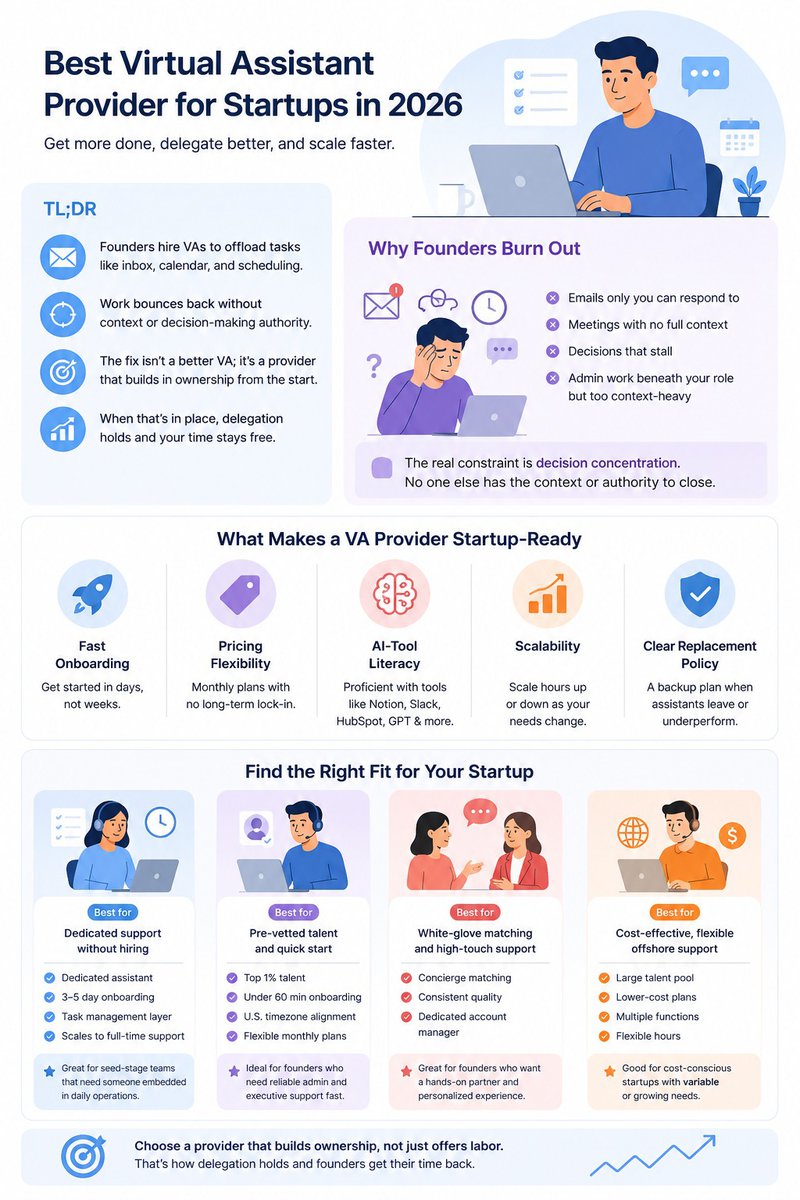
- Most startup founders hire a VA to get tasks off their plate, inbox, calendar, scheduling, and the usual.
- The work gets handed off, but keeps bouncing back because the assistant has the task, not the context or the call to make decisions around it.
- The fix isn't a better VA; it's choosing a provider that builds in ownership structure from the start, not just labor.
- When that's in place, delegation actually holds, and your time stops refilling with the same work you already handed off.
Founders who try to run everything themselves don't scale; they stall. According to a report by Asana, knowledge workers spend roughly 60% of their time on operational busywork rather than the work they were actually hired to do. For startup founders, that number likely runs higher.
This guide breaks down the best virtual assistant providers for startups in 2026, what each one offers, who it's built for, and where it fits in your growth stage.
Wing Assistant leads the list for early-stage teams that need dedicated, embedded support without the cost or commitment of a direct hire. If you're evaluating options and want a clear comparison before making a call, this is where to start.
Why Startup Founders Burn Out Before They Scale
You're 12 months in. The product works. Customers are paying. But your calendar looks like a Tetris game that's already lost. Inbox zero is a myth you stopped believing in around month four.
The common read on this is capacity. You just need more hours, or maybe a better productivity system. But capacity isn't the actual constraint. The constraint is decision concentration, every operational task routes back to you because no one else has the context or authority to close it out.
This shows up the same way across most early-stage teams:
- Emails that need a response only you can give
- Meetings that exist because no one else has the full picture
- Decisions that stall because the person handling the task doesn't have the authority to finish it
- Admin work that's beneath your role but too context-heavy to hand off cleanly
Hiring a virtual assistant sounds like the fix. Sometimes it is. But the provider you choose determines whether you get real operational relief or just someone managing your inbox while the real drag continues underneath. Learn more about best appointment setting assistant.
What Makes a VA Provider Startup-Ready
Not every VA provider is built for early-stage companies. Enterprise-focused firms assume long ramp times, fixed scopes, and stable workflows. Startups don't have any of those.
A provider worth evaluating should clear at least four bars:
- Fast onboarding. If it takes three weeks to get started, you've already lost momentum on the problem you were trying to solve.
- Pricing flexibility. Monthly retainers with no long-term lock-in matter when your burn rate is a live variable.
- AI-tool literacy. Your VA will touch tools like Notion, Slack, HubSpot, or GPT-based workflows. Proficiency here isn't optional in 2026.
- Scalability. You might need 10 hours a week today and 40 hours in six months. The provider should handle that without making you renegotiate from scratch.
- Clear replacement policy. Assistants leave or underperform. A provider without a stated backup process transfers that risk entirely to you.
The difference between a provider that works and one that doesn't usually isn't the talent; it's whether the operational structure around that talent is built for how early-stage teams actually run.
How These Providers Were Evaluated
Every provider on this list was assessed against the same criteria. No sponsored placements. No affiliate rankings. The goal was a clean comparison that a founder could actually use to make a decision.
Providers with vague replacement policies, opaque pricing, or no trial options were flagged. Those with strong track records specifically in early-stage environments were weighted higher.
| Evaluation Criteria | What We Looked For |
|---|---|
| Talent Vetting | Selectivity, skill assessment, and transparency |
| Pricing Model | Clarity, flexibility, and commitment terms |
| Startup Specialization | Early-stage experience, relevant case use |
| Tool Stack Compatibility | Proficiency with modern startup tools |
| Onboarding Speed | Time from signup to productive delegation |
Top Virtual Assistant Providers for Startups in 2026
Wing Assistant
Best for: Startups that need full-time dedicated support without the overhead of a direct hire. Wing pairs founders with a dedicated assistant trained on a specific tool stack. Onboarding runs 3–5 days.
Pricing starts around $599/month for part-time and scales to full-time dedicated support. The platform includes a task management layer so delegation doesn't depend entirely on verbal handoffs. Strong fit for seed-stage teams that need someone embedded in daily operations.
Pros: Dedicated model, fast onboarding, strong tool coverage.
Cons: Higher floor cost than shared-assistant models.
Wishup
Best for: Founders who need pre-vetted talent quickly and want U.S.-based timezone alignment.
Wishup claims to accept roughly 1% of applicants and focuses on bookkeeping, admin, and executive support.
Onboarding is typically under 60 minutes once matched. Pricing is subscription-based with monthly flexibility.
Pros: High vetting standards, fast start.
Cons: Less flexible on non-admin task types.
Assist World
Best for: Executives and founders who want a white-glove matching process.
Assist World takes a concierge approach; a dedicated account manager handles the matching rather than an algorithm.
Response time and assistant quality are consistent points of positive feedback. Better for founders who have had bad experiences with generic platforms.
Pros: High-touch onboarding, quality consistency.
Cons: Premium pricing, smaller talent pool.
BruntWork
Best for: Cost-sensitive startups that need flexible, offshore support across multiple functions.
BruntWork operates with a larger offshore talent pool and lower price points, starting around $9–12/hour depending on role type.
Covers customer support, admin, social media, and some technical roles. A reasonable entry point for pre-seed founders watching every dollar.
Pros: Low cost, wide role coverage.
Cons: Less startup-specific; quality varies by role.
Athena
Best for: High-output founders who want a deeply integrated executive assistant.
Athena focuses on executive-level delegation, calendar architecture, chief of staff-style prioritization, and strategic inbox management.
The matching process is selective on both sides. Pricing is higher and reflects the positioning.
Pros: High capability ceiling, strong systematic approach.
Cons: Not designed for task-volume delegation; higher cost.
Time Etc
Best for: Solopreneurs and early founders who need light, flexible support without commitment.
Time Etc uses experienced (5+ years) U.S.-based assistants on a shared model.
Plans start around $290/month. Good for founders who need occasional support rather than daily coverage.
Pros: Experienced talent, low entry cost.
Cons: The shared assistant model limits availability.
Side-by-Side Comparison
Use this table as a quick reference before going deeper into any individual provider. It won't make the decision for you, but it will eliminate options that don't fit your stage or budget before you spend time on a sales call.
| Provider | Model | Starting Price | Best For | Onboarding Speed | Contract Terms | Tool Literacy | Replacement Policy |
|---|---|---|---|---|---|---|---|
| Wing Assistant | Dedicated | ~$599/mo | Seed-stage daily ops | 3–5 days | Monthly, no lock-in | High | Yes |
| Wishup | Dedicated | ~$999/mo | Admin + bookkeeping | Same day | Monthly | High | Yes |
| Assist World | Dedicated | Custom | White-glove matching | 1–3 days | Flexible | High | Yes |
| BruntWork | Flexible/Shared | ~$9–12/hr | Budget-conscious startups | 3–7 days | Hourly/Monthly | Medium | Limited |
| Athena | Dedicated | ~$3,000/mo | Executive delegation | 1–2 weeks | Annual | High | Yes |
| Time Etc | Shared | ~$290/mo | Light/flexible support | 2–4 days | Monthly | Medium | Yes |
A few things worth noting before you move on:
- Dedicated models cost more but maintain context across tasks — that matters more as your operation gets complex
- Shared models work well for low-volume, intermittent needs, but slow down when task volume picks up
- Onboarding speed only matters if your side is ready — no SOPs means a slower ramp, regardless of the provider
- Price reflects positioning — Athena and Assist World are priced for executive-level delegation, not task volume
Which Provider Fits Your Stage
The right VA provider at pre-seed looks nothing like the right one at Series A. Stage determines task volume, delegation complexity, and how much operational structure you actually have in place. Matching the provider to where you are now — not where you're headed — is what makes delegation stick.
Pre-Seed / Solo Founder You're doing everything. Budget is tight, and your workflows aren't fully defined yet. You need coverage, not complexity.
- Low-cost entry point with no long-term commitment
- Shared or hourly model is enough at this volume
- Focus on offloading the most repetitive, time-consuming tasks first
- Best fit: Time Etc, BruntWork
Seed Stage: You have some process in place, and recurring operational drag is starting to compound. A dedicated assistant starts making sense here.
- Daily support across admin, inbox, calendar, and CRM
- Needs someone who can maintain context across ongoing tasks
- Fast onboarding matters — you don't have weeks to ramp someone up
- Best fit: Wing Assistant, Wishup
Series A and Beyond Task volume isn't the problem anymore — decision support and operational coordination are. You need someone who functions closer to a chief of staff than a task executor.
- Executive-level delegation with structured ownership
- The assistant needs to manage priorities, not just complete them
- Higher cost is justified by the complexity of what's being offloaded
- Best fit: Athena, Assist World
| Stage | Primary Need | Recommended Model | Best Fit |
|---|---|---|---|
| Pre-Seed / Solo | Basic task coverage | Shared / Hourly | Time Etc, BruntWork |
| Seed | Daily embedded support | Dedicated | Wing Assistant, Wishup |
| Series A+ | Decision support | Dedicated / Executive | Athena, Assist World |
Red Flags to Watch For
Not every VA provider that looks good on a landing page holds up under pressure. These are the signals worth catching before you sign anything.
Vague or Bundled Pricing
- No clear pricing before a sales call is a red flag
- Bundled tiers that obscure what you're actually paying for
- Prices that only make sense with an annual commitment
No Replacement or Backup Policy
- Assistants leave, get sick, or underperform — that's normal
- A provider without a stated replacement process transfers that risk entirely to you
- Ask specifically: what happens on day one if my assistant can't deliver?
No Trial or Short Commitment Option
- A 6-month minimum is a bet they're asking you to make on a relationship you haven't tested
- Any reputable provider at this price point should offer a trial or a monthly entry option
- If they won't, the risk profile is wrong for an early-stage team
Generic Talent Pools With No Vetting Transparency
- "We screen all assistants" is not a vetting process
- Ask for the rejection rate and what the assessment actually covers
- No answer or a vague one tells you what you need to know
Poor Communication Standards
- Slow response times during the sales process predict slow response times after
- No dedicated point of contact means your issues get triaged by a support queue
- If handoff and escalation paths aren't clear upfront, they won't be clear later either
The providers worth working with can answer all of these directly and without hesitation. If a sales conversation can't get there, the operational relationship won't either.
Frequently Asked Questions
Is a dedicated or shared VA model better for startups?
It depends on task volume and consistency. If you need daily support across multiple functions, a dedicated assistant maintains context and moves faster. If your needs are intermittent, a shared model costs less and still covers the gap. Most seed-stage founders find that dedicated support pays for itself once delegation becomes systematic. Wing's Executive Assistant and Administrative Virtual Assistant are built specifically for this kind of embedded, daily support.
How quickly can a startup VA be productive?
With a well-structured onboarding, clear SOPs, tool access, and a defined task scope, most VAs reach productive output within the first week. The bottleneck is usually on the founder's side: no documented process means the VA rebuilds context from scratch on every task. Wing's Project Manager and CRM & Automation Specialist roles are scoped to reduce that ramp time by coming in with defined workflows already in place.
What's the best virtual assistant provider for startups on a tight budget?
Start with the tasks that have the highest time cost and the lowest decision requirement. Wing offers role-specific assistants across functions like Lead Generation, Bookkeeping, and Social Media, so you're paying for exactly the coverage you need rather than a generalist who only partially fits the role. That specificity is what keeps costs reasonable without sacrificing output quality.
The Structural Shift Worth Making
The reason most founders stay overloaded isn't that they can't find help. It's that they hand off tasks without transferring the operational ownership that makes those tasks stay delegated.
A VA provider solves part of that. The other part is deciding — clearly — what you're no longer responsible for executing, and building the handoff process that makes it stick.
The providers on this list aren't interchangeable. Each fits a specific stage, budget, and delegation style. The right choice is the one that matches where you are now, not where you hope to be in a year.
If you're at the seed stage and need embedded daily support with fast onboarding and a structured task layer, Wing is the place to start.

Dianne Florendo is a content writer who creates engaging SEO content about virtual assistants, outsourcing, and business productivity.