

Most teams set up Salesforce, then leave reps to update it whenever they get to it. Records go stale, duplicates pile up, and “active” deals stay marked active long after the prospect went quiet. A dedicated Wing VA works inside Salesforce daily, catching what automation can’t: qualifying leads, cleaning up duplicates, and flagging deals that have actually stalled. Forecasts start matching what’s really in the pipeline, and nobody’s scrambling to explain bad numbers before a board meeting.
Gartner research suggests roughly 30% of CRM data goes outdated within a year, and that closing that gap can lift forecast accuracy by a similar margin.
A deal sits in Salesforce marked “active” for six weeks after the prospect stopped responding. A duplicate contact splits activity history across two records, so nobody sees the full picture before the next call.
Leadership assumes the fix is more rep discipline or better automation rules, when the actual gap is structural: Salesforce automates action, but it cannot exercise judgment about what’s true, current, or worth acting on. That judgment call has to sit with a person, and it has to be someone’s full job, not a rep’s afterthought.
A CRM stays accurate only as long as someone owns its upkeep as continuously as the system runs. This article breaks down why that decay happens even when Salesforce is set up correctly, and what actually closes the gap: a dedicated Wing VA managing the CRM upkeep automation was never built to handle.
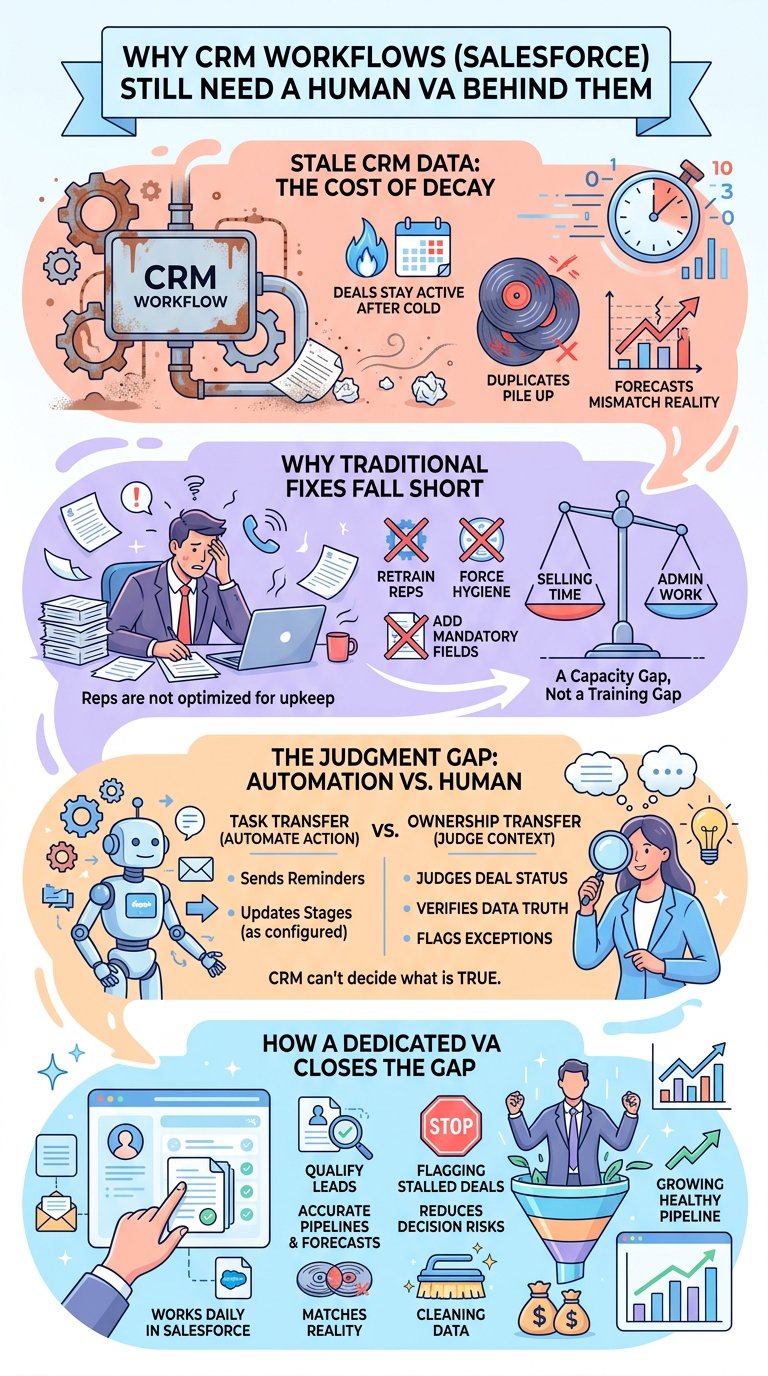

Salesforce Runs, but Your Pipeline Still Decays
Every sales leader has seen this version of the problem. The forecast says the quarter is on track. Then two of the “committed” deals turn out to have gone cold three weeks earlier, and nobody had touched the record to reflect it.
Salesforce didn’t cause this. It reported exactly what was entered. The stage said “committed” because that’s what someone typed in during the last real update, and nothing since then contradicted it inside the system, even though plenty contradicted it outside the system.
The same pattern shows up in smaller ways constantly:
- A lead comes in through a form, gets auto-assigned, and sits untouched because nobody checked whether it matched the ICP before it landed in a rep’s queue.
- Two contacts for the same account get created six months apart, splitting activity history between them.
- A follow-up sequence keeps firing to a prospect who already replied to say they’re not interested, because the reply came through email and never got logged back into the record.
Each of these is small. None of them shows up as a Salesforce failure, because the automation itself works fine. But add them up across a growing pipeline, and the CRM stops being a reliable source of truth. It becomes a record of what people remembered to enter, which is a very different thing.
Why Rep Training Won’t Fix Salesforce Data
The instinct here is to fix the humans:
- Retrain reps on CRM hygiene.
- Add mandatory fields so a stage can’t be updated without a next step attached.
- Write an SOP for how often records need review.
- Tie compliance to a KPI reps already resent tracking.
These aren’t unreasonable ideas. A rep who never logs anything is a real problem, and some baseline discipline matters. But this response treats the issue as a training gap, when it’s actually a capacity gap. Reps are optimized to sell, not to maintain data, and asking them to do more upkeep on top of quota doesn’t change that trade-off. It just adds friction to the job they’re actually measured on.
The missing variable isn’t rep behavior. It’s ownership. Nobody on the team is responsible for the CRM’s accuracy as a standing task, separate from closing deals. Automation covers the trigger: if a field changes, do this next. It does not cover the judgment: is this lead actually qualified, has this deal actually stalled, is this contact still worth pursuing? That judgment sits in a gap between what reps have time for and what admins are set up to configure.
Stricter rules push harder on the same gap. What actually closes it is a person whose job is that judgment, working inside Salesforce daily, separate from the sales motion itself.
How Data Quality Quietly Erodes
This gap doesn’t appear on day one. Early on, a small team with a handful of deals can keep the CRM accurate through sheer proximity. The founder or sales lead knows every deal personally, so even sloppy entry gets caught and corrected in conversation.
As the pipeline grows, that proximity disappears. More reps means more records changing in more places, on a schedule that no one person naturally tracks anymore. But the workflows built during the small-team phase don’t get rebuilt. Nobody stops to add a dedicated upkeep function, because the system still looks like it’s working. Reports still generate. Fields still populate. The reminders still fire.
That surface-level function is exactly what hides the decay. A dashboard full of numbers reads as reliable, whether or not those numbers reflect current reality. Leadership trusts the report because it exists and looks complete, not because anyone has verified it against what’s actually happening in the deals.
A few things quietly keep the gap alive:
- Reps optimize for their own metrics. Updating a stage takes thirty seconds; auditing whether it’s still accurate takes real attention they don’t have time for.
- Leadership treats the CRM as infrastructure configured once, not a surface that needs continuous tending as volume grows.
- Nobody owns catching the decay, so it never gets flagged until it’s already widespread.
The gap doesn’t announce itself. It just quietly widens until the data can no longer be trusted at a glance.

When Bad Salesforce Data Becomes a Real Risk
There’s a specific point where this stops being a minor annoyance and starts being a real business risk. It usually shows up around the same volume threshold: enough deals and reps that no single person can mentally track pipeline health anymore, so the CRM has to actually be trusted as the source of truth.
Before that point, the fatigue is task-level. A leader can personally spot-check a dozen deals and catch what’s off. Past that point, the fatigue shifts to decision-level: too many records to check individually, so leadership has to decide how much to trust a system they no longer have visibility into. That’s a heavier, more anxious kind of load, because the stakes now include forecasting, board reporting, and resourcing decisions built on data nobody has verified.
The trigger event that makes this visible is usually a specific failure:
- A deal reported as healthy falls through, and the post-mortem reveals it had gone quiet weeks earlier with no one noticing.
- A forecast miss gets traced back to duplicate records inflating pipeline value.
- Growth pressure pushes more deals through the same unmanaged process, creating more chances for the gap to produce a costly surprise.
Once this happens once, it tends to happen again unless the underlying ownership problem gets fixed. Reps get told to be more careful. The same gap reopens within a quarter, because carefulness was never the actual variable.
Salesforce Automates Tasks, Not Ownership
The useful distinction here is between task transfer and ownership transfer. Automating a workflow transfers tasks. It does not transfer ownership of whether the underlying data is still true. Those are different kinds of delegation, and confusing them is what creates this whole pattern.
| Task Transfer (What Salesforce Does) | Ownership Transfer (What It Doesn’t Do) |
|---|---|
| Sends an email | Judges whether the email should have gone out |
| Updates a related field | Verifies the update reflects what’s actually true |
| Triggers a reminder | Decides if the reminder still matters |
Salesforce, or any CRM, can absorb an enormous number of tasks. What it cannot absorb is decision rights over ambiguous cases:
- Whether a lead is actually qualified.
- A stalled deal should be reclassified.
- Whether a contact who went quiet should be dropped or nurtured differently.
Those calls require judgment applied consistently over time, which means they need an owner, not a rule.
Most teams never assign that ownership explicitly. It gets split between reps who don’t have time and admins who configure the system but don’t watch the deals inside it day to day. The result is a workflow that runs perfectly and a dataset that nobody is actually accountable for.
The fix isn’t more automation or more rules for reps. It’s assigning that ownership as a standing role: someone whose job is to hold decision rights over CRM accuracy, working the exceptions automation can’t judge, every day, as the pipeline moves.
How a Wing VA Closes the Data Gap
This is the role a Wing VA is built to fill: not replacing the CRM, and not replacing reps, but holding the ongoing ownership that neither one is set up to hold. A dedicated Wing VA works inside Salesforce daily, handling the judgment calls and cleanup that automation triggers but can’t resolve on its own.
None of this requires giving up control of the sales process. A VA works with role-based access inside the existing CRM, following the workflows already built, and the ownership stays continuous because it’s one dedicated person’s job, not a task split across whoever has a spare ten minutes.
| What Salesforce Automates | What Still Needs a Human |
|---|---|
| Triggering reminders and follow-up sequences | Judging whether a deal is actually stalled |
| Populating fields when data is entered | Verifying that entered data is still accurate |
| Routing new leads to a rep queue | Qualifying a lead before it reaches a rep |
| Generating reports from existing records | Checking whether those records reflect reality |
| Flagging duplicate matches | Merging duplicates and preserving history |
The system of record doesn’t change. What changes is whether anyone is actually keeping it honest.
This isn’t theoretical. Oceans Ventures, a New York venture capital firm, handed off CRM data entry, verification, and deal enrichment to a dedicated Wing assistant working inside their Affinity CRM:
- 848+ days of CRM data and research support delivered
- 43+ portfolio companies monitored
- Cleaner, more accurate deal data feeding faster screening decisions
Co-Founder Sara Barek put it simply: the assistant delivers “very prescriptive data that helps us make decisions faster and narrow the funnel.”
The tool was different (Affinity, not Salesforce), but the underlying gap was the same one this article has been describing: automation ran the workflow, and someone still had to own whether the data behind it was true.
The Real Fix for Salesforce Pipeline Health
None of this means reps have been careless or that the Salesforce setup was configured wrong. The tool is doing exactly what it was built to do: automate the workflow once the inputs are correct. What it was never going to do on its own is keep those inputs correct, because that takes ongoing judgment, not another rule.
Once that distinction is clear, the fix stops being about pushing reps harder or adding more fields to a form. It’s about assigning someone the standing job of holding that judgment: reviewing what’s stalled, qualifying what’s new, and keeping the pipeline honest as it grows. That’s a different role than selling, and it works best when it’s treated as one.
A Wing VA can take on that ownership directly inside your existing Salesforce setup, so the system stays accurate without adding to what your reps are already carrying. Schedule a call to see how it fits into your current workflow.
Yes. Most clients set up role-based access so a Wing CRM & automation specialist can update records, manage pipeline data, and clean duplicates inside Salesforce without touching admin-level configuration or automation rules. Access scope is defined during onboarding based on what your team is comfortable delegating to Wing, and it can expand as trust builds. No. A Salesforce admin manages configuration, integrations, and system architecture. A Wing CRM data entry assistant handles the daily upkeep an admin doesn’t have time for: record accuracy, deduplication, lead qualification, and pipeline review. The two roles work alongside each other, not in place of one another. A Wing sales development representative focuses on outbound prospecting and booking meetings. A Wing CRM & automation specialist focuses on keeping Salesforce accurate and current for deals already in motion. Some businesses use both Wing roles together, since prospecting and pipeline upkeep are different jobs with different daily priorities.Frequently Asked Questions

Dianne Florendo is a content writer who creates engaging SEO content about virtual assistants, outsourcing, and business productivity.