

Most teams set up Salesforce, then leave reps to update it whenever they get to it. Records go stale, duplicates pile up, and “active” deals stay marked active long after the prospect went quiet. A dedicated Wing VA works inside Salesforce daily, catching what automation can’t: qualifying leads, cleaning up duplicates, and flagging deals that have actually stalled. Forecasts start matching what’s really in the pipeline, and nobody’s scrambling to explain bad numbers before a board meeting.
Most SMBs don’t second-guess Genesys. It’s built for scale, and it delivers on that. But scale isn’t the same as resolution: only 25% of contact centers have fully integrated automation into daily operations (IBM), and 85% of CX leaders say customers leave a brand when their issue goes unresolved on the first contact (Masterofcode). Genesys can process the interaction. It can’t guarantee the outcome.
This piece covers why that gap forms, why it grows with your ticket volume, and where Wing Assistant fits inside a Genesys setup to actually close it.
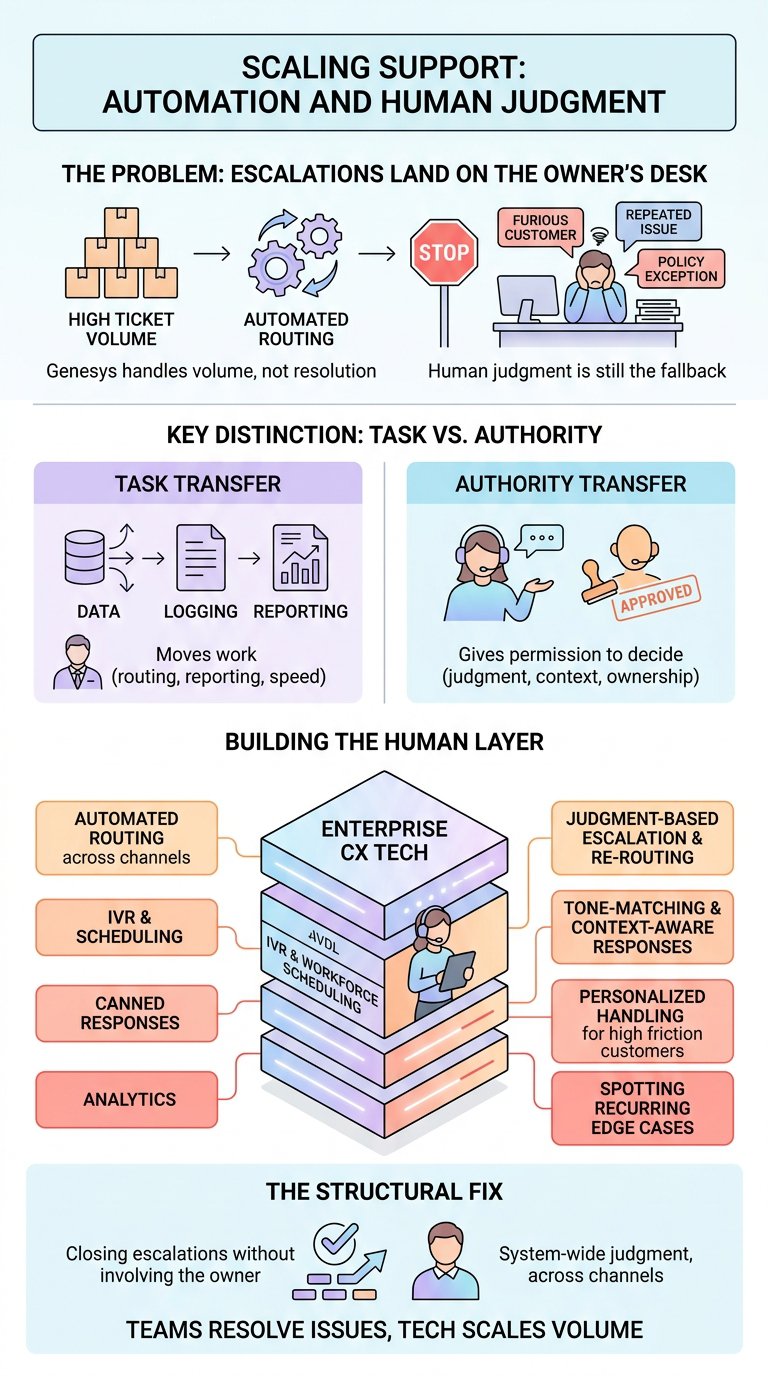

The Genesys Investment That Still Needs You
You brought in Genesys because your support operation outgrew spreadsheets and shared inboxes. The routing got smarter. The dashboards got cleaner. Workforce management stopped being a guessing game.
And yet the same escalations still land on your desk. Not the volume ones, Genesys handles volume fine. It’s the exceptions:
- The customer who’s furious but not wrong
- The ticket automation routes to the wrong queue three times in a row
- The account history a bot can’t read between the lines of
Every one of those still needs a human to slow down, weigh context, and make a call.
That’s not a Genesys failure. It’s a mismatch between what the platform was built to do and what your team assumed it would absorb.
Genesys was built to orchestrate conversations at scale. It was never built to have them. Somewhere between “we implemented an enterprise CX platform” and “I’m still the fallback for every hard ticket,” the gap in the system became your job description. Learn more about Shopify assistant for hire.
Why More Configuration Isn’t the Fix
The instinct, when Genesys doesn’t fully close the gap, is to configure harder:
- Add another routing rule
- Refine the IVR tree
- Build a new workflow for the edge case that just came up
It feels like progress because it’s tangible work inside a tool you’re already paying for. It’s also the wrong lever.
Every new rule you add still just moves the task; you’re teaching the system to route conversations more precisely. But the conversations that keep escaping to you aren’t routing failures. They’re judgment failures: moments where the system correctly identifies that a human decision is needed and correctly has nowhere reliable to send it.
Genesys can flag that a ticket needs escalation. It cannot decide what to say to a repeat customer who’s had the same issue twice, or whether a refund request that breaks policy is still the right call this once. That decision has to live somewhere. Right now, by default, it lives with you.
What’s missing isn’t a smarter workflow. It’s a person with standing authority to hold that judgment consistently, across channels, without it bouncing back to the owner every time.

How the Escalation Habit Actually Forms
This doesn’t happen all at once. It forms in small, reasonable-looking steps:
- It starts small. A handful of tickets a week don’t fit the automation cleanly. You handle them yourself, faster than training someone else to, and the volume’s too low to register as a problem.
- It gets justified by scale. As ticket volume grows, so does the number of edge cases Genesys correctly flags but can’t resolve. You keep absorbing them because the pattern’s already set, and handing off “the hard ones” feels riskier than just doing them.
- It gets reinforced. Each time you personally close an escalation, the system quietly confirms that you’re the fallback layer, not the workflow.
Nobody decided this on purpose. It’s the accumulation of a hundred small, correct-in-the-moment choices to just handle it, none of which included building a human layer with the standing to handle it without you.
When the Ticket Load Becomes a Decision Load
The pattern stays invisible as long as task volume and decision volume grow at roughly the same rate. You can absorb both, so nothing feels broken.
The inflection point arrives when they decouple:
- Ticket volume climbs steadily with growth. It’s more of the same work.
- Decision volume climbs faster. A bigger customer base doesn’t just mean more tickets, it means more edge cases, more repeat escalations, more moments where policy and judgment collide.
Task load was always manageable. Decision load is what actually breaks.
You’ll usually feel the trigger event before you can name it: a week where you try to step back, and the exceptions don’t slow down without you, they pile up. That’s the moment Genesys’s ceiling becomes visible. The platform was never the constraint. The missing human layer was.
Task Transfer vs. Authority Transfer
The sharper model here is simple: there’s a difference between transferring tasks and transferring authority.
- Task transfer is what Genesys does well. It moves the work of routing, logging, and reporting off a person’s plate.
- Authority transfer is different. It means someone other than the owner has standing permission to make the judgment call, own the outcome, and not escalate back up by default.
| Task Transfer | Authority Transfer | |
|---|---|---|
| What moves | The work itself (routing, logging, reporting) | The right to decide |
| Who Genesys serves | Volume and consistency | Nobody, by design |
| What it fixes | Speed and organization | Nothing, on its own |
| Who still owns the call | The owner, by default | Whoever holds standing authority |
Most SMBs configure the first and never build the second. That’s why the escalations keep finding their way home. The system was optimized to move tasks, not to hold decision rights anywhere but the top.
Where a Wing VA Fits Inside Genesys
This is where a trained Wing virtual assistant fits, not as a replacement for Genesys, but as the authority layer the platform was never designed to provide.
A Wing VA works inside your existing Genesys setup, monitoring queues, catching the tickets automation misroutes, and applying the tone and judgment a script can’t. They build context over time: your escalation rules, your tolerance for exceptions, your customers’ history, so the same decision doesn’t need to route back to you every time it repeats.
| Genesys Handles | Where a Wing VA Adds the Human Layer |
|---|---|
| Automated routing across channels | Judgment-based escalation and re-routing when automation misfires |
| IVR and workforce scheduling | Tone-matching and context-aware responses on live tickets |
| Analytics and queue reporting | Spotting recurring edge cases and flagging real fixes, not just symptoms |
| Canned and templated responses | Personalized handling for repeat or high-friction customers |
A Wing customer support VA doesn’t compete with the platform. They sit inside it, holding the judgment layer Genesys was always going to need a human for.
This plays out the same way outside of Genesys, too. Mountain Gazette, a subscription publisher managing customer service and order support in Shopify, brought on a Wing e-commerce assistant to sit inside their existing tools rather than replace them:
- 29% faster response times to customers
- 90% subscriber renewal rate
- Full Shopify and email support integration
- Recovered missed revenue opportunities the team didn’t have bandwidth to chase
As Editor and Owner Mike Rogge put it: “There’s pre-Komal Mountain Gazette and post-Komal Mountain Gazette, and post-Komal Mountain Gazette is a much better place for us to be.” The tool didn’t change. The judgment layer inside it did.
The Structural Fix You’ve Been Missing
None of this means Genesys was the wrong call, or that you configured it badly. The platform is doing exactly what it was built to do: move volume, not hold judgment.
What was missing was never another workflow. It was a person with standing authority to make the calls the system was always going to defer to a human, consistently, without routing back to you by default.
Once that layer exists, the tool you already invested in finally works the way you expected it to from the start.
Ready to add the human layer Genesys was always going to need? Book a call with Wing.
No. Wing places a trained Customer Service Representative inside your existing Genesys configuration, monitoring queues and handling the escalations the platform correctly flags but can’t resolve on its own. The tech stays; the judgment layer gets filled in. Yes. The pattern isn’t specific to Genesys’s scale, it’s about any CX automation reaching its limit at judgment calls. Wing’s CRM & Automation Specialist role applies the same layer regardless of which platform you’re running. A Wing VA is trained, managed, and supported by a Customer Success Manager, with backup coverage built in. You get standing authority for escalations without owning the hiring, training, or turnover risk yourself. Wing’s IT Helpdesk and Account Manager roles are both built around exactly this kind of ownership.Frequently Asked Questions

Dianne Florendo is a content writer who creates engaging SEO content about virtual assistants, outsourcing, and business productivity.