







TL;DR
- Most executives treat EA hiring as a talent search, find the right person, and figure out the rest later.
- That skips the decision that actually determines whether the support works: dedicated or fractional, and whether that model matches your real workload.
- Match the engagement structure to your hours, responsiveness needs, and budget before you look at a single candidate.
- Get that right, and the hire works. Get it wrong, and even a great EA underdelivers.
Executives who delegate effectively recover an average of 8 hours per week, but only when the support structure matches the actual workload. The model matters as much as the person.
This article breaks down the difference between dedicated and fractional EA support, cost, availability, context depth, and the workload signals that tell you which structure fits your stage.
If you're weighing both options, Wing Assistant offers fractional EA support built for executives who need senior-level coverage without the overhead of a full-time hire.
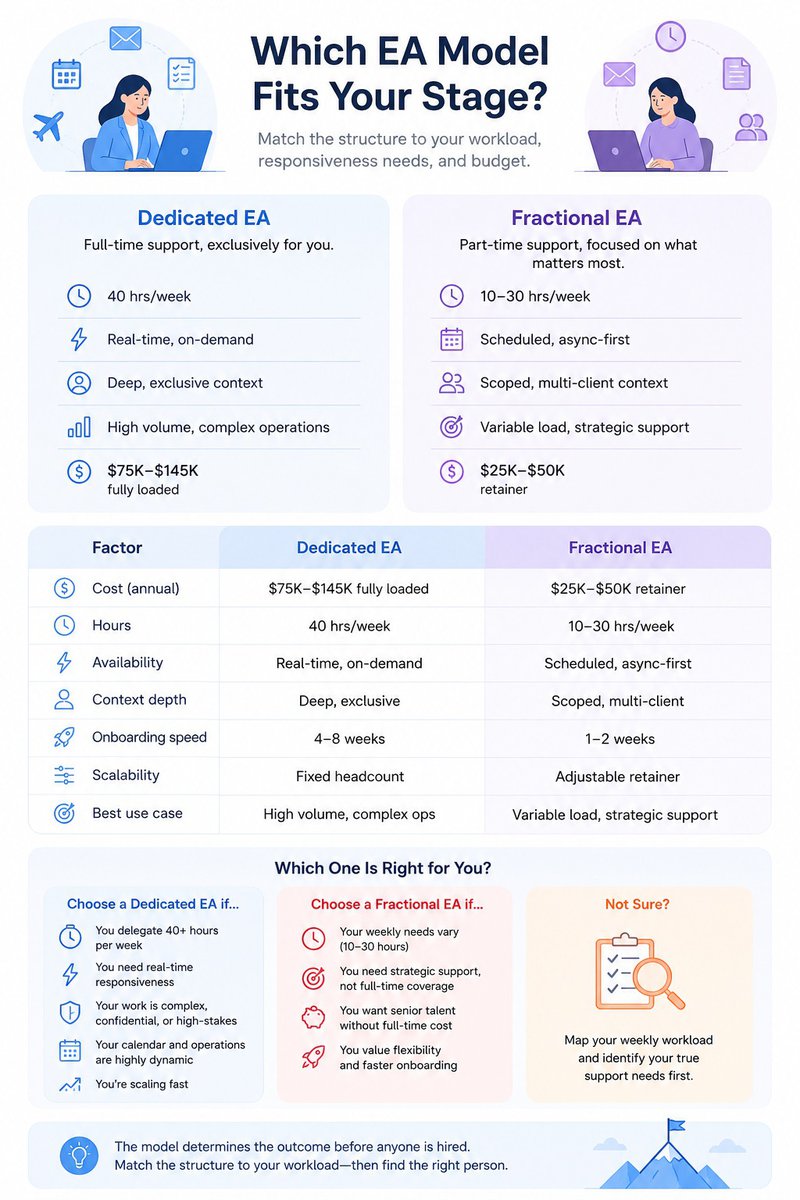
The Model Determines the Outcome Before Anyone Is Hired
Most executives treat EA selection as a talent problem. Find someone sharp, well-organized, experienced with C-suite support, and the rest follows. That framing misses the more consequential decision sitting underneath it.
The engagement model determines the outcome before a single candidate is evaluated. Get it wrong, and even a strong EA underdelivers. Specifically, the model sets:
- Availability — whether your EA is on-call or working within scheduled windows
- Context depth — whether they're embedded exclusively in your workflow or splitting attention across clients
- Accountability structure — who they're responsible to and how performance is measured
- Cost — fully loaded overhead vs. a predictable monthly retainer
Hire a fractional EA into a 40-hour-a-week support need and you get gaps at the worst moments. Hire a dedicated EA for 15 hours of weekly delegation and you're carrying significant overhead for capacity you won't use.
This is an infrastructure decision, not a hiring decision. The structure has to match the workload before the search begins.
What Is a Dedicated EA?
A dedicated EA provides full-time or near-full-time support, typically 40 hours per week, exclusively to one executive. They build deep institutional knowledge over time and don't just complete tasks; they anticipate them.
A dedicated EA typically handles:
- Calendar and scheduling — full ownership of your time, priorities, and meeting cadence
- Communications — inbox management, stakeholder correspondence, follow-ups
- Travel and logistics — end-to-end coordination with real-time adjustments
- Project follow-through — tracking deliverables across teams and vendors
- Confidential and sensitive work — board prep, personnel matters, high-stakes coordination
What it costs:
Dedicated EAs are typically employed directly (W-2) or through a staffing arrangement. Fully loaded annual cost, salary, benefits, payroll taxes, equipment, and PTO coverage runs $75,000 to $145,000, depending on experience level and market.
The core value proposition:
Continuity and depth. A dedicated EA is embedded in your operational reality. They can handle complex multi-stakeholder coordination and respond in real time because your work is their only context. Learn more about best cold calling assistant.
What Is a Fractional EA?
A fractional EA provides senior-level executive support on a retainer basis, typically 10 to 30 hours per week, shared across a small number of clients. The engagement is scoped, predictable, and structured around your highest-leverage needs rather than hourly availability.
A fractional EA typically handles:
- Inbox and communications triage — prioritizing what needs your attention and what doesn't
- Calendar management — scheduling, rescheduling, and protecting your focus time
- Travel coordination — logistics and itinerary management within scoped hours
- Project and vendor coordination — follow-ups, status tracking, deadline management
- Board and meeting prep — materials, agendas, and pre-read distribution
What it costs:
Annual cost typically runs $25,000 to $50,000 on retainer, no benefits, payroll taxes, or equipment overhead. Onboarding is faster because fractional EAs operate with established systems and a narrower, more defined scope of work.
The core value proposition:
Senior capability without full-time cost. Fractional EAs are typically experienced operators who work with a small number of executives simultaneously. What you trade is real-time availability and the depth that comes from exclusive focus.
Dedicated EA vs. Fractional EA: Side-by-Side
| Factor | Dedicated EA | Fractional EA |
|---|---|---|
| Cost (annual) | $75K–$145K fully loaded | $25K–$50K retainer |
| Hours | 40 hrs/week | 10–30 hrs/week |
| Availability | Real-time, on-demand | Scheduled, async-first |
| Context depth | Deep, exclusive | Scoped, multi-client |
| Onboarding speed | 4–8 weeks | 1–2 weeks |
| Scalability | Fixed headcount | Adjustable retainer |
| Best use case | High volume, complex ops | Variable load, strategic support |
When a Dedicated EA Is the Right Choice
Volume is the primary indicator. If you have 40 or more hours of weekly delegation, a fractional engagement will run out of hours and create gaps. But hours alone aren't the only signal. Consider a dedicated EA when:
- Your delegation load is high — 40+ hours of weekly support across calendar, communications, travel, and project coordination
- You need real-time responsiveness — your work requires someone available during your working hours who can act immediately on shifting priorities
- Confidentiality is a factor — board relationships, sensitive personnel matters, or high-stakes negotiations require an EA who holds full context and is accountable only to you
- Your calendar is complex — multi-timezone scheduling, frequent travel, and heavy stakeholder coordination that requires constant, embedded oversight
- You're scaling fast — rapid growth creates operational complexity that a scoped retainer can't absorb reliably
The bottom line:
If you are running a scaling company with a full operational calendar and need someone embedded in your workflow, dedicated is the right model. The cost is high, but so is the gap when that level of support is missing.
When a Fractional EA Is the Right Choice
If your support needs are real but not constant, fractional is the structurally correct choice. Variable workloads, project-heavy periods followed by lighter stretches, are poorly served by fixed full-time overhead. Consider a fractional EA when:
- Your delegation load is under 25 hours per week — consistent but not high enough to justify a full-time headcount
- Your workload fluctuates — busy quarters followed by slower periods, where full-time coverage would go underutilized
- You're early-stage — managing burn rate while still needing senior support for inbox triage, vendor coordination, board prep, and travel logistics
- You're testing EA support for the first time — fractional lets you define what you actually need before committing to a full-time structure
- Async response windows work for you — your work doesn't require someone on-call; most tasks can be handled within a scheduled window
The bottom line:
Fractional is not a compromise; it's the right structure for a specific stage and workload profile. If your weekly delegation load is under 25 hours and your operations can tolerate async coverage, fractional delivers senior capability at a cost that fits where you are.
The Hidden Costs Most People Miss
Dedicated EA comparisons often stop at base salary. That understates the real number significantly. Here's what the fully loaded cost actually looks like:
Side-by-side cost comparison:
| Cost Factor | Dedicated EA | Fractional EA |
|---|---|---|
| Base / Retainer | $75K–$105K | $25K–$50K |
| Payroll Taxes | ~$6K–$8.4K | None |
| Health Benefits | $6K–$15K | None |
| Equipment / Software | $1.5K–$3K | None |
| PTO Coverage | 10–15 days unpaid gap | Built in |
| Total Estimated Cost | $90K–$145K+ | $25K–$50K |
The hidden cost on the fractional side:
Scope creep. If your needs grow beyond the retainer hours and you don't address it, you either overload the engagement or leave work undone. The retainer structure requires honest scoping upfront — but that's a conversation, not an overhead line item.
Where Wing Fits
Wing operates at the fractional and scalable end of this spectrum, providing structured executive support for leaders who need senior-level coverage without the overhead of a full-time hire. The engagement is scoped to your actual workflow, not a fixed 40-hour block.
The results bear it out. When Cathy Fisher, founder of Quistem, paired with a Wing Executive Assistant, she reclaimed 25% of her working time with measurable outcomes across the board:
- 25% of CEO's time reclaimed — redirected from daily admin to strategy and growth
- 9 recurring admin tasks offloaded — scheduling, inbox management, internal workflows, and portal documentation
- 1,000+ workdays of EA support delivered — consistent, structured, and reliable
“He’s freed up my brain and my time. I can now focus on value creation instead of a thousand little tasks.”
— Cathy Fisher, Founder & CEO
If your weekly delegation load doesn't warrant a full-time hire but your operations can't afford gaps, that's exactly where Wing is designed to fit.
Frequently Asked Questions
Is a fractional EA the same as a virtual assistant?
No. A VA typically handles defined, repeatable tasks — scheduling, data entry, inbox sorting. A fractional EA operates at a higher level: stakeholder communications, project coordination, and executive decision support. The scope, judgment required, and professional experience are meaningfully different. Wing offers both — a dedicated Executive Assistant for senior-level support, or an Administrative Virtual Assistant for structured back-office coverage — so you're not forced to overhire or underhire for what you actually need.
How many hours does a fractional EA typically work?
Most fractional EA arrangements run 10 to 30 hours per week, structured as a monthly retainer. The specific hours depend on your delegation load and the scope defined at the start of the engagement. Hours are not always interchangeable week-to-week, most retainers are structured around a consistent workflow rather than on-demand hourly draws. Wing's Executive Assistant and Personal Assistant roles are both scoped to fit your actual workload, whether that's part-time fractional coverage or full dedicated support.
Which model is better for a startup?
For most early-stage founders, fractional is the structurally correct starting point. Fixed full-time EA overhead is difficult to justify when the company is managing burn rate and the support need is real but variable. Wing's Virtual Assistant for Consultants and Administrative Virtual Assistant roles are built for exactly this stage — senior capability at a cost that fits where you are. If delegation volume grows past 30 to 40 hours weekly, the case for a dedicated Executive Assistant becomes clear.
The Decision Is Structural, Not Personal
Executives who choose the wrong EA model don't make a talent mistake; they make an infrastructure mistake. The model has to match the workload before the search begins.
The sharper frame: you are not hiring a person. You are selecting an operational model. The right person inside the wrong model will underdeliver. Match the structure first.
Wing offers both models, scoped to your stage, your workload, and your budget. If you're ready to build the right support structure, book a demo, and we'll help you figure out exactly what you need.

Dianne Florendo is a content writer who creates engaging SEO content about virtual assistants, outsourcing, and business productivity.