

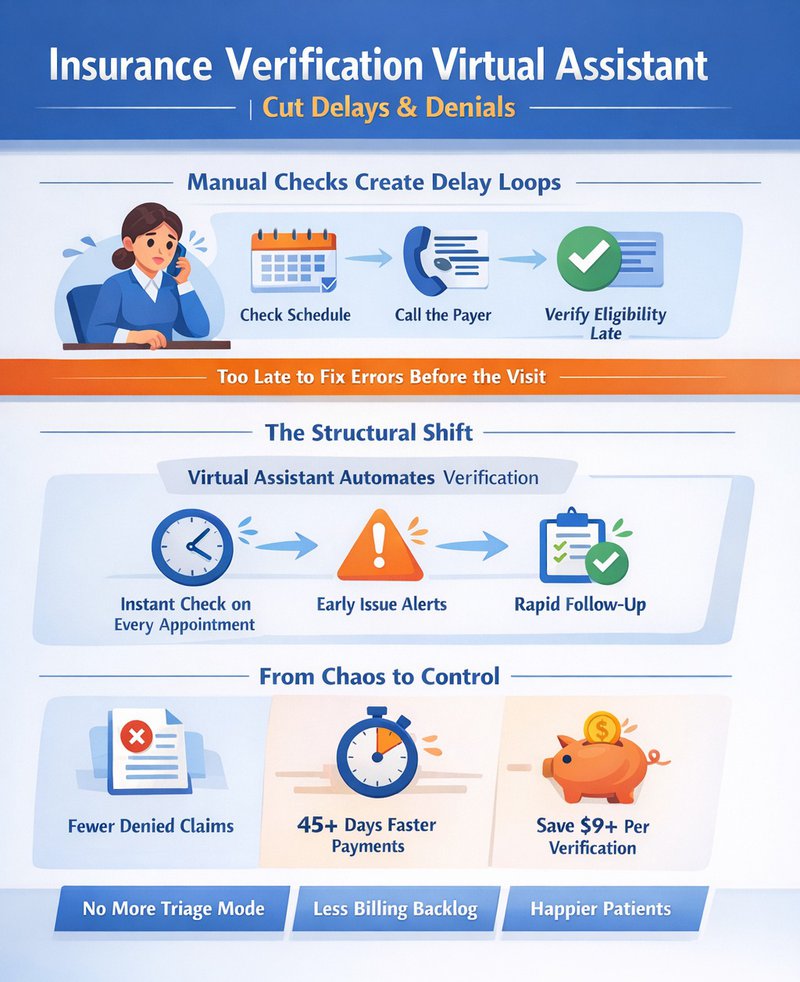
Most practices run verification manually; a staff member checks the schedule, contacts the payer, and moves on. The problem isn’t effort. It’s timing. By the time the check runs, the window to fix a coverage issue before the visit is already narrow. An insurance verification virtual assistant moves that check upstream, automated, triggered by every appointment, flagging problems early enough to resolve them. The result isn’t just fewer denials. It’s a front desk that starts the day in triage mode.
An insurance verification virtual assistant is a trained remote specialist who confirms a patient’s insurance eligibility and benefits before their appointment, using automated queries against payer databases instead of manual phone or portal checks.
Unlike traditional front-desk verification, which runs on a staff member’s schedule, an insurance verification VA is triggered by every new appointment and flags coverage problems 48–72 hours ahead of the visit, early enough to fix them before the patient shows up.
Insurance verification runs quietly until it doesn’t, and when it breaks, it shows up as denied claims, check-in surprises, and billing staff buried in payer calls. According to the 2022 CAQH Index, manual eligibility verification costs $10.59 per transaction versus $1.59 for automated. At scale, that gap is significant.
In this article, we cover why manual verification keeps failing, what’s actually driving it, and how an insurance verification virtual assistant fixes the problem at the structural level.
When the Front Desk Becomes a Bottleneck
A claim gets denied. The billing team traces it back to an eligibility mismatch: the patient’s plan changed, but nobody caught it before the visit. Here’s what follows:
- Staff spend 20+ minutes reworking the submission
- The payer requires additional documentation
- Reimbursement arrives 45 days late, or not at all
This isn’t a one-off failure. It’s a pattern. Consider the numbers:
- The average denial rate in outpatient settings runs between 5% and 10%
- Eligibility errors account for nearly a quarter of initial rejections
- Each reworked claim costs $25 to $118 in administrative labor before resolution
The front desk isn’t failing because people are careless. The friction is structural: verification is being run as a manual, sequential task inside a workflow that moves faster than any individual can consistently track.

Manual Verification vs. VA-Assisted Verification
| Metric | Manual Verification | VA-Assisted Verification |
|---|---|---|
| Cost per transaction | $10.59 | $1.59 (automated) |
| When the check happens | 24–48 hours before the visit, staff-initiated | Triggered automatically at appointment creation; re-checked if patient data changes |
| Issue flagged | Often at check-in or after claim denial | 48–72 hours before the visit |
| Rework per denied claim | $25–$118 in administrative labor, plus 20+ minutes of staff time per rework | Exceptions routed to staff with the issue and resolution steps already attached — no rework from scratch |
| Measured outcome (Wing client case study — Provida Family Medicine) | Baseline | 50% faster admin workflows, 35% fewer billing errors, 25% faster claims processing, 40% higher patient satisfaction |
The Fix Everyone Tries First; and Why It Falls Short
When denial rates climb, the default response is predictable:
- Hire another verification specialist
- Tighten the checklist
- Add a manual audit step before claims go out
These feel like solutions because they add capacity. But they address throughput, not architecture.
The missing variable isn’t headcount, it’s trigger timing. Manual verification runs on a human schedule, which means:
- It starts too late
- It runs inconsistently across staff
- It produces no actionable alert when coverage changes between the verification date and the visit
Adding people to a broken trigger cycle doesn’t fix the cycle. It makes it more expensive. The structural question isn’t “how do we verify faster?” It’s “when does verification happen, and what owns the response when something is wrong?”
How the Delay Pattern Actually Forms
Practices don’t arrive at chronic verification problems overnight. The pattern builds across months, reinforced by decisions that feel reasonable in isolation:
- Verification starts as a scheduled, staff-driven task, usually 24 to 48 hours before the visit
- Early on, this is manageable. As volume grows, the same staff carry a larger eligibility queue
- Verification gets compressed into smaller windows
- Edge cases — complex plans, recent changes, secondary coverage — get triaged quickly rather than resolved thoroughly
When a denial surfaces, the team identifies the specific error and patches it. What goes unexamined is the systemic condition:
- Eligibility was checked too late
- The process was too manual
- There was no feedback loop when patient data changed after the initial verification
Leadership often reinforces the pattern by rewarding resolution speed, how fast denials are reworked, rather than addressing the verification trigger itself.

When It Becomes Undeniable
The inflection point is not a single bad quarter. It’s a fatigue shift. Billing coordinators who once managed exceptions are now managing a system that runs almost entirely on exceptions.
The signal usually shows up as one of three things:
- A denial rate that no longer responds to staff additions
- A revenue cycle report showing a consistent 45-to-60-day lag on a specific payer group
- A compliance audit revealing verification documentation gaps across multiple providers
At this point, the team isn’t behind because they’re working poorly. They’re behind because the structure they’re maintaining was designed for a lower patient volume and a narrower payer mix.
The Structural Model: Verification Needs Automated Ownership
The correct lens here is not task management — it’s decision rights.
Manual verification assigns the task to staff but leaves three things unowned:
- The triggering
- The exception flagging
- The follow-through
That’s where Wing comes in. Wing’s insurance verification virtual assistants are trained specifically for healthcare billing workflows — shifting ownership from a person to a system. Instead of staff initiating checks based on appointment schedules, Wing’s assistant:
- Runs continuous, automated queries against payer databases
- Triggers on appointment creation
- Updates when patient data changes
- Escalates immediately when coverage is inactive, mismatched, or missing
The practical difference: instead of discovering an eligibility issue at check-in or post-claim, the assistant surfaces it 72 hours before the visit, assigns a resolution task, and tracks closure. The human role moves from executing verification to reviewing exceptions that require judgment.
Compliance and Turnaround, at a Glance Wing’s insurance verification VAs are HIPAA-trained and operate inside your existing practice management system and payer portals — no data leaves your systems of record. Standard turnaround: coverage issues are flagged 48–72 hours before the scheduled visit, giving your billing team a resolution window instead of a same-day scramble.
Where Wing Insurance Verification Virtual Assistant Fits Structurally
Wing’s insurance verification virtual assistants are built around this ownership model. They integrate directly with practice management systems and payer portals and deliver.
For multi-provider practices and high-volume outpatient clinics, this means verification runs consistently at scale, without depending on staffing levels or individual throughput on any given day. For smaller practices, it means a billing coordinator can manage a significantly larger schedule without proportional overhead growth.
What this looks like in practice: Provida Family Medicine, a primary care clinic in Gurnee, Illinois, partnered with Wing to address scheduling delays, billing bottlenecks, and data inconsistencies that were affecting both patient satisfaction and operational efficiency. After onboarding Wing’s healthcare virtual assistants, who managed EHR updates, patient intake, and insurer coordination, the results were measurable:
- 50% faster clinic admin workflows
- 35% reduction in billing errors
- 25% faster claims processing
- 40% higher patient satisfaction scores
Frequently Asked Questions
An insurance verification VA runs automated eligibility checks against payer databases as soon as an appointment is booked, then re-checks if patient data changes before the visit. It flags coverage problems — inactive policies, plan mismatches, missing prior authorization — 48 to 72 hours ahead of time, and routes only the cases that need a judgment call to your billing staff. It doesn’t replace billing staff; it removes the manual, time-boxed checking that causes issues to surface too late.
Eligibility errors account for nearly a quarter of initial claim rejections. Verifying coverage automatically at booking — rather than manually in the 24-to-48-hour window before a visit — catches mismatches while there’s still time to fix them: updating a lapsed plan, confirming secondary coverage, or triggering a prior authorization before the appointment happens. That earlier catch is what actually lowers the denial rate, not faster claims rework after the fact.
Yes. Wing’s insurance verification virtual assistants are built to parse multi-payer scenarios, including coordination of benefits, plan-specific coverage tiers, and prior authorization triggers. Wing flags situations requiring human review rather than making a binary eligibility decision on ambiguous cases, so your billing team only gets pulled in when judgment is actually needed.
Wing is designed to catch issues early, typically 48 to 72 hours before the visit, precisely to avoid last-minute scrambles. When late-breaking changes occur (plan lapses, address updates), Wing routes alerts immediately to your billing team with the relevant payer contact and resolution steps already included.
No. Wing integrates directly with your existing practice management system without requiring a workflow overhaul. Wing runs in parallel with your current process during an initial transition period, which allows staff to calibrate exception-handling before Wing takes full ownership of the verification cycle.
A Different Way to Think About the Problem
Chronic eligibility denials aren’t a performance problem; they’re a structural one. Your team isn’t under-skilled. They’re operating a verification system that was never built for the volume and payer complexity they’re managing today.
An insurance verification virtual assistant fixes the trigger, not just the symptom. When verification runs automatically, escalates precisely, and tracks resolution without manual coordination, the billing team gets back to doing work that actually requires them.
If that’s the shift your practice needs, book a demo with Wing, and we’ll walk through what it looks like for your specific workflow.

Dianne Florendo is a content writer who creates engaging SEO content about virtual assistants, outsourcing, and business productivity.