






TL;DR
- Most executives hire an assistant when the calendar is already out of control, and the inbox is weeks behind.
- The problem is not the backlog; it is that every operational decision in the company still terminates with you, assistant or not.
- The fix is not finding someone to take on tasks. It is finding someone who owns the operational layer, so it stops defaulting back to you.
- When that role is filled correctly, you stop being the last line of defense on logistics and start having the bandwidth to actually lead.
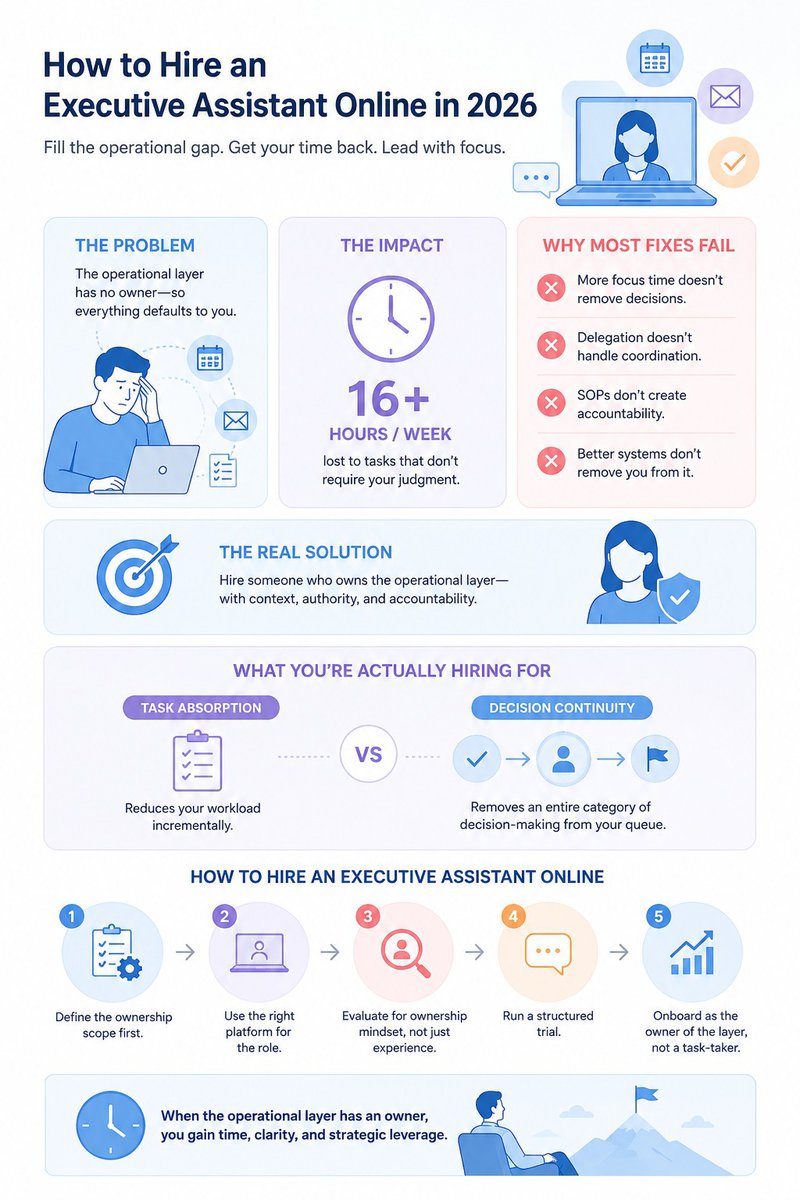
Executives lose an average of 16 hours per week to tasks that never required their judgment in the first place, such as scheduling, follow-ups, inbox triage, and coordination.
This guide breaks down exactly how to hire an executive assistant online in 2026, what to look for, how to evaluate candidates, and which platforms are worth your time. If you have been managing the operational layer yourself and wondering when the right time to hire is, this will give you a clear answer.
Wing Assistant is referenced throughout as a structural solution for executives who need more than occasional help; they need someone who owns the layer entirely.
The Operational Layer Has No Owner
You are not behind because you are disorganized. You are behind because every decision about logistics, scheduling, follow-up, and coordination terminates with you, not because you made that choice, but because no one else has the authority or context to close those loops.
This is not a personal productivity problem. It is a structural gap:
- The executive layer is occupied.
- The operational layer is vacant.
- Vacancy always filled with whoever is closest, and in most companies, that is you.
The friction shows up in predictable ways:
- A calendar that never reflects your actual priorities
- Emails are moving more slowly than decisions require
- A growing stack of follow-throughs that are yours by default, not by design
It feels like a time problem. It is a structural problem.
Hiring an executive assistant online does not fix your schedule. It fills the ownership gap, and that distinction matters more than most executives realize before they make the hire.
Why the Default Playbook Fails
Most executives cycle through the same interventions before making the hire:
- Block more focus time
- Delegate more to the team
- Build a better task system
- Write clearer SOPs
These work at the margins. What they do not do is assign structural ownership to the operational layer.
Here is why each falls short:
- Focus blocks protect time, but do not eliminate decisions still landing in your queue
- Delegation moves execution but not coordination
- SOPs document process but do not create accountability
- Better systems organize the work, but do not remove you from it
The missing variable is a role with both context and authority, someone who owns the operational layer continuously, not just completes tasks when asked. Without that role, loops do not close, and the work defaults back to you regardless of how good everything else looks on paper. Learn more about best amazon seller assistant.
How the Gap Forms Without Being Noticed
It starts with small decisions that each feels rational in the moment:
- Respond to the scheduling request yourself because it is faster
- Handle the vendor email because context transfer would take longer than just resolving it
- Close the follow-up loop because no one else has the information
None of it triggers an alarm. But the pattern compounds.
Within six months, the operational layer is yours by default, not because you claimed it, but because nothing redistributed it. What locks it in:
- Every direct action you take trains the organization that you are the operational fallback
- The system stabilizes around that assumption
- Redistributing it later requires not just a hire but a behavioral reset across how your team routes decisions
The pattern goes unnoticed because the output stays consistent for a while. The cost does not show up in deliverables; it shows up in decision speed, strategic availability, and compounding cognitive fatigue.
What You Are Actually Hiring For
This is where most hiring decisions go wrong. Executives search for someone to take tasks off their plate. That framing produces the wrong hire and the wrong outcome.
The structural role of a qualified executive assistant is not task absorption. It is decision continuity:
- Holding context across ongoing priorities
- Managing follow-through without being prompted
- Closing loops without requiring your constant input
- Acting with enough authority to keep things moving when you are unavailable
That distinction matters. Here is the difference in practice:
- A task-oriented hire reduces your workload incrementally
- An ownership-oriented hire removes an entire category of decision-making from your queue
One is relief. The other is leverage.
When you hire an executive assistant online, you are looking for someone who can operate the layer between your decisions and their execution — with enough context to act, enough authority to close loops, and enough structure to keep things moving without you in the middle of every exchange.
How to Hire an Executive Assistant Online: The Process
Finding the right person online follows a clear sequence. Platforms vary, but the evaluation framework does not.
Define the Ownership Scope First
Before writing a job description, identify which operational categories will transfer. Be specific; a vague scope produces vague hires.
Common ownership categories to define upfront:
- Calendar management and scheduling
- Inbox triage and email communication
- Project coordination and deadline tracking
- Vendor and contractor management
- Travel planning and logistics
- Meeting prep and follow-through documentation
Use the Right Platform for the Role
Not all platforms are built for executive-level support. The type of platform you use determines the type of hire you get.
| Platform Type | Best For | Limitation |
|---|---|---|
| General freelance marketplaces | One-off tasks, short projects | Not built for ongoing operational ownership |
| Job boards | Full-time in-house hires | Slower process, higher overhead |
| EA-specific platforms (e.g. Wing) | Ongoing remote executive support | Requires a clear scope to get full value |
Evaluate for Judgment, Not Just Speed
In interviews, do not just test task completion. Test how candidates handle incomplete information.
What to look for:
- How they reason through ambiguous scenarios
- Whether they escalate appropriately or stall
- How do they close loops when context is missing
- Whether they ask the right questions before acting
Speed is a commodity. Judgment under ambiguity is the differentiator.
Set a Structured Onboarding Protocol
The first 30 days should not be trial by fire. Define what ownership transfer looks like week by week.
A simple onboarding structure:
| Week | Focus |
|---|---|
| Week 1 | Shadow and observe — learn systems, tools, preferences |
| Week 2 | Handle low-stakes tasks independently |
| Week 3 | Take ownership of defined categories with check-ins |
| Week 4 | Full operational ownership with async reporting |
An assistant who receives a clear authority transfer onboards faster and performs at higher leverage sooner.
Hire an Executive Assistant Online | Where Wing Fits
Most executives who reach this point have already tried the standard fixes, better systems, clearer delegation, and tighter calendars. What they have not tried is placing a dedicated person in the operational layer with the authority and context to own it.
That is the gap Wing is built to fill.
Wing matches executives with dedicated assistants who are onboarded into existing systems and held accountable for operational follow-through, not just task completion. The results are consistent across industries:
Living Spec freed up enough founder bandwidth, and the results are:
- 3,000+ leads reached through outreach
- 30% month-over-month growth (up from 20%)
- 13,140+ hours of executive support delivered
- Streamlined email management, outreach, and research
“It seems like Wing does a pretty good job matching people almost automatically. Maybe there’s magic behind the scenes.”
— Dylan Schiemann, Co-Founder
The common thread is not the industry. It is the structural shift, from executive as operational fallback to executive as strategic owner.
Wing does not reduce your task list. It removes an entire category of work from your decision queue.
Frequently Asked Questions
What is the difference between a virtual assistant and an executive assistant?
A virtual assistant typically handles discrete, assigned tasks, data entry, scheduling requests, and research. An executive assistant operates at a higher level of context and authority, managing the operational layer continuously. The difference is not just skill level; it is the scope of ownership the role carries and the degree of judgment it requires. Wing offers both a dedicated Executive Assistant and an Administrative Virtual Assistant, depending on the level of ownership your operation requires.
How do I know if I am ready to hire an executive assistant online?
The clearest signal is not task volume. It is when operational decisions, scheduling, follow-through, and coordination are consistently consuming time that should be allocated to strategic work. If the operational layer defaults back to you because no role owns it, you are ready. Wing’s US-Based Executive Assistant and Personal Assistant roles are specifically structured for executives at that inflection point.
Can an online executive assistant handle confidential work?
Yes, with proper infrastructure. NDAs, access controls, and communication protocols make confidential work manageable in a remote context. The more important question is whether the assistant has the judgment to handle sensitive information, which is an evaluation question, not a platform question. Wing’s Virtual Assistant for Consultants and Project Manager roles are matched for exactly this kind of structured, high-trust operational support.
The Structural Reframe
You did not fall behind because you lacked discipline or made bad decisions. You fell behind because a structural role was absent, and the work filled your calendar by default.
Hiring an executive assistant online is not a workaround. It is the correct structural response to a real organizational gap. The right hire does not take tasks from you; it removes an entire operational category from your decision queue.
That is what leverage looks like at the executive level. Not doing less. Owning less of the wrong layer.
If you are ready to close the gap, book a demo with Wing Assistant and see how the right hire changes the structure of your day.

Dianne Florendo is a content writer who creates engaging SEO content about virtual assistants, outsourcing, and business productivity.