







TL;DR: Most execs wait until the inbox is on fire, then hire someone and just hand them a task list. The list keeps refilling because nobody's actually making calls for you; they're just doing what you already decided. The real reason to hire a virtual assistant for busy executives is judgment, not just task execution. Once that happens, your calendar stops running your day, and you start running it again.
What Overload Actually Looks Like Day to Day
The signal usually shows up in the calendar before it shows up anywhere else. Meetings get double-booked. Follow-ups slip a day, then a week. An executive who used to answer email within the hour is now answering it at 11 p.m., among other things that mattered more that day.
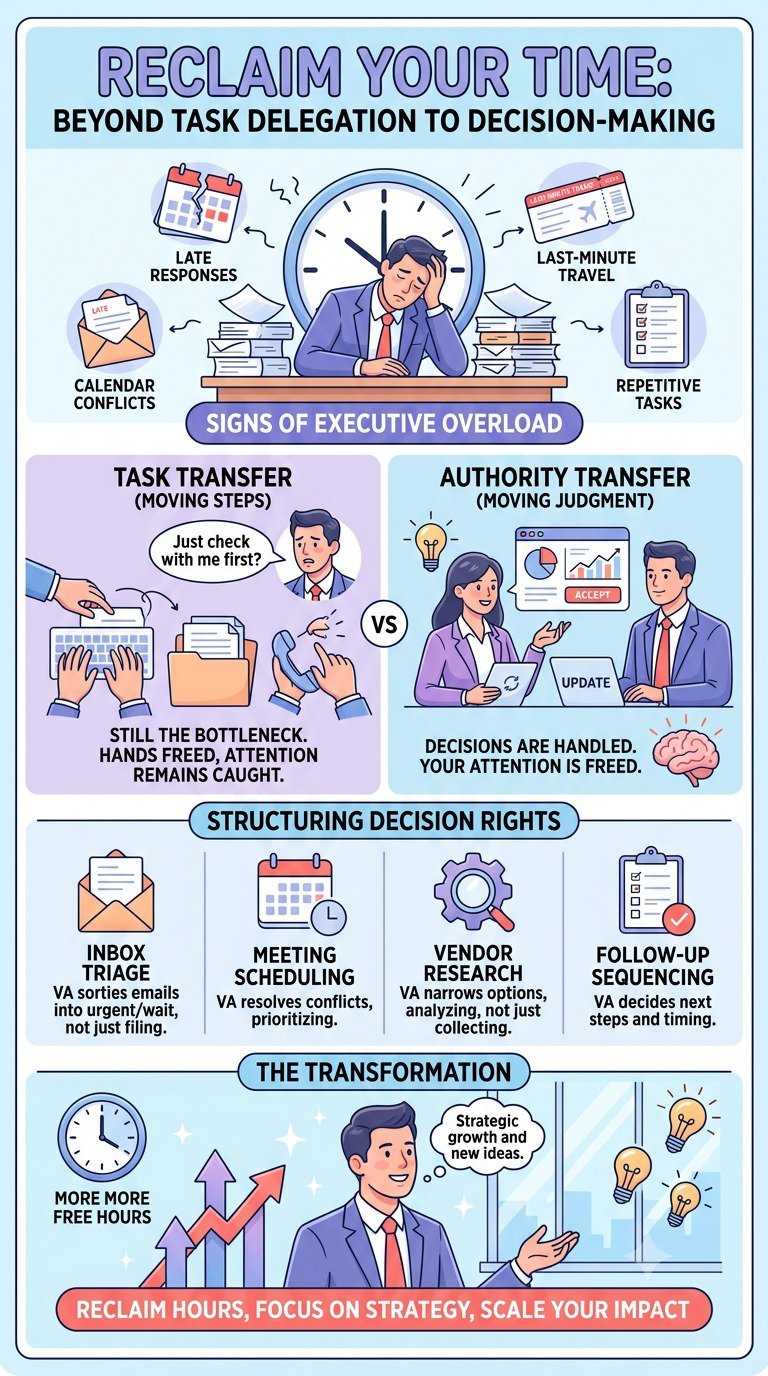
A few markers tend to cluster together when this is happening:
- Inbox response time creeping past 24 hours on things that used to get same-day replies
- Travel got booked last-minute because there was no bandwidth to plan ahead
- Small commitments, an intro call, a document review, getting missed, not ignored
- The same three tasks reappear on the weekly list, never fully closed out
None of these are personal failures. They're what happens when someone's calendar has more inputs than their hours can absorb. The question worth asking isn't "how do I work faster." It's why the work keeps landing on one desk in the first place, which is usually the moment executives start looking into how to hire a virtual assistant for busy executives who actually make decisions, not just tasks.
More Hands Isn't the Same as Less Load
The instinctive response when things get overwhelming is usually one of three moves:
- Hire another person to help chip away at the list
- Try to "delegate better", hand off more, and explain less
- Finally, write the SOPs that have been sitting in a draft folder for two years
Each of these feels reasonable. More hands should mean less backlog. Clearer docs should mean fewer questions. That logic isn't wrong; it's just incomplete.
Here's where it breaks: you can hand off every task on your list and still be the bottleneck, because the tasks were never the real constraint. The constraint is that every decision, what's urgent, what can wait, who gets an answer first, still routes through you. Hiring someone to execute more of the same task list just moves the pile. It doesn't move the decision point.
The piece most people skip is decision rights. Task transfer moves the motion off your plate. Decision-rights transfer moves judgment off your plate. Only one of those actually lightens the load, and it's not the one most people default to first.
How "Just Check With Me First" Becomes a Habit
This pattern rarely starts as a crisis. It starts small, one exception that seemed harmless at the time:
- "Just run it by me first" on one decision, just this once
- That becomes the default for similar decisions a few weeks later
- Nobody revisits the rule once the original reason for it is gone
- A dozen categories of decisions are still routing through you, out of habit rather than necessity
Each exception gets reinforced the same way. You answer quickly because it's faster than explaining the judgment call. The team learns that checking first is safer than deciding on their own. Over time, that loop becomes the operating norm, not a temporary workaround, just "how things work here."
The leadership behavior that locks it in is subtle: staying available. Availability feels like good leadership, and early on, it is. But constant availability is also what trains a team to route decisions upward instead of resolving them at the point of contact, which is exactly what quietly rebuilds the bottleneck you're trying to remove.
The Threshold Where Task Delegation Falls Short
The shift becomes visible at a specific threshold, not a bad week, but a change in what's actually competing for your attention:
- Early on, you feel the task load; there's simply more to do
- As things grow, you start feeling decision load, more to weigh in on, faster, with less context each time
- The volume of calls needing your judgment starts outpacing the volume of things needing your hands
The usual trigger is a failed step-back. A few common versions:
- A vacation where the inbox didn't slow down, it just piled up, waiting
- A delegation attempt that quietly reverted within a week, without anyone deciding it should
- A growth spurt that added headcount, but no one added decision-making capacity anywhere else
That's the moment it stops being a time-management problem and starts being a structural one. More hours in the day won't fix it; the issue isn't your schedule; it's who's allowed to decide what.
The Real Difference Between Delegating and Deciding
Task transfer means someone else executes the same steps you would have. Authority transfer means someone else can make the call on your behalf, within a defined scope, without checking with you first. Most delegation efforts stop at the first kind, and that's exactly why the bottleneck doesn't go away.
Here's the difference laid out side by side:
| Task Transfer | Authority Transfer | |
|---|---|---|
| What moves | The steps | The judgment call |
| Example | “Schedule this meeting” | “Own my calendar — decide what gets priority” |
| Who still decides | You | Them, within the defined scope |
| What it frees up | Your hands | Your attention |
| Where it breaks down | They still have to check with you | They act, then update you |
The sharper model: build structured ownership around categories of decisions, not just categories of tasks. A few examples of what that looks like in practice:
- Inbox triage — deciding what's urgent vs. what waits, not just filing
- Meeting scheduling — deciding what gets priority when things conflict
- First-pass vendor research — narrowing options, not just gathering them
- Follow-up sequencing — deciding what needs a nudge and when
Once ownership is structured this way, you're not managing fewer tasks; you're managing fewer decisions. That's the actual relief. And it's the difference between hiring help and hiring a system.
Why Wing Delivers Structure, Not Just Support Hours
This is where a managed model does something a solo hire or freelance platform typically can't: it builds the decision-rights structure in from day one, instead of leaving the executive to define it alone, under pressure, after the fact. It's also the core reason more leaders choose to hire a virtual assistant for busy executives through a managed service instead of a freelancer.
At Quistem, a North Carolina consultancy led by Cathy Fisher, the founder, was juggling high-level client work with scheduling, inbox management, and internal process upkeep, the same overload pattern most executives hit before they call it a bottleneck. Wing matched her with a full-time Executive Assistant who took over her inbox, client scheduling, and internal workflows.
The results:
- 25% of the CEO's time reclaimed
- 9 recurring admin tasks fully offloaded
- 1,000+ workdays of executive support delivered
As she put it, her assistant freed up her brain and her time, which is the actual marker of authority transfer, not just task transfer. The tasks didn't just move to someone else's desk. The judgment calls did too.
On the objections that usually come up at this stage: confidentiality gets handled through NDAs before day one, not after a concern surfaces. Time zone overlap is set during matching, not negotiated later. And oversight isn't something the executive has to manage themselves; it's built into how Wing structures the assistant relationship from the start.
Frequently Asked Questions
Is hiring a virtual assistant actually cheaper than an in-house EA?
Usually, yes — but the real comparison isn't cost; it's what an hour of your time is worth against managed support. Wing's Executive Assistant plans start well below the cost of a full-time in-house hire, and the ROI question is how many high-value hours get freed up, not just what the assistant costs monthly.
How long before a new virtual assistant is actually useful?
Most Wing clients see functional task ownership within the first one to two weeks, once onboarding and tool access are complete. Full authority transfer — where decisions route to your General Virtual Assistant or Executive Assistant by default — typically takes closer to a month of consistent handoff.
What if I only need help with my calendar and inbox, not full EA-level support?
That's a scope question, not a limitation. Wing's Personal Assistant role is built for exactly this: calendar ownership, inbox management, and day-to-day coordination, without the broader strategic scope of a full Executive Assistant.
What Changes Once Decisions Aren't Yours Alone
None of this means you did anything wrong by staying available; that instinct is what built the company. But it's also what keeps it capped at your bandwidth.
The shift isn't delegating more. It's delegating differently, handing off the judgment calls, not just the motion. That's the actual reason to hire a virtual assistant for busy executives: not to clear the list, but to stop being the only one allowed to decide what's on it.
Ready to make the shift? Book a demo and see how a Wing assistant can take real ownership off your plate.

Dianne Florendo is a content writer who creates engaging SEO content about virtual assistants, outsourcing, and business productivity.