

Most of us compare VA services the same way: cheapest rate, most flexible contract, best reviews. That comparison doesn’t tell you what happens the day your VA quits or isn’t working out, which is the day that actually costs you. Look instead at who’s responsible for vetting and replacement: you, or the company you’re paying. Get that one thing right and you stop rehiring every few months.
Most small business owners already know they’re losing time to admin work; one industry estimate puts it at around 16 hours a week. What fewer owners have figured out is why the VA they hire to fix that doesn’t always stick.
This article breaks down why the usual comparison (price, hours, flexibility) doesn’t predict whether a VA relationship will last, what actually does, and where Wing Assistant fits among five other providers that small businesses commonly shortlist.
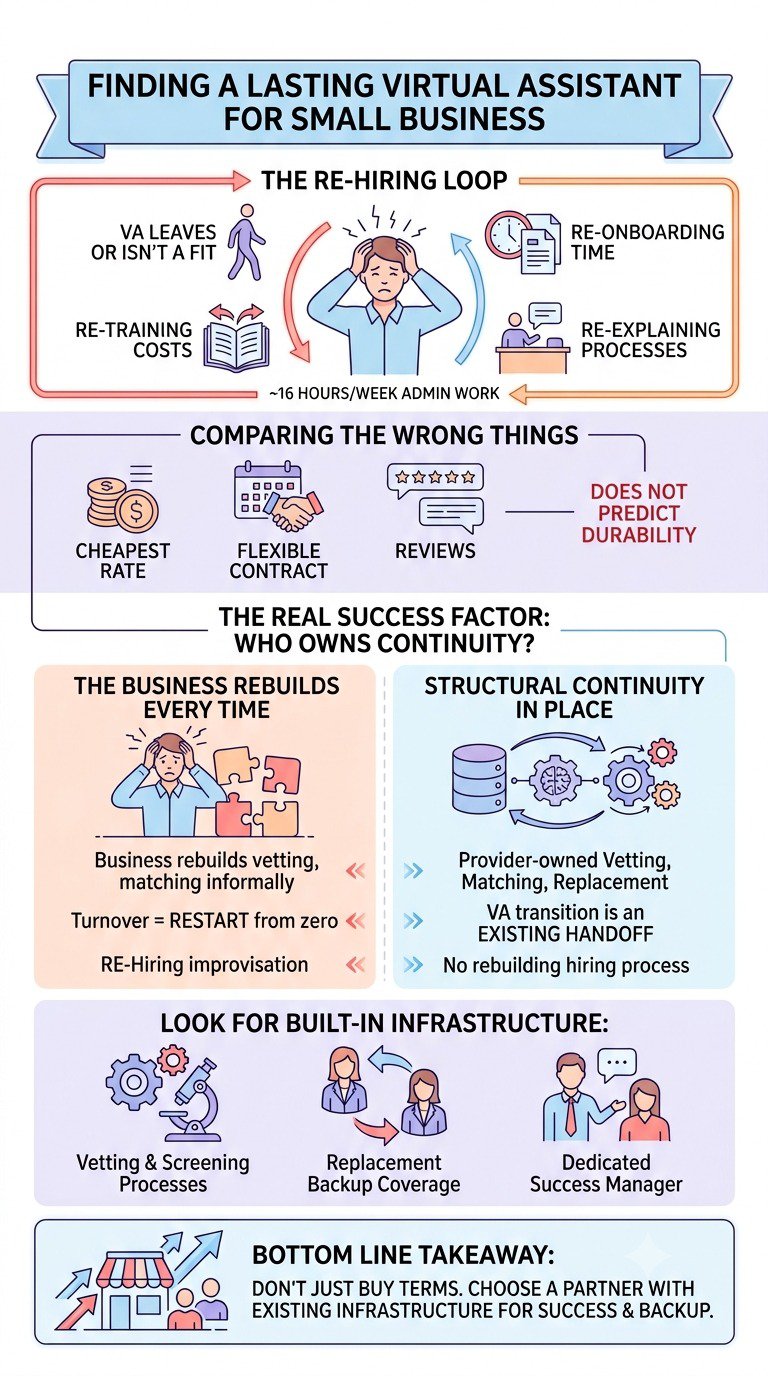
Why You Keep Re-Hiring for the Same Role
Small business owners hiring their first or second virtual assistant almost always start the search the same way:
- Compare rate per hour across a handful of providers
- Check contract flexibility and cancellation terms
- Skim reviews and star ratings
- Pick whichever combination looks best and treat the decision as closed
Six months later, the same owner is running the same search again. The VA left, or wasn’t a fit, or needed more oversight than the arrangement was supposed to require, and the business absorbed the cost of:
- Re-training a new person from scratch
- Re-onboarding into tools and workflows
- Re-explaining processes that were never written down in the first place
The pattern repeats because the comparison criteria never change. Each cycle re-evaluates price and flexibility, the same two variables that failed to predict the last outcome. What’s missing is the one thing that actually determines whether a VA relationship holds: whether the provider has built infrastructure for vetting, matching, and replacement, or whether that infrastructure is something the business is quietly rebuilding, informally, every time. Learn more about virtual assistant for small business.
What Rate and Contract Terms Don’t Tell You
The instinct to compare price and contract length isn’t unreasonable. Those are the two line items a business owner controls directly, and they’re the easiest figures to put side by side across providers. A lower rate and a month-to-month contract look, on paper, like lower risk.
But rate and flexibility describe the terms of the relationship, not its durability. They say nothing about:
- How a provider actually screens candidates before placing them
- What happens when a VA underperforms
- Whether a replacement is available without the business restarting its search from zero
Two providers can offer identical pricing and identical contract terms and still produce completely different outcomes, because the variable that predicts outcome sits upstream of the terms, the provider’s internal vetting and continuity system.
Comparing price and flexibility is comparing the wrapper. The structural variable is what’s inside it: whether the vendor has already solved matching and backup, or whether the business will be solving it themselves, repeatedly, disguised each time as “trying a new VA.”

Why the First Hire Works and the Next One Doesn’t
The first hire is usually driven by immediate relief. Task load drops, the owner reclaims hours, and the arrangement looks like a clear win. That early success quietly becomes the template; next time a VA is needed, the same rate-and-flexibility comparison runs again, because it worked before.
What goes unnoticed: the first success wasn’t evidence the comparison method was sound. It was evidence that one match happened to work. When the next VA doesn’t work out —
- Different skill gaps
- Different communication style
- Different reliability
— the owner treats it as a one-off vendor problem rather than a signal that the selection method has no real mechanism for predicting fit.
The loop locks in because re-vetting from scratch each time feels like due diligence. It isn’t a system; it’s repeated improvisation. The leadership behavior that sustains this is treating each VA relationship as an isolated hire rather than an ongoing function that needs a structural home, a fixed vetting and backup process the business doesn’t have to reinvent on every turnover.
The Turnover Point You Can’t Ignore Anymore
The pattern usually becomes visible at the second or third VA transition, not the first. One turnover reads as bad luck. A second or third, especially once the business has grown enough that a VA’s absence creates visible operational drag, reads as something structural.
The fatigue shift that marks this point isn’t more work; it’s a different kind of work. The owner stops being tired from tasks and starts being tired from decisions:
- Re-screening candidates all over again
- Re-explaining context and history
- Re-deciding whether to trust someone new with the same responsibilities
Task load has been delegated. Decision load hasn’t.
The trigger event is usually a growth moment that exposes the gap directly: a busy season, a new client, a deadline, landing exactly when the business is mid-transition between VAs. That timing is what makes the missing structure impossible to keep ignoring.

What You’re Really Comparing: Tasks or Continuity
Every VA hire is a task transfer: someone else now does the work. What most comparisons miss is a second, separate transfer that determines whether the first one holds: the transfer of decision rights over who does that work next, and what happens when the current person can’t.
Two ways this plays out:
- Task-transfer only: The business hires a VA but keeps ownership of vetting, backup, and continuity by default, whether the owner realizes it or not. Every time a VA leaves, that ownership resurfaces as the owner’s problem to solve alone.
- Structural continuity: The vendor holds standing responsibility for vetting, matching, and replacement, so a VA transition becomes a handoff inside an existing system rather than a restart.
The comparison that actually predicts outcome for the best virtual assistant services for small business isn’t rate versus flexibility. It’s whether decision rights over continuity sit with the business or with the provider’s infrastructure.
How Wing Stacks Up Against Other VA Providers
Here’s the same shortlist most small business owners end up building anyway, Wing plus five others that come up constantly in these searches, but laid out with continuity as a column, not an afterthought:
| Provider | Starting Price | Contract Length | Specialization | Standout Feature |
|---|---|---|---|---|
| Wing | ~$699/month | Month-to-month | General support + specialized roles (EA, healthcare, marketing) | Built-in vetting, backup coverage, and a dedicated success manager |
| Belay | ~$3,800+/month (unpublished; based on reported client rates) | Requires sales consultation | US-based executive support, bookkeeping | Domestic-only, high-touch vetting |
| Boldly | ~$2,520+/month | Subscription staffing | Executive-level EA/PM support | W-2 employed staff |
| Wishup | ~$1,299/month | Month-to-month | General dedicated VA | Fast onboarding, short trial window |
| MyOutDesk | ~$1,788/month | Month-to-month | Real estate, healthcare (HIPAA-aware) | Industry-specific screening |
| Time Etc | ~$390/month (10 hrs) | No contract | Light US-based admin support | Hourly-block flexibility |
Line them up this way and most of these companies are still selling you the terms, a rate, a contract, a set of hours. Wing’s setup is built around the part those terms don’t cover: matching you with the right person from the start, and having someone ready to step in if that match doesn’t work out. It’s the same reason Quistem and Carty Custom Builders stuck with their VA long after other attempts fell apart, not because it was cheaper, but because they stopped having to rebuild the hiring process themselves every few months.
The best virtual assistant services for small business use cases aren’t necessarily the cheapest; they’re the ones with a clear vetting and replacement process built in, so a mismatch doesn’t turn into a restart from zero. Wing builds this in from the start, whether you’re hiring a General Virtual Assistant for day-to-day support or an Administrative Virtual Assistant for something more specialized. Published and reported rates in 2026 range from roughly $390/month for a few hours of light admin support to several thousand dollars/month for premium, fully dedicated US-based staff. Wing’s General Virtual Assistant and Personal Assistant roles start around $699/month, which is worth weighing against what’s actually included in vetting and backup, not just the rate. This depends entirely on the provider’s replacement policy. Some require the business to restart the search independently; Wing includes matching adjustments and replacement coverage as part of the standing arrangement, whether that’s for an Executive Assistant, a Bookkeeping Virtual Assistant, or a Customer Service Representative.Frequently Asked Questions
The Bottom Line on Choosing a VA Service
None of this is a case for ignoring price. It’s a case for treating price as one line in a larger comparison, not the whole comparison. A business that keeps re-running the same rate-and-flexibility search after every VA turnover isn’t making a series of bad hiring decisions. It’s using a selection method that was never built to predict fit in the first place.
The shift is small but structural: stop asking which provider is cheapest or most flexible, and start asking which one already owns the vetting and continuity problem. That’s the comparison that determines whether the next VA relationship holds past the first few months.
Ready to see how Wing handles it? Book a demo.

Dianne Florendo is a content writer who creates engaging SEO content about virtual assistants, outsourcing, and business productivity.