

TL;DR: You’re behind on the books because nobody owns the cadence, not because the work is hard. Outsource bookkeeping, and the right setup keeps the daily record, chases the invoices, and closes the month without you pushing it. The trick is knowing what to hand off, what to demand on security, and what a quote is really hiding before you sign.
It’s 9 pm, QuickBooks is still open, and instead of feeling like you’re on your grind, you feel three months behind. You’re double-checking across email accounts, trying to remember why an invoice from six weeks ago never cleared. You scroll past a dozen line items that don’t reconcile, a client payment that might have landed, or might not have.
You started your business so you could ‘be your own boss’, but now it’s like you have become your own assistant.
Somewhere in this mess is money you’ve already earned and can’t see. You can’t make a good decision about hiring, or spending, or slowing down if you don’t actually know what’s true. The tasks are annoying, and the invisibility is dangerous. So you guiltily put it all at the bottom of a to-do list, and here you are at 9 pm.
If this cycle is becoming hauntingly familiar, it might be time to hire a bookkeeping assistant.
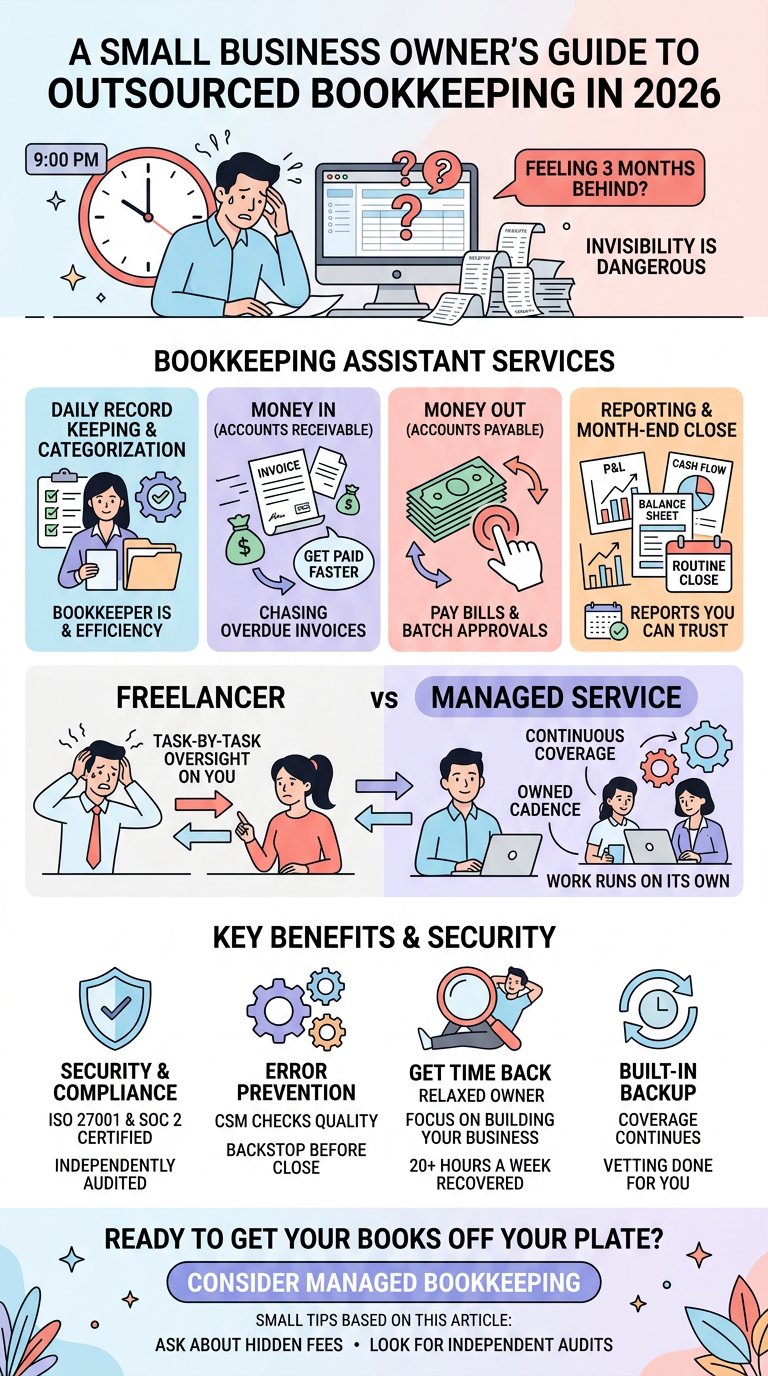

What an Outsourced Bookkeeper Actually Does
What would a bookkeeper take off your plate? “Bookkeeping” gets used as a catch-all, but the work splits into a few distinct jobs, and knowing which is which is the difference between hiring the right help and hiring a warm body to sit near your books. Here’s the whole of it, from the daily record up to the reports you actually read.
Bookkeeper vs. accountant
What to know up front is that bookkeeping and accounting, although often used interchangeably, are not the same thing. A bookkeeper’s job is to keep the daily record, to make sure the number on the screen matches the money in the accounts. An accountant’s, on the other hand, is to interpret that record. They ask what this means for the business, what should change, what you owe, and how to file it.
An accountant without a clean, current ledger to work from is just guessing with better vocabulary. And a bookkeeper can’t file your taxes or tell you whether to raise prices.
So what problem do you actually have? If you don’t trust the numbers on the screen, that’s a bookkeeper problem.
The day-to-day record
A bookkeeper is recording and categorizing every transaction that comes in and out of the business. Every payment, expense, and deposit lands in the right place with the right label. It sounds like the boring part because it is the boring part. It’s also the part that decides whether your month-end numbers mean anything at all.
This is the foundation of the work, and everything that sits on it is only as good as this. Get it wrong here, and the fanciest report is just a color-coded guess.
Then there is the reconciliation. They match the books against what the bank and credit card statements actually say. You are not the only solopreneur who is putting this work off, but it causes the most pain further down the road. Skip it for a few months, and you don’t have a small problem; you have a 9 pm every weekend problem.
Money in, money out
Accounts payable is tracking what you owe and paying it on time. They are going to manage this process right up to the point of payment, and then it is all on the account owner. What that means is they receive the invoice, verify it against what was ordered, code it to the right account, and queue it up. Instead of you doing all that work, they hand over a batch to approve, or can tell you what is due next week. All you have to do is click to pay.
Accounts receivable is the other direction, and it’s where small-business cash actually gets stuck. Sending the invoice is the easy half. Chasing the unpaid one is the tedious half. A bookkeeper is taking both halves off your plate. Their job is to send out the invoice and log it as receivable, track everything that is outstanding, and start chasing down the ones who are overdue.
They maintain the aging view, keep it current as payments land, and hand the record to you: here’s what’s outstanding, here’s what’s 60 days late, here’s who to worry about. Then they keep on chasing.
The reporting layer
The day-to-day recording is one thing, but it needs to be turned into something you can actually read. Whether you are using QuickBooks or Excel, a bookkeeper is going to work with the tools you know to keep everything legible. From the monthly P&L to a balance sheet snapshot, you will start to be able to see the story the money is telling you. Where it is, where it is going, what is your cash flow situation looking like?
It’s the routine of the month-end close that makes the reports trustworthy. You are not lacking data, but that data doesn’t mean anything if you are not tracking it consistently. At the end of each period, the bookkeeper ties everything off. All transactions in, all accounts reconciled, nothing left dangling.
Once it’s closed, the month is final. You can close that mental tab and breathe a sigh of relief. Hire financial assistant.
Comparing Outsourced Bookkeeping Models
When you outsource bookkeeping, you’re choosing between three very different things, and which one you go for depends on your specific needs.
Tools vs. freelancer vs. managed service
QuickBooks, Xero, and Excel are all just tools where you put your data. They are able to sort, put out fancy reports, and their newest features probably incorporate some AI capabilities to do great sorting. But they do not make decisions, they do not chase, and they do not notice. No matter how good the tool is, someone is still going to have to go through it. If that someone is you, you haven’t actually outsourced your bookkeeping.
A freelancer completes a task. You hand them a task, they do it and hand it back. Great for a get-out-of-jail-free card, but the books are a standing obligation that regenerates every single day. A freelancer you engage task by task means you’re the one deciding when each task starts. The oversight lands back on you.
A managed service keeps the records month to month. You get a remote bookkeeper, but you also get a Customer Success Manager sitting over the work, checking the quality and handling the priorities so none of that lands back on you. This means with good outsourced bookkeeping services you are setting the goals and priorities, but work is being done by the bookkeeper and being steered by the CSM.

Quick comparison
Here are your main outsourced bookkeeping services at a glance:
| AI/Software tool | Freelancer | Managed service | |
|---|---|---|---|
| What you get | A place to put your data | A task done on request | Your books kept, month to month |
| Who runs it | You | You decide each task | A bookkeeper, steered by a CSM |
| Ongoing or one-off | Ongoing, but manual | Task by task | Continuous coverage |
| Who catches mistakes | Nobody, it can’t notice | The freelancer, if they’re on | A CSM checking before close |
| Where oversight lands | On you | Back on you | On the service |
| Best for | DIY, if you have the time | One-offs and cleanups | Handing it off for good |
What ongoing coverage looks like
Bookkeeping might seem like a very task-oriented sort of job, and is probably what you are thinking of when you think “bookkeeper”. Still, just because the job is well defined does not mean that handing over tasks is necessarily what you want to do. Like with the freelancer, you give them a task like “Do the cash flow report”, they do it and hand it back. In that scenario, you are still the one the work routes through; you need to decide what needs doing and when.
Ongoing coverage is the exact opposite. The bookkeeper knows the rhythm of your month, so the reconciliation happens because it’s the 3rd, not because you remembered to ask. The close happens because the month ended. You’re not dispatching tasks; the work runs on its own cadence. The reason the founder in our opening vignette is three months behind is not that the work is hard (although the work might very much be tedious), but rather because no one is dedicated to the cadence.
This does mean that if someone owns the close, they need to be inside everything: your bank feed, your invoices, your statements, your numbers. Coverage only works if you actually hand over the keys to the kingdom. What if they get it wrong and you don’t catch it until it’s expensive?
Data Security and Remote Bookkeeping
This is the question with bookkeeping outsourcing: handing over the books means handing over bank access, statements, the whole picture, to someone you’ve just met. There are two versions of that fear.
Your financial data
First, security. This is someone inside your finances, so the bar is higher. Look for two standards, ISO 27001 and SOC 2. They mean a provider has been independently audited, so an outside party checked how they handle data and signed off, rather than just telling you they’re careful. And don’t let anyone sell you an NDA alone and call it security.
Then access: who can see what, and who can move money. Those aren’t the same permission. Remember the accounts-payable point, where they prep the batch, and you click to pay. The authority to move money stays with who you choose. You should be able to set how far the trust goes.
Getting it right
Mistakes cost money. Whether it’s a wrong category or a payment logged against the wrong invoice, the later you catch it, the more expensive the mistake becomes.
So interrogate it before you sign. All virtual bookkeeping services promise oversight. Ask what the CSM actually does. Are they reading your numbers, or glancing at a board that says the tasks went green? Confirming the work got done is not the same as confirming it got done right.
Then pin down what they mean by “hands-off.” The bad version cuts you out completely, and you find out how the year went sitting across from your accountant in spring. The good version takes the work off your plate but leaves you the view. You want to stop doing your books. You don’t want to stop knowing them.
What Outsourced Bookkeeping Costs
Nobody puts the real number on the website, and the one they do put up is rarely the one you’ll pay.
What drives the quote
The frustrating answer is really “it depends”. What you’ll pay comes down to your transaction volume, how far behind you’re starting, whether you need part-time or full coverage, and how much you’re asking one person to take over. A quiet solo consultancy and a busy shop doing hundreds of transactions a month are not the same job, so obviously they do not cost the same.
How to read a quote
The clean-looking monthly rate is designed to draw you in. The useful work is in the questions underneath it.
- How many hours or how much volume does that price cover, and what happens the month you go over?
- Is there a setup or catch-up fee sitting under the monthly line?
- Are your books behind?
- If so, is onboarding cleanup going to cost you extra?
- Is there a contract, or can you leave when it stops working?
- Are the reports you actually care about included, or billed on top?
None of that shows up in the big number. A low rate wrapped in a long contract and a stack of extras can cost more than a higher rate with nothing hidden. The clearer a provider is about what’s included, the easier the real total is to see before you sign. Hire a bookkeeper.
Wing: Bookkeeping That Stays Current Without You
Wing Assistant is a managed service that matches, trains, and manages a dedicated bookkeeping assistant for your business. You get one person who learns how your books work and stays on them, backed by a manager who checks the work and keeps the month on schedule. Vetting and training happen before they ever reach you, so you’re not taking on someone new to run. One call to map out what’s behind, and most clients are live within 72 hours.
- Wing is ISO 27001 compliant and SOC 2 certified.
- Your assistant is AI-trained and fluent in the tools your books already live in.
- There’s a CSM reading the work before the month closes.
- Backup and replacement coverage is built in.
- Coverage continues if your assistant is ever out, and your context stays with Wing.
Carty Custom Builders, a homebuilder in Austin, handed their books to a dedicated Wing assistant who kept QuickBooks current and the reporting on time. They got back more than 20 hours a week on bookkeeping alone. In their words: “Working with our Wing Assistant has allowed us to focus on building and less on office work.”
A dedicated bookkeeping assistant runs $899/mo part-time and $1,499/mo full-time, with no recruiting cost, no benefits, and no long contract. It’s help that doesn’t create more work.
Ready to get your books current and off your plate? Book a free consultation and see how it works.
Any provider worth considering should be independently audited, not just promise they’re careful. Wing is ISO 27001 compliant and SOC 2 certified; the work lives in a secure workspace rather than someone’s laptop, and the authority to move money stays with you. With a lot of services you’re handed whoever’s free, no say in it. Wing matches you instead, doing the vetting and shortlisting, and you connect with your bookkeeping assistant before they start so you get a say in the fit. With a single freelancer, one sick day is your problem and a departure can stall the books for weeks. Because Wing keeps your work in Wing Workspace and a CSM on the account, a backup steps in when your assistant is out, and if someone leaves for good, Wing handles the replacement while your context carries over.FAQs