






TL;DR
- Most practices respond to documentation overload by hiring more staff, extending hours, or layering on EHR automation.
- None of it sticks, the volume keeps growing, and the same people are still doing the work.
- Outsourcing moves documentation to a team built specifically for it, so clinical staff isn't the default catch-all for every admin task.
- Physicians get their time back. The documentation still gets done.
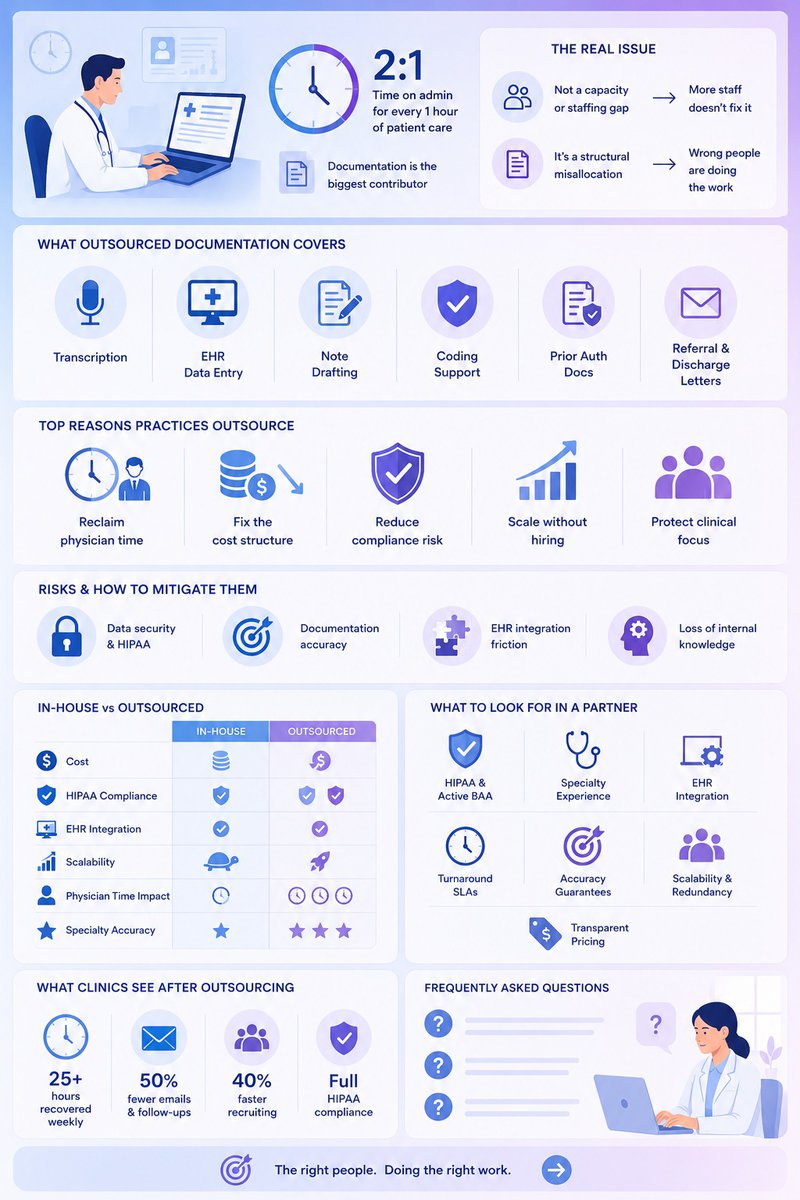
Physicians now spend nearly two hours on administrative work for every hour of direct patient care, and documentation is the single largest contributor. For small-to-mid-sized practices, that ratio isn't sustainable.
This guide covers what outsourcing medical documentation actually involves, why practices are making the shift, what the risks are, and how to manage them, and what to look for in a partner. It also includes real outcomes from clinics that have worked with Wing Assistant to offload documentation and reclaim clinical capacity.
The Documentation Burden Isn't a Capacity Problem
The numbers are consistent across specialties and practice sizes. Physicians spend 34–55% of their working hours on documentation, not patient care. The instinct is to treat it as a staffing gap:
- Hire another scribe
- Add a documentation coordinator
- Extend front desk hours
That framing isn't wrong, it's just incomplete. The problem isn't headcount. It's that the wrong people are doing the work. Physicians and licensed staff are absorbing high-volume, process-driven tasks that require no clinical judgment, and it's eating time that generates neither revenue nor better outcomes.
When practices actually map where the hours go, the pattern is the same every time: high-frequency, low-complexity tasks sitting in the queue of your most expensive resources. That's not a capacity problem. That's a structural one.
What Outsourcing Medical Documentation Actually Covers
Outsourcing clinical documentation means moving structured, process-intensive tasks to a specialized external team. The scope varies by practice, but the core categories are consistent:
- Medical transcription — converting physician dictation into formatted clinical notes
- EHR data entry — patient records, visit summaries, lab results, updates
- Clinical note drafting — AI-assisted or scribe-supported drafts that physicians review and sign
- Coding support — ICD-10 and CPT assignment to keep billing accurate
- Prior authorization docs — supporting materials for insurance approvals
- Referral and discharge letters — standardized outbound correspondence from visit notes
Medical scribe services, healthcare virtual assistants, and EHR documentation support teams each sit at different points in this stack. The right mix depends on your volume, turnaround requirements, and how complex your specialty documentation gets. Learn more about appointment setting assistant pricing.
Top Reasons Practices Outsource Documentation
Reclaiming physician time
- Physicians who offload transcription and EHR entry report 1.5–2.5 more patient appointments per day, without adding hours.
Fixing the cost structure
- In-house scribes and coordinators carry fixed costs: salary, benefits, training, and turnover. Outsourced documentation is priced per note, per hour, or by volume; it scales with actual usage instead of headcount.
Reducing compliance exposure
- Specialized providers maintain BAA agreements, audit trails, and staff training protocols that most small-to-mid practices can't replicate internally at the same level.
Scaling without hiring
- Telehealth growth, volume spikes, and multi-site expansion create documentation surges. Outsourced teams absorb that variability without the lag of recruiting and onboarding new staff.
Risks and How to Mitigate Them
The concerns are legitimate. Here's what to watch and how to handle each one.
Data security and HIPAA compliance
- Require a signed BAA before any data is shared
- Confirm end-to-end encryption, role-based access controls, and third-party security audits
- This is non-negotiable — verify it, don't assume it
Documentation accuracy
- Set a contractual accuracy benchmark (98%+ is standard for medical transcription)
- Keep a physician review and sign-off step in the workflow
- Spot-audit regularly for the first 60 days
EHR integration friction
- Confirm the provider has hands-on experience with your specific platform
- Gaps that require manual re-entry will erase the efficiency gain
- Run a pilot before committing to full volume
Loss of internal knowledge
- Outsourcing process-driven tasks doesn't remove institutional knowledge; it frees your clinical staff to focus on the work that actually requires it
- Define clearly upfront which tasks transfer out and which stay in-house
What to Look for in an Outsourcing Partner
The vendor selection decision carries more weight than the outsourcing decision itself. A provider misaligned on turnaround time or specialty expertise will generate rework that erases the efficiency gain. Evaluate on these dimensions:
- HIPAA certification and active BAA — verify it covers all data types your practice handles, including audio recordings and structured EHR data.
- Specialty experience — documentation complexity varies significantly. A general transcription vendor may lack the vocabulary, formatting standards, or coding familiarity required for cardiology, oncology, or behavioral health.
- EHR integration depth — native integration or established workflow with your EHR reduces handoff friction and eliminates re-entry risk.
- Turnaround SLAs — define acceptable turnaround at the contract level, typically 12–24 hours for standard notes and same-shift for real-time scribe support.
- Accuracy guarantees — look for contractual benchmarks and a defined process for error correction and root cause review.
- Scalability and redundancy — confirm the provider can absorb volume spikes without service degradation.
- Transparent pricing — model the cost at current and projected throughput before signing.
In-House vs. Outsourced Documentation: Quick Comparison
| Factor | In-House | Outsourced |
|---|---|---|
| Cost structure | Fixed — salary, benefits, training, turnover | Variable — scales with documentation volume |
| HIPAA compliance | Dependent on internal training quality | Dedicated programs; audited protocols |
| EHR integration | Native access; no handoff required | Requires setup; varies by provider |
| Scalability | Slow; tied to hiring and onboarding | Rapid volume adjustment; no recruiting lag |
| Physician time impact | Limited — task load stays near clinical staff | Significant — removes documentation from physician workflow |
| Specialty accuracy | Depends on individual staff experience | Depends on vendor specialty depth |
| Oversight requirement | Low — direct management | Moderate — SLA monitoring, periodic audits |
What Clinics See After Outsourcing: Wing in Practice
The structural argument for outsourcing documentation holds up in the data. Here's what two healthcare practices experienced after partnering with Wing.
Administrative tasks: scheduling, billing, documentation, compliance tracking — were consuming over 25 hours per week across the clinical team. Wing matched the practice with a HIPAA-trained healthcare VA with seven years of medical sector experience.
- 25+ hours per week recovered from clinic admin
- 50% reduction in emails and manual follow-ups
- 40% faster recruiting and onboarding
- Full HIPAA compliance maintained throughout
“I’m really glad Wing was available to assist me with a well-trained, highly functioning assistant who integrated easily into our practice.”
— Stephen Schneider, Clinical Director
Both outcomes reflect the same underlying shift: when documentation and administrative tasks move to a resource built for them, clinical staff stop functioning as the default catch-all, and the operational metrics follow.
Frequently Asked Questions
Is outsourcing medical documentation HIPAA compliant?
It can be — but compliance depends entirely on the provider, not the model. Any vendor handling protected health information must sign a Business Associate Agreement and maintain documented safeguards. Verify their certification status, audit history, and security architecture before transferring any patient data. Wing's HIPAA-Compliant Virtual Assistants are trained specifically for this — compliance is built into the engagement, not added on afterward.
What types of documentation are best suited for outsourcing?
High-volume, process-driven tasks are the primary candidates: transcription, EHR data entry, referral letters, prior authorization documentation, and discharge summaries. Wing offers specialized roles for each — including Medical Transcription Specialists, Clinical Documentation Specialists, Prior Authorization Specialists, and Medical Scribes — so you're not fitting a generalist into a specialized workflow.
How does outsourcing documentation help reduce physician burnout?
Burnout in clinical settings is rarely about patient volume alone — it's about cognitive fragmentation: switching from patient care to data entry to documentation queues repeatedly throughout the day. Moving that load to a dedicated resource removes the interruption loop entirely. Wing's Healthcare Virtual Assistants and Medical Administrative VAs are matched to your practice's specific workflow, so the transition is structured rather than disruptive — and physicians get protected focus time back from day one.
The Structural Reframe
The documentation burden didn't appear overnight. It accumulated incrementally as clinical volume grew faster than administrative infrastructure, and stayed invisible until the load became undeniable.
Practices that recognize this as a structural misallocation, rather than a staffing or discipline problem, approach the solution differently. They're not looking for harder-working staff or better SOPs. They're looking for the right ownership model: process-intensive work handled by resources built for it, and clinical staff focused on the judgment work they were trained for.
The question isn't whether your documentation is getting done. It's whether the right people are doing it.
Book a demo to see how Wing structures documentation support for practices like yours.

Dianne Florendo is a content writer who creates engaging SEO content about virtual assistants, outsourcing, and business productivity.