

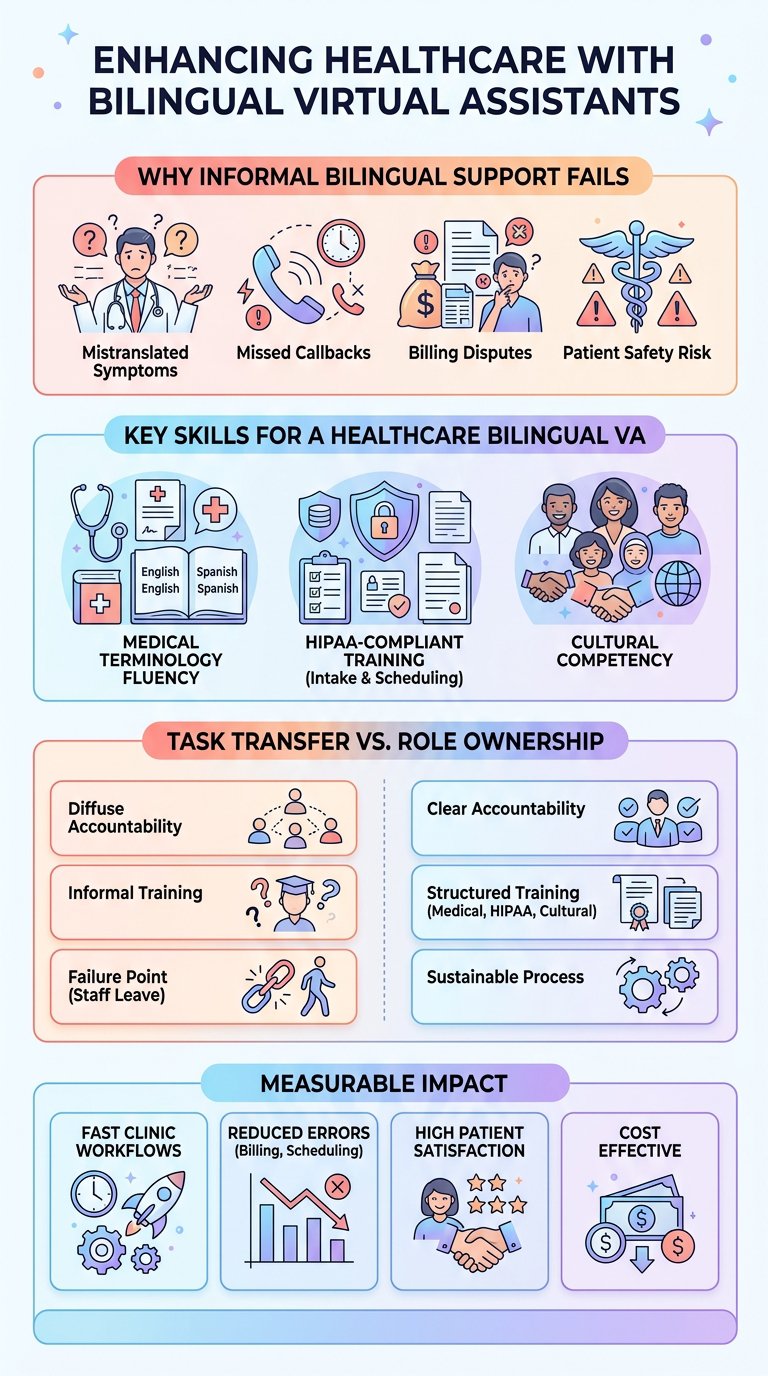
Right now, most practices just wait for whoever’s on shift to happen to speak Spanish and pull them onto the call. That works fine until it doesn’t, mistranslated symptoms, missed callbacks, and billing explanations patients never actually understood. A bilingual virtual assistant fixes this by making language support a real role: trained on medical terms, patient intake, and how to explain a bill without losing someone in translation. Patients stop falling through the cracks, appointments stop getting missed, and it doesn’t cost you a second full-time hire to get there.
Language gaps in healthcare aren’t a minor scheduling hiccup; they’re a patient safety issue. Miscommunication has been linked to 59% of serious adverse events among patients with limited English proficiency in hospitals. That’s not a case for hiring “someone who speaks Spanish.” It’s a case for building bilingual support into the practice the same way you’d build any other clinical safeguard.
This piece breaks down why informal bilingual coverage tends to fail quietly before it fails loudly, what a properly trained bilingual virtual assistant actually needs to know beyond the language itself, and how Wing Assistant approaches this differently, treating bilingual patient support as a defined, accountable role rather than a task handed to whoever’s available.

Why Healthcare Practices Lack Bilingual Support
Most practices don’t plan for a language gap. It shows up gradually:
- A Spanish-speaking patient calls, and whoever’s free that day takes it.
- It works well enough that nobody flags it as a process.
- Volume grows, and “well enough” starts slipping: missed callbacks, garbled insurance details, consent forms nobody’s sure were actually understood.
The tension isn’t staffing capacity. It’s that bilingual coverage has been treated as a personality trait some employees happen to have, not a defined operational function with its own training and accountability. That’s the structural gap a bilingual virtual assistant for healthcare is built to close, but only if it’s built correctly.
What a Bilingual Virtual Assistant Needs to Know
The instinctive response is to look for anyone conversational in the target language and slot them into the same intake process everyone else uses. It seems reasonable, the person can talk to the patient, so the gap looks closed.
It isn’t. Conversational fluency and clinical-workflow fluency are different skills. A real bilingual virtual assistant for healthcare needs:
- Medical terminology fluency in both languages — a mistranslated symptom or medication name carries more risk than a mistranslated dinner order.
- HIPAA-compliant training specific to intake and scheduling — consent language and PHI handling don’t translate loosely.
- Cultural competency — how patients from different backgrounds describe symptoms, discuss cost, or ask about follow-up care.
Without those three things, “bilingual” support is just conversational overlap wearing a compliance-shaped costume. The missing structural variable isn’t language ability — it’s role-specific training layered on top of it.
How Informal Bilingual Coverage Becomes the Norm
This pattern forms quietly:
- One bilingual staff member absorbs the extra calls early on because it’s faster than finding a formal solution.
- That staffer becomes the default routing point, every LEP patient interaction now depends on one person’s availability and one person’s undocumented judgment calls about what to translate and how.
- Nobody notices, because the calls still get answered.
- Each successful improvised call “proves” the informal system works, which discourages anyone from building a real process.
Leadership sees a problem being handled, not a single point of failure being built. That’s what locks the pattern in: proof of function gets mistaken for proof of stability.
When You Need a Bilingual Virtual Assistant
The shift becomes visible at a specific threshold, usually when patient volume or staff turnover removes the one person the informal system depended on. The trigger events tend to look like:
- A missed prior-authorization call.
- A billing dispute traced to a mistranslated copay explanation.
- A compliance audit that asks who’s actually verifying interpreter qualifications.
At that point, the task load (answering more bilingual calls) has turned into decision load (who is accountable for interpretation accuracy, and can the practice prove it). That’s the fatigue shift that makes practices start actively evaluating dedicated bilingual VA support instead of continuing to patch the gap internally.

Task Coverage vs. a Dedicated Bilingual Role
The sharper model here is the difference between task transfer and role ownership:
- Task transfer — someone else picks up the bilingual calls.
- Role ownership — someone is trained, accountable, and measured specifically on bilingual patient experience.
| Task Transfer | Role Ownership | |
|---|---|---|
| What it means | Bilingual calls get answered by whoever’s available | A defined bilingual role with its own training and accountability |
| Accountability | Diffuse — no one owns the outcome | Clear — one function measured on results |
| Training | Informal, picked up on the job | Structured: medical terminology, HIPAA, cultural competency |
| What’s measured | Whether the call got answered | Intake accuracy, appointment follow-through, billing clarity |
| Failure mode | Breaks when the one bilingual staffer leaves or is unavailable | Continues regardless of any single person’s schedule |
A bilingual virtual assistant for healthcare only solves the underlying problem when it’s structured as role ownership: a defined role with its own training standard and quality checks, not a translated extension of the existing front-desk task list.
How Wing’s Bilingual Virtual Assistants Help
This is exactly where the comparison between staffing paths matters, because each option handles role ownership differently.
| Wing Bilingual VA | Generic Outsourcing | In-House Bilingual Hire | |
|---|---|---|---|
| Cost | Fraction of a full-time salary; no benefits overhead | Often comparable to Wing on paper, lower on vetting depth | Full salary, benefits, and onboarding cost |
| Ramp-up time | Days to onboard into existing workflows | Variable; minimal role-specific training | Weeks to months, including recruiting |
| Scalability | Add or adjust hours as patient volume shifts | Limited flexibility once contracted | Fixed headcount, hard to scale down |
| Quality control | Vetted for medical fluency, HIPAA training, ongoing oversight | Inconsistent, rarely healthcare-specific | Depends entirely on hiring process |
The pattern shows up in Wing’s own healthcare partnerships. At Provida Family Medicine, a primary care practice in Gurnee, Illinois, bringing on a trained healthcare VA led to:
- 50% faster clinic admin workflows
- 35% reduction in billing errors
- 40% higher patient satisfaction
- 30% fewer scheduling errors, 25% faster claims processing
At Bryant West Psychology, a Manhattan mental health practice, a HIPAA-trained healthcare VA delivered:
- 25+ hours per week saved on clinic admin
- 50% fewer emails and manual follow-ups
- 40% faster recruiting and onboarding
Neither engagement was staffed specifically as a bilingual role, but both make the same underlying point: once a healthcare VA is trained and accountable to the practice’s actual workflow, scheduling, billing, intake, and compliance, the errors and delays tied to informal, undocumented coverage drop sharply.
That’s the same shift a bilingual VA makes for language access specifically: fewer dropped follow-ups, cleaner intake documentation, and a measurable drop in billing disputes tied to miscommunication, without the cost or ramp-up time of a second in-house hire.
Frequently Asked Questions
No. Wing’s Bilingual Healthcare Assistant handles intake, scheduling, and administrative communication. For clinical encounters requiring certified medical interpretation, informed consent for procedures, for example, practices should still use a qualified interpreter service alongside their VA.
Wing’s bilingual VAs are staffed through its HIPAA-Compliant Virtual Assistant program, which covers healthcare intake and scheduling specifically, plus vetting on medical terminology in both languages, not just general conversational fluency screening.
Yes. Wing’s Healthcare Virtual Assistant roles, including bilingual placements, are onboarded directly into the practice’s existing systems, EHR, scheduling, and patient communication tools, so bilingual support runs inside current workflows rather than as a separate parallel process.
None of this is a staffing failure. It’s what happens when a real operational need gets handled through goodwill and improvisation because nobody built the role it actually needed. The fix isn’t finding someone else who happens to be bilingual, it’s defining bilingual patient support as its own accountable function.
Practices that make that shift stop treating language access as a lucky staffing coincidence and start treating it as infrastructure. Schedule a call with Wing to see what a dedicated bilingual virtual assistant looks like inside your specific workflow.

Dianne Florendo is a content writer who creates engaging SEO content about virtual assistants, outsourcing, and business productivity.