

TLDR When you’re running enough rentals, the tenant texts, repair calls, rent chasing, and vacancy listings stop fitting into the day. A property management virtual assistant takes that recurring work off your plate: fielding tenants, coordinating maintenance, following up on rent, and filling empty units.
A property management virtual assistant handles the operational grind of running rentals remotely. It’s the kind of help you go looking for when the business starts growing. Growth is good news, but more business, more problems.
Say on a random Tuesday you’re mid-negotiation with a tenant over a late payment when the call comes in: water’s coming through the ceiling, and the upstairs unit is empty because those tenants are away. Suddenly the afternoon you’d set aside for a vacancy listing is gone.
It’s all landing on one person and starting to get sloppy. A virtual assistant comes in to start making sense of all the chaos.
When you’re emailing about the late rent, the VA mans the leakage call. The emergency access and the vendor booking are handled by the VA while you manage the stressed-out tenant in front of you. You’re only interrupted once for a spend approval. After a morning of tag-teaming, you are both ready for the afternoon to sort out the vacancy listing.
Messy reactive workload becomes something you can hand off when you hire a property management VA.
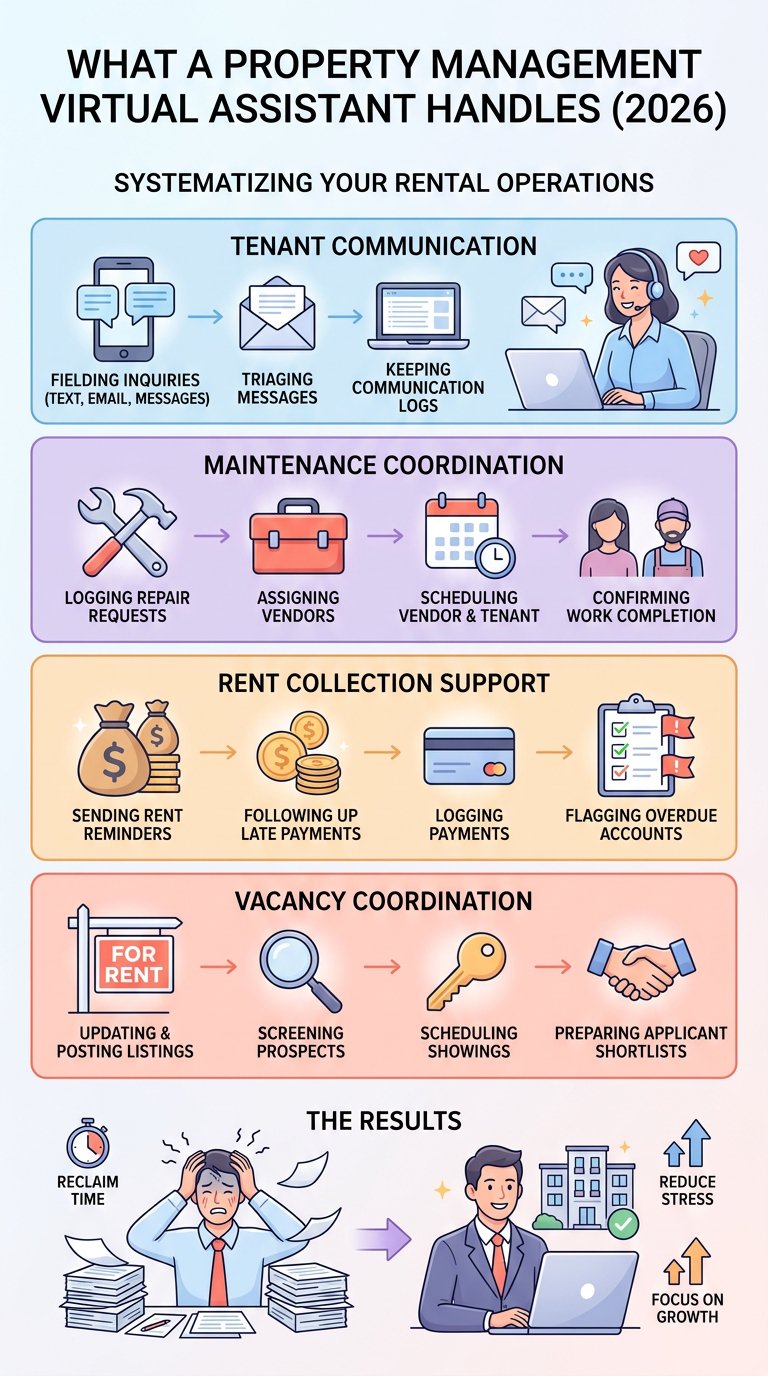
What a Property Management VA Handles
Strip the stress out of a day like that, and you’re left with four kinds of work a property management VA can help you with: tenant communication, maintenance coordination, rent collection support, and vacancy coordination.
The day-to-day below is primarily focused on residential. If your tenants are businesses, most of the below still applies, with some commercial-specific work covered further down.

Tenant communication
Bob texts that the dishwasher’s leaking, Stacy emails asking if they can repaint the bedroom, Shannon is calling to know when their lease renews, John hasn’t sent back the signed renewal, and a new prospective tenant messages on Zillow at 9 pm asking if the unit’s still available. They are not queuing politely.
A VA works in all these channels and triages the messages. They handle:
- Respond to tenant inquiries
- Triage and route messages
- Keep the communication log
- Send reminders and updates
Your attention is saved for the lease renewals.
Whatever you are using, DoorLoop or Google Sheets, “I told you about the mold in March” is a fight you don’t want to have from memory. Once the conversation is over, the VA is going to record it and make sure you have that paper trail. Timelines can be reconstructed quickly so these disputes can be handled quickly and professionally, without turning into a dispute of “who said what and when.” Hire virtual receptionist.
Maintenance Coordination
A repair is a game of ping-pong. The request, the right vendor, the scheduling, and the did-they-actually-show follow-up. A property manager assistant can play that game for you.
Since your VA is already working your communication, the request lands with them. They will:
- Log maintenance requests
- Assign requests to vendors
- Coordinate vendor and tenant scheduling
- Confirm work order completion
A VA’s job is to go through your maintenance process, so you don’t have to, and then follow up. Confirm with the vendor that the job is done and send a quick “did that fix it?” message to the tenant a few days later. The vendor might have remodeled the shower, but the smell coming from the drain trap is still stinking up the apartment.
It’s what makes a tenant feel like someone’s paying attention, and it keeps a small problem from going quiet until it becomes the next tenant’s complaint.
Rent Collection
Rent money normally arrives on its own, but every late payment is a decision on how much grace to extend to the tenant. Too strict and you risk souring the relationship, and too lenient and you risk a snowball of late payments. A property management virtual assistant cannot make these judgment calls, but they can support you in running the monthly rituals around rent.
They handle:
- Sending rent reminders
- Following up on late payments
- Logging payments and flagging overdue
Late rent is inherently an emotionally fraught situation on the tenant’s side of things. When you’re the one sending the third reminder, you’re the landlord hassling them. When the VA runs it, the chasing becomes less personal, more procedural. It’s a steady and unemotional cadence that keeps your name from the confrontation.
By the end of every rent cycle, your VA hands you the (hopefully short) list of tenants who are late, along with any communication logs. Once you’ve decided on next steps, you can either take over communication or let the VA continue running it.
Between the two of you, the emotional back-and-forth of rent becomes a system.

Vacancy coordination
This is where the specialty of a VA for property management really pays off, because they’re already trained on industry-standard platforms. Once a tenant hands in their notice, the virtual assistant can start preparing.
They handle:
- Updating and posting listings
- Screening prospects
- Scheduling and confirming showings
- Packaging the applicant shortlist
The listing gets drafted and posted across Zillow, ApartmentFinder, Zumper, and Realtor.com. Most of those platforms will auto-generate a listing description, but the AI doesn’t know that “cozy” is going to be read as “tiny.” When the platform flags its top applicants, it can’t tell the difference between someone over the line doing gig work and someone just barely under the line but who’s been at the same job for six years.
Your VA is trained on these AI tools and algorithms and knows where they fall short. The listing that goes live is AI-assisted but human, and the shortlist is real prospects, not just the ones the numbers surfaced.
The final call, as always, is yours, but now you’re choosing from a better set of options. Hire property management assistant.
What Happens After Hours
Remote property management, even when it’s hired overseas, tends to keep to your business hours, but what happens when live emergencies start coming in? Sometimes a Zillow message arrives at 9 pm and can wait till morning. Other times it’s a locksmith request at 1 am. A dedicated PM virtual assistant has no other clients but you, but that doesn’t mean they’re on call 24/7. Which leaves the 1 am problem, and two ways to handle it.
The first is to hire a VA specifically for after hours; you set their working hours to the ones you’re not covering yourself. While you sleep, admin is still getting done, and those emergency calls are being answered quickly.
The second is genuine 24-hour coverage, usually a more specialized setup. It means more than one seat: maybe a remote after-hours receptionist for the evenings and a property manager VA for the workdays, or a small team splitting days, evenings, and weekends.
It all depends on you and your needs: if you’re looking for more admin help or more phone coverage.
Commercial Property Management
Residential and commercial are different enough that they’re different roles. If your tenants are businesses, a few things work differently.
What changes
The two big shifts are lease administration and CAM reconciliation.
Lease administration is all the critical dates buried in commercial leases. Your VA keeps the lease calendar and flags each one before it lands, so a renewal or an escalation never catches you off guard.
Common Area Maintenance reconciliation is the other one. Reconciling CAM means matching what each tenant actually owes against what they were billed. It’s fiddly, and it’s usually a once-a-year scramble. It’s exactly the kind of detailed cross-checking your VA does, surfacing the discrepancies for you to sign off on.
What stays the same
The rest rhymes with residential. Tenant communication still runs day to day; it just skews toward businesses instead of residents. A shop owner chasing a signage approval or a broken HVAC before opening isn’t so different from a tenant reporting a leak; the VA fields it, logs it, and routes what needs routing.
The relationship is longer, and the stakes per message can be higher, but the coordination is the same. Keep the thread moving so it never lands back on you.
Get a Dedicated Property Management Assistant with Wing
Wing is a fully managed virtual assistant service, so you’re not taking on someone new to manage. You get one dedicated property management assistant, vetted and trained before they reach you, backed by a customer success manager who checks the work and arranges backup when they’re out. You’re not the fallback.
Because they’re dedicated, they get better at your business the longer they’re in it. Six months in, your assistant knows your vendors, knows which building always has the boiler complaint, and knows the tenant who needs three reminders and the one who pays the day you ask.
Since you’re handing over tenant data and system access, it matters that Wing is ISO 27001 compliant and SOC 2 certified, with role-based access and a secure workspace so nothing sensitive lives on a personal laptop.
Owners who delegate with Wing reclaim around 65% of their leadership time at roughly 70 to 80% of the cost of a comparable in-house hire.
A dedicated residential property management VA runs $600/mo part-time and $1,199/mo full-time. The commercial role, with lease administration and CAM reconciliation, runs $650/mo part-time and $1,299/mo full-time.
Ready to keep tenant requests and maintenance coordination from piling up? Book a free consultation
FAQ
Whatever you already use. Your VA works inside your existing setup, whether that’s a platform like DoorLoop or AppFolio or a stack of spreadsheets and email. They fit your tools; you don’t switch to theirs.
Yes, but with Wing you don’t run an interview process the way some VA services make you. Wing matches you with a vetted assistant, and if you want, you can meet them first to check the fit.
You’re not stuck with the match. If it isn’t working, Wing replaces them, and because your setup and history are documented, the new assistant picks up where the last one left off instead of starting cold.
It starts with a 15-minute call. From there, Wing handles the matching, setup, and tool access, and your assistant is usually working within 72 hours. The first week, you spend a little time each day getting them up to speed.