

Practices are handing more front-office and billing work to virtual assistants to cut costs and give in-house staff room to breathe. The catch: plenty of providers say “HIPAA compliant” without a signed BAA, documented training, or real access controls, and the practice carries the risk when something goes wrong. The fix is to vet every provider against a short, specific checklist before anyone touches patient data. Do that, and you can offload intake, scheduling, insurance verification, and billing follow-up without adding compliance exposure.
In 2025, HHS OCR data analyzed by HIPAA Journal shows 772 large healthcare breaches exposed the records of roughly 138.5 million people, and hacking and other IT incidents drove more than 80% of them. Outsourced help isn’t automatically safer or riskier than in-house staff. It depends entirely on how the provider handles access, training, and accountability.
This guide covers what a HIPAA compliant virtual assistant actually is, which tasks they can safely take on, a 7-step vetting checklist, the red flags worth walking away from, and how leading providers compare, including Wing Assistant.
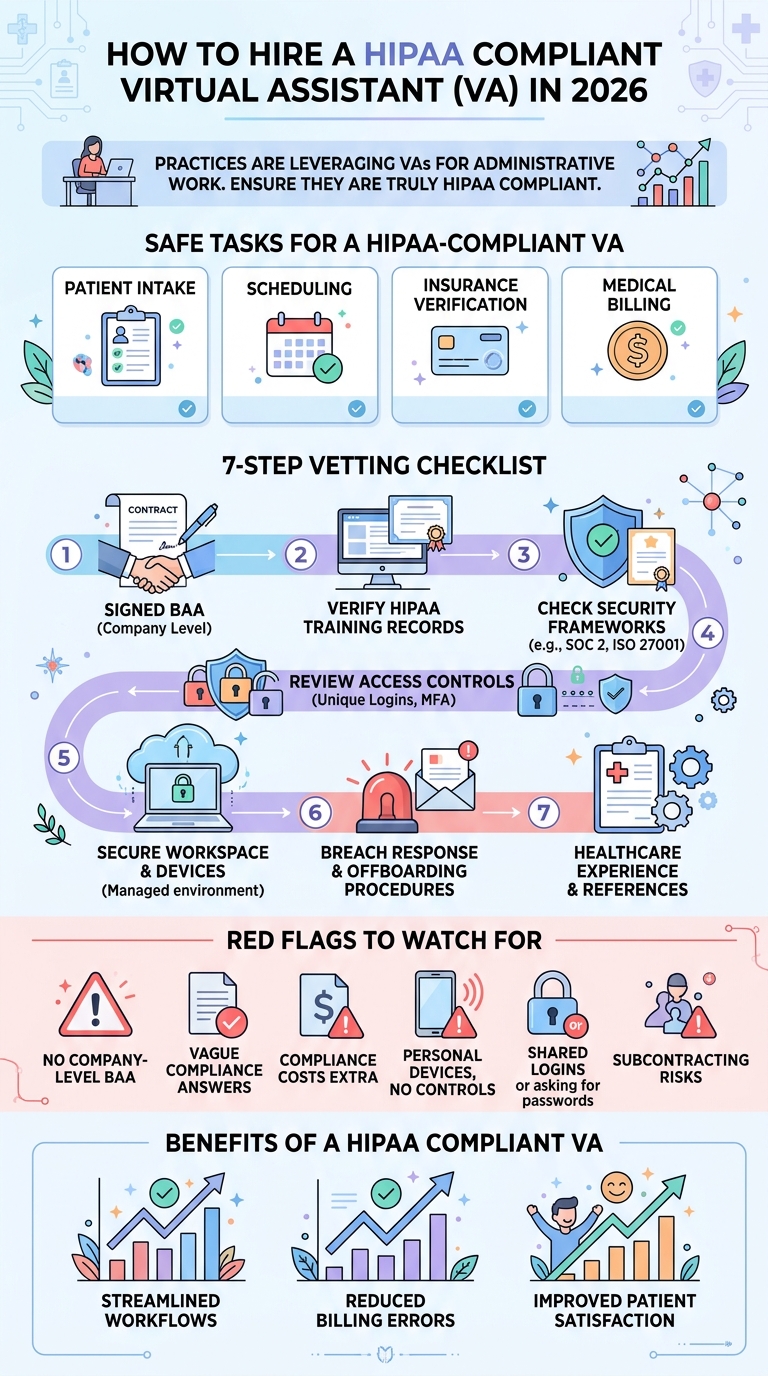
What is a HIPAA compliant virtual assistant?
A HIPAA compliant virtual assistant is a remote administrative professional who handles protected health information (PHI) under a signed Business Associate Agreement, completes documented HIPAA training, and works inside systems with technical safeguards such as role-based access, multi-factor authentication, and audit logging.
One thing to know upfront: HHS does not issue or recognize any official “HIPAA certification.” A provider can complete HIPAA training, pass third-party security audits like SOC 2 or ISO 27001, and sign a BAA, but “HIPAA compliant” is ultimately a description of practices, not a badge. That’s why buyers need to verify, not take the label at face value.
Compliance is also shared. Under HIPAA, a VA provider that handles PHI on your behalf is a business associate, and business associates are directly liable for safeguarding that data. Your practice is still responsible for choosing a provider that can do it.

HIPAA compliant virtual assistant tasks: what can they safely handle?
Most administrative work that touches PHI can be delegated, as long as the right safeguards are in place.
| Task | PHI involved? | Safeguards to require |
| Patient intake and registration | Yes | BAA, EHR role-based access, MFA |
| Appointment scheduling and reminders | Yes | Minimum necessary access, secure phone/SMS tools |
| Insurance eligibility verification | Yes | Payer portal access logged per user, no shared logins |
| Prior authorizations | Yes | Secure document handling, no local downloads |
| Billing and claims follow-up | Yes | Access limited to billing modules, audit trail |
| Medical documentation support | Yes | EHR access controls, encrypted communication |
| Patient care coordination | Yes | Secure messaging, documented handoff procedures |
| Medical records retrieval | Yes | Secure transfer channels, defined retention rules |
| Marketing, reviews, and social media | Usually not | Policy against posting or replying with PHI |
The principle behind all of it is HIPAA’s minimum necessary standard: a VA should only see what they need to do the job. A scheduling VA doesn’t need full chart access, and a billing VA doesn’t need clinical notes.
How to hire a HIPAA compliant virtual assistant: 7-step vetting checklist
Run every provider through these seven steps before signing. If a provider can’t answer one clearly, treat that as an answer.
1. Confirm the provider will sign a Business Associate Agreement
This is non-negotiable. HIPAA requires a BAA before any business associate creates, receives, maintains, or transmits PHI for you. Ask whether the BAA is signed at the company level (the provider is accountable for every assistant it places) or whether only the individual VA signs. Company-level is what you want.
2. Ask for proof of HIPAA training
“Our VAs are HIPAA trained” isn’t proof. Ask:
- Who delivers the training and what does it cover?
- How often is it refreshed?
- Can you see completion records for your assigned VA?
3. Check third-party security frameworks
HIPAA sets the rules; frameworks like SOC 2 and ISO 27001 show an independent auditor has checked whether the provider actually follows strong security controls. Ask for the current report or certificate, not just a logo on the website.
4. Review access controls
You’re looking for:
- Unique logins for every VA (never shared credentials)
- Multi-factor authentication on EHR, PM, and payer portals
- Role-based access tied to the tasks the VA performs
- Audit logs so you can see who accessed what and when
5. Ask how devices and workspaces are secured
This is where many VA arrangements fall apart. Ask whether VAs work on personal laptops or managed environments, whether PHI can be downloaded, copied, or printed locally, and how screens and sessions are monitored. A secure virtual workspace that blocks local storage of PHI is the stronger setup.
6. Confirm breach response and offboarding procedures
Ask what happens if a VA’s credentials are compromised, how quickly you’ll be notified, and how access is revoked the day a VA leaves or is replaced. HIPAA’s Breach Notification Rule sets an outer limit of 60 days from discovery, but you want a provider whose internal timeline is much faster.
7. Check healthcare-specific experience and references
Ask which EHR and PM systems their VAs have used, which specialties they support, and whether you can speak with a current healthcare client. A provider that mainly places general admin VAs will need you to do the healthcare training yourself.
Quick-copy checklist
- Company-level BAA signed before day one
- HIPAA training records available for your VA
- Current SOC 2 and/or ISO 27001 documentation
- Unique logins, MFA, role-based access, audit logs
- Managed workspace with no local PHI storage
- Written breach notification and offboarding process
- Healthcare references and EHR experience

HIPAA compliant virtual assistant red flags to watch for
Walk away, or at least slow down, if you see any of these:
- No BAA, or “the VA signs it, not us.” That leaves no company accountable for the person handling your patients’ data.
- Vague answers. “We’re fully compliant” with no documentation to back it up.
- Compliance sold as an add-on. If HIPAA safeguards cost extra, ask what the base service is missing.
- Personal devices and home networks with no workspace controls.
- Shared logins or a request for “your EHR password.”
- No named point of contact if something goes wrong.
- Subcontracting you can’t see. Your VA should be the person doing the work. A 2025 breach at Sentara Health, reported in HIPAA Journal’s monthly data, involved unauthorized EMR access after an employee farmed out work to other individuals, the exact kind of risk that managed oversight is meant to prevent.
HIPAA compliant virtual assistant providers compared
Below is how several healthcare VA providers describe their offerings. Pricing and terms change, so confirm current details directly with each provider before deciding.
| Wing Assistant | MEDVA | HelloRache | Freelance marketplaces | |
| BAA | Signed at company level | Confirm scope with provider | Confirm before signing | Usually individual only, if at all |
| Security frameworks | HIPAA, SOC 2, ISO 27001 | HIPAA compliance tied to its Security Package | HIPAA-trained VAs | Varies by freelancer |
| VA model | Dedicated VA | Dedicated VA | Dedicated VA | Individual contractor |
| Pricing model | Flat rate | From $10/hour, flat hourly | $9.50/hour | Varies |
| Management support | Customer Success Manager | Account support | Self-managed after placement | Self-managed |
| Replacement guarantee | 24-hour replacement | Confirm with provider | Confirm with provider | None |
| Secure workspace | Wing Workspace platform | Confirm with provider | Confirm with provider | Typically personal device |
One detail worth flagging on MEDVA: a competitor’s review cites MEDVA’s own site stating its services are HIPAA compliant only when used with the MEDVA Security Package, so ask exactly what that package includes and costs.
For deeper side-by-side breakdowns, see MedVA vs. Wing Assistant and HelloRache vs. Wing Assistant.
How Wing delivers HIPAA compliant virtual assistants
Wing Assistant built its healthcare virtual assistant service around the checklist above, so practices don’t have to piece compliance together themselves.
- Company-level BAA. Wing signs the BAA, so Wing is accountable for every assistant it places with your practice.
- HIPAA, SOC 2, and ISO 27001 compliance. Independent frameworks backing the security claims, not just training certificates.
- Wing Workspace. VAs work inside a controlled platform rather than on unmanaged personal setups.
- Dedicated VA model. One assistant who learns your EHR, your workflows, and your patients’ needs, instead of a rotating pool.
- Customer Success Manager. A named point of contact for onboarding, performance, and any concerns.
- 24-hour replacement guarantee. If the fit isn’t right, you’re not left short-staffed.
- Flat-rate pricing. Predictable monthly cost with no compliance add-ons.
Wing VAs support practices across patient intake, scheduling, insurance verification, prior authorizations, medical billing, coding, denials management, clinical documentation, and patient care coordination. Practices serving Spanish-speaking patients can also add a bilingual healthcare assistant.
What results do practices see with a HIPAA compliant virtual assistant?
Provida Family Medicine
Provida Family Medicine, a growing primary care practice in Gurnee, Illinois, was struggling to keep up with the admin load that came with rising patient volume. Scheduling delays, billing bottlenecks, and data inconsistencies were starting to affect patient satisfaction and internal efficiency.
Wing placed trained healthcare virtual assistants who took over EHR updates, patient intake, and insurer coordination. Within weeks, workflows across scheduling, billing, and communication were running more smoothly, and the in-house team was back to focusing on patient care.
| Result | Impact |
| Clinic admin workflows | 50% faster |
| Billing errors | 35% reduction |
| Patient satisfaction | 40% higher |
| Scheduling errors | 30% fewer |
| Claims processing | 25% faster |
“The recruitment process was absolutely wonderful. Everyone at Wing was knowledgeable and friendly.”
Carlos Baltazar, Manager of Office Operations & HR, Provida Family Medicine
Ready to hire a HIPAA compliant virtual assistant?
Get a dedicated VA who’s trained, covered by a company-level BAA, and working inside a secure platform from day one. Book a call with Wing to talk through the tasks you want to delegate.
Frequently Asked Questions
Yes, with the right controls. A Wing medical administrative virtual assistant gets a unique login with MFA and role-based permissions limited to the tasks they handle, so every action is attributable and auditable.
They should, and ideally the provider signs it at the company level. Wing signs a BAA with every healthcare client before its HIPAA compliant virtual assistant starts work.
Healthcare VA pricing typically runs by the hour or on a flat monthly rate, and some providers charge extra for HIPAA safeguards. Wing uses flat-rate pricing with compliance included. See our medical virtual assistant salary and cost guide for a full breakdown.
Yes. Intake is one of the most common healthcare tasks delegated to VAs. Wing’s medical intake specialists handle registration, demographic and insurance collection, and form follow-up inside your EHR.
Yes. Wing’s medical billing specialists support claim submission, payment posting, and follow-up, while coding specialists and denials management specialists handle code review and rejected claims.
A medical scribe focuses on clinical documentation during or after patient visits. A HIPAA compliant VA usually covers a broader set of admin work like scheduling, intake, and billing. Wing offers both, along with clinical documentation specialists.
No. HHS doesn’t issue official HIPAA certifications. Look instead for a signed BAA, documented training, and independent security audits like SOC 2 and ISO 27001, all of which Wing provides.

Dianne Florendo is a content writer who creates engaging SEO content about virtual assistants, outsourcing, and business productivity.